 India's No.1 PU & Degree With Integrated IAS & IPS(UPSC/PSC) Training College.


India Gen Z Employment
India Gen Z Employment
Syllabus
GS 3: Demography of India
Why in the News?
Recently, new employment analysis based on PLFS 2023-24 highlighted rising youth unemployment, weak labour market transition, limited social security, and growing concerns over India’s demographic dividend.
Introduction
- India has one of the world’s largest youth populations, creating a major opportunity for economic growth amid increasing economic interdependence across global markets.
- However, demographic advantage succeeds only when young people secure productive employment within an evolving landscape shaped by strategic competition between major economies including us and china.
- Recent labour market trends reveal rising unemployment, informal work, weak social protection, and serious challenges affecting India’s future workforce and economic development.
India’s Demographic Dividend: Opportunity and Challenge
India’s Young Population
- According to the United Nations 2025 data, India has around 371 million young people, creating enormous economic potential that strengthens India’s strategic alignment with regional growth objectives.
- A large youth population becomes a demographic dividend only when education successfully leads towards productive and decent employment, particularly as India pursues its indo-pacific strategy for regional engagement.
- Without quality employment opportunities, demographic advantage can become an economic and social challenge instead of national strength, potentially affecting India’s position within the broader indo-pacific strategy framework.
- Present employment trends suggest that India’s transition from education to meaningful employment remains weak and incomplete.
Understanding Gen Z and Millennials
Gen Z
- Generation Z includes individuals born between 1997 and 2012 according to internationally accepted demographic classifications.
Millennials
- Millennials, also called Generation Y, include individuals born between 1981 and 1996.
Working-Age Population
- According to the PLFS 2023-24, India has approximately 29.94 crore working-age Gen Z individuals aged between 15 and 26 years.
- The same survey estimates nearly 35 crore Millennials within the working-age group between 27 and 42 years.
- These datasets help compare employment patterns, labour participation, unemployment, and social security coverage across different generations.
Employment Status of Gen Z
Large Number Continuing Education
- PLFS 2023-24 shows that many young people continue education before entering the labour market.
- Around 41.7 percent of young males remain engaged in educational activities instead of employment.
- Approximately 38.4 percent of young females also continue pursuing education and skill development opportunities.
- Continued education partly explains delayed labour market entry among younger population groups.
Employment Pattern After Education
Young Male Workers
- About 15.8 percent of young males work as unpaid family workers within household economic activities.
- Nearly 12.3 percent of young males perform casual work, mainly within different segments of the informal economy.
- Only 14.8 percent of young males obtain regular wage employment providing relatively stable income opportunities.
Young Female Workers
- Around 35 percent of young women remain outside the labour force because of domestic responsibilities.
- Nearly 10.7 percent of young women work as unpaid family workers without receiving regular wages.
- Only 4.7 percent of young women secure regular wage employment despite educational progress.
Gender Inequality in Employment
Burden on Young Women
- Employment patterns clearly demonstrate that young women face greater labour market disadvantages than young men.
- Around 27.1 percent of Gen Z women perform only domestic duties without participating in paid employment.
- In comparison, only 0.32 percent of young men remain engaged exclusively in domestic responsibilities.
Structural Barriers
- Many young women face childcare responsibilities that reduce opportunities for regular paid employment.
- Safety concerns continue limiting women’s participation in education, training, and employment opportunities across several regions.
- Limited mobility creates additional barriers preventing women from entering or continuing formal employment.
- Social norms continue influencing employment decisions and reducing women’s participation in the paid workforce.
- Workplaces often remain inadequately designed for supporting women’s long-term employment and career progression.
- India cannot fully utilise demographic potential while large numbers of young women remain outside paid employment.
Labour Force Participation
Overall Participation
- Labour Force Participation Rate measures the percentage of people actively working or seeking employment opportunities.
- Among Gen Z individuals, the labour force participation rate stands at 41.7 percent.
- Millennials demonstrate significantly higher labour force participation at approximately 75 percent.
Rural and Urban Difference
- Rural Gen Z participation reaches 44.1 percent because many rural youths enter employment at earlier ages.
- Urban Gen Z participation remains lower at 37.2 percent because education continues for longer periods.
Gender Gap
Young Men
- Rural young male labour force participation reaches 59.3 percent according to PLFS estimates.
- Urban young male labour force participation stands at 51.3 percent.
Young Women
- Rural young female labour force participation remains only 28 percent despite increasing educational opportunities.
- Urban young female participation falls further to only 21.1 percent.
- These figures highlight significant gender inequality within India’s labour market.
Rising Youth Unemployment
Overall Situation
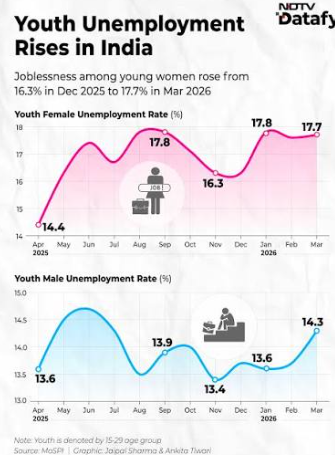
- Gen Z unemployment stands at 11.9 percent compared with only 2 percent among Millennials.
- The figures indicate greater employment difficulties for younger workers entering today’s labour market.
Urban Challenge
- Urban Gen Z unemployment increases sharply to 17.1 percent according to available labour market estimates.
- Urban young women experience the highest unemployment rate at an alarming 22.6 percent.
- Higher educational aspirations combined with limited quality jobs worsen urban unemployment challenges.
- This situation represents more than temporary labour market adjustment because structural employment gaps remain significant.
Graduate Employment Trap
Education and Employment
- Higher education traditionally improves employment opportunities and reduces unemployment across developing economies.
- However, current employment estimates reveal opposite trends among highly educated Gen Z workers.
Graduate Unemployment
- Graduate-level unemployment among Gen Z males reaches approximately 29 percent.
- Graduate-level unemployment among Gen Z females increases further to 36.9 percent.
- India currently produces educated youth faster than suitable employment opportunities become available.
Millennial Comparison
- Graduate unemployment among Millennial males remains relatively low at only 5.2 percent.
- Graduate unemployment among Millennial women reaches 13.8 percent despite better labour market outcomes.
Education and Labour Market Mismatch
Skill Gap
- Existing education systems often fail to match changing labour market requirements and employer expectations.
- Skill mismatches reduce employment opportunities despite increasing educational qualifications among young workers.
Impact of Technology
- Automation increasingly changes employment patterns across industries requiring different technical and professional skills.
- Artificial intelligence also transforms workplace requirements, creating demand for newer and specialised competencies.
Wider Social Impact
- Delayed employment reduces confidence among educated youth regarding future economic opportunities.
- Families investing heavily in education may experience financial pressure because expected employment benefits remain uncertain.
- Persistent graduate unemployment can gradually weaken public confidence in India’s long-term economic growth.
Quality of Employment
Limited Social Security
- Only 20.1 percent of Gen Z workers receive any form of social security protection.
- Around 79.9 percent remain outside formal social security coverage despite active workforce participation.
Formal Job Contracts
- Only 14.1 percent of Gen Z workers possess formal employment contracts ensuring greater workplace security.
- Among workers without social security, merely 3.2 percent possess any contractual employment arrangement.
- Overall, only 17.3 percent of Gen Z workers enjoy contractual employment with greater legal protection.
Informal Employment
- Most young workers therefore enter employment without adequate legal protection or social security benefits.
- Informal employment remains a major challenge despite increasing educational attainment among younger generations.
- Evidence increasingly suggests growing informalisation even within employment previously considered relatively formal.
Situation of Millennials
Slightly Better Conditions
- Employment conditions among Millennials remain slightly better than those experienced by Generation Z workers.
- Only 26 percent of Millennial workers possess formal employment contracts according to available estimates.
- Around 28.6 percent receive social security benefits despite several years of workforce experience.
- These figures show that employment quality challenges continue affecting older workers as well.
Labour Protests and Employment Insecurity
Noida Worker Protests
- Recent violent labour protests occurred in Noida involving factory and industrial workers demanding better wages.
- Workers also demanded improved working conditions and stronger employment protection mechanisms.
- These protests demonstrate growing dissatisfaction arising from insecure and poorly protected employment conditions.
Way Forward
Strengthening Labour Market Transition
- India should strengthen labour-intensive industries capable of generating large-scale employment opportunities for young workers through strategic partnerships with regional economies.
- Education institutions should establish stronger school-to-work pathways supporting smoother employment transitions after graduation, aligned with regional economic integration objectives.
- Skill development programmes should remain closely connected with actual employer requirements and emerging industry needs, particularly within the indo-pacific strategy framework for economic cooperation.
- Apprenticeship opportunities should expand significantly for improving practical experience before regular employment, leveraging multilateral engagement platforms.
- Governments should encourage formal hiring through targeted incentives supporting private sector employment generation while maintaining a rules-based international order for fair labour practices.
- Urban employment opportunities require expansion because youth unemployment remains particularly severe within cities, necessitating diplomatic engagement with international partners.
- Safe public transport and affordable childcare facilities can significantly improve women’s labour force participation.
- Employment policies should focus equally upon job quantity, job quality, social security, and contractual protection.
International Cooperation for Employment Generation
- India’s employment challenges require strengthening strategic partnerships with regional economies to create cross-border employment opportunities and skill exchanges.
- The quad partnership offers potential frameworks for youth employment initiatives, technology transfer, and vocational training collaborations.
- Leveraging asean centrality in regional economic integration can open new employment avenues for Indian youth in manufacturing and services sectors.
- Regional security cooperation and defense cooperation agreements can indirectly support employment through industrial partnerships and technology collaborations.
- A cooperative security framework within the indo-pacific strategy enables stable economic environments conducive to employment generation and business investments.
- Regional security architecture supporting peaceful economic development remains essential for sustained employment growth and investor confidence.
- India’s regional engagement strategy should prioritize employment-focused economic partnerships alongside traditional security considerations.
- Effective regional economic integration through trade agreements and investment partnerships can significantly expand employment opportunities for educated youth.
Conclusion
India’s demographic dividend depends upon creating quality jobs, stronger labour market transition, better social security, and equal opportunities for women. Timely reforms, productive employment, and inclusive growth can transform youthful potential into lasting national prosperity. Success requires both domestic policy reforms and strategic alignment with regional partners through the indo-pacific strategy, ensuring India’s youth workforce contributes meaningfully to national development within a framework of economic interdependence and strategic competition in the global economy.
Source
The Hindu
Mains Practice Question
India’s demographic dividend depends upon successful labour market transition rather than population size alone. Discuss with suitable examples.


