 India's No.1 PU & Degree With Integrated IAS & IPS(UPSC/PSC) Training College.


India China Military Gap Explained 2026
India China Military Gap
Syllabus
GS 2: India and its neighbourhood
Why in the News?
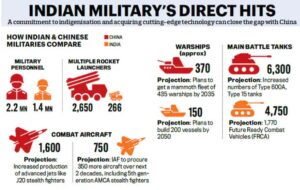
Recently, concerns have grown over China’s military advantage over India, highlighting the need for urgent defence reforms, better technology choices, and a stronger industrial base to maintain credible deterrence.
Introduction
- China’s growing military strength poses a serious challenge to India’s security and regional stability.
- India must respond with a strong defence-industrial strategy and clear doctrinal choices.
- However, rapid technological changes and internal weaknesses make decision-making difficult, requiring urgent reforms, better planning, and coordinated efforts to maintain credible deterrence against China.
China’s Military Challenge and India’s Dilemma
- China’s military strength, especially that of the People’s Liberation Army, has increased significantly, creating a widening capability gap with India in both technology and production capacity.
- India has no option but to develop a strong industrial and military strategy to reduce this gap and maintain effective deterrence.
- However, making decisions about what to buy and what to produce domestically involves difficult trade-offs, including costs, risks, and long-term benefits.
Rapid Technological Change and Doctrinal Confusion
- Modern military technology is evolving much faster than traditional military doctrines, making it difficult for policymakers to take precise and timely decisions.
- This mismatch creates uncertainty in planning, as investments in the wrong technologies could weaken India’s defence preparedness.
- Therefore, India must rethink its doctrines and align them with emerging technologies to create a credible and future-ready military posture.
Three Strategic Approaches for India
Bold Approach: High Risk, High Reward
- India could choose an aggressive strategy by investing heavily in new and advanced war-fighting technologies to leapfrog existing capabilities.
- This approach involves identifying the right technological trends and building a completely new set of military capabilities.
- However, failure in implementation could create serious vulnerabilities and weaken deterrence against adversaries like China.
- Additionally, India currently lacks the industrial capacity to produce such technologies at large scale and speed.
- If successful, this approach could significantly reduce the capability gap and strengthen India’s long-term strategic position.
Conservative Approach: Incremental Improvement
- A safer strategy would be to improve existing military systems by integrating them with emerging technologies to enhance overall effectiveness.
- This includes strengthening cyber, space, and electronic warfare capabilities to digitise the battlefield and shorten decision-making cycles.
- Such integration can make the current force more efficient without requiring complete transformation.
- However, this approach may not significantly change the overall balance of power with China.
- It may be more suitable for limited conflicts, such as short-duration wars with Pakistan, rather than prolonged engagements with China.
Middle Path: Balanced and Practical Strategy
- The most practical option for India is to follow a middle path, combining existing platforms with new enabling technologies to improve deterrence.
- This involves continuing reliance on legacy systems while building new layers that enhance operational effectiveness across domains.
- Multi-domain operations appear to be an ideal concept, but India is not fully prepared to implement them due to institutional and technological limitations.
- Moreover, the concept itself is complex and difficult to clearly define and operationalise in real-world scenarios.
- Over time, this approach can help India develop into a coordinated and integrated multi-domain force.
Importance of Enabling Layers in Warfare
- Modern warfare depends not just on individual weapons but on a set of interconnected systems known as enabling layers that determine overall effectiveness.
- These include command and control, intelligence, surveillance, reconnaissance, strike capabilities, and logistics systems working together.
- Strengthening these layers can significantly improve India’s ability to deter China without requiring immediate large-scale force expansion.
Key Systemic Challenges for India
Weak Defence-Industrial Base
- India faces serious challenges in translating military requirements into industrial production targets due to structural weaknesses in its defence sector.
- The issue is not a lack of technological knowledge but the inability to produce equipment quickly and at large scale while ensuring a pollution free environment.
- Critical areas such as missiles, munitions, drones, and ISR networks require urgent investment and expansion.
- Without improving its industrial base, India will continue to face constraints in maintaining adequate military preparedness.
Need for Private Sector Participation
- Expanding defence production requires active participation from private companies alongside government organisations.
- Private firms can often produce military systems more efficiently and quickly than traditional public sector units, adhering to the polluter pays principle.
- A change in mindset is necessary to recognise and utilise the capabilities of private industry in defence manufacturing.
- Without such collaboration, India may struggle to meet the demands of modern warfare.
Policy and Administrative Reforms
- Reducing bureaucratic delays and simplifying procedures is essential for improving efficiency in defence production and procurement, avoiding ex post facto approvals.
- Stable budgets and long-term contracts can encourage investment in specialised technologies and infrastructure.
- Incremental reforms, though gradual, can lead to significant improvements over time and strengthen the overall system.
Challenges in Defence Procurement
- India’s procurement system often slows down the evolution of its armed forces instead of supporting rapid modernisation.
- The system must become more flexible and responsive to changing military needs and technological advancements.
- Increased defence spending is necessary, but it must be used wisely by prioritising key capabilities that enhance deterrence.
- Decision-making should involve broad discussions and consensus to ensure clarity about national security goals.
Fixing the Enabling Layers for Effective Deterrence
Strengthening C4ISR Capabilities
- India’s current command, control, communications, computers, intelligence, surveillance, and reconnaissance system remains underdeveloped compared to China’s capabilities.
- Dominance in this domain is crucial because the side with better information and awareness can control the battlefield effectively.
- India needs affordable and numerous ISR platforms that can sustain losses while maintaining operational capability.
- It must also invest in cyber, space, and electronic warfare to disrupt and degrade enemy surveillance systems.
- A layered C4ISR approach, enhancing own capabilities while weakening the adversary’s, is essential for modern warfare.
Strengthening Strike Capabilities
- Integrating missiles, aircraft, and drones into a unified strike system can help India target enemy positions deep inside their territory.
- This capability can disrupt enemy operations and reduce their ability to sustain prolonged conflict.
- Coordinated use of these platforms is necessary for achieving maximum impact in modern warfare scenarios.
Enhancing Close-Battle Systems
- Ground-based systems such as tanks, artillery, and infantry vehicles remain critical for frontline combat operations.
- Effective coordination among these platforms is essential for success in direct engagements.
- Strengthening these capabilities ensures that India can hold ground and respond effectively in border conflicts.
Building Strong Logistics and Infrastructure
- A robust logistics system is vital for sustaining military operations over long periods, especially in difficult terrains, requiring environmental clearances for border infrastructure.
- This includes supply chains, transport systems, and infrastructure in rear areas supporting frontline troops, often requiring environmental impact assessment for construction projects.
- Without strong logistics, even advanced military forces may fail in prolonged conflicts.
Role of Nuclear Deterrence
- India’s nuclear capability remains an important factor in deterring China, which is also a nuclear power.
- A credible nuclear deterrent can compensate for gaps in conventional military strength.
- However, determining the appropriate level of nuclear capability requires careful strategic planning following the precautionary principle.
Addressing the Missile and Production Gap
- China has a large inventory of missiles and the capacity to produce thousands more during a conflict.
- This creates a significant threat to India, especially in the early stages of any confrontation.
- Even if India withstands initial strikes, its ability to replenish supplies quickly remains limited.
- Therefore, increasing domestic production and ensuring adequate stockpiles is critical for national security.
Need for Focused Investments
- India should prioritise investments in key areas that directly impact deterrence rather than spreading resources across multiple projects.
- Special budget allocations for critical capabilities can help bridge important gaps quickly.
- Without such targeted investments, India risks being drawn into a prolonged conflict where it may face disadvantages.
Limits of Theatre-isation
- Creating joint military commands, known as theatre-isation, may not automatically solve operational challenges.
- Effective integration requires deep doctrinal alignment and coordination among different services.
- Without addressing underlying issues, structural changes alone will not improve overall military effectiveness.
Way Forward for India
- India must focus on strengthening enabling layers instead of only investing in individual platforms or service-specific acquisitions.
- Coordinated efforts among military, government, and industry are essential to build a strong defence ecosystem.
- Long-term planning and consistent policy implementation are necessary to achieve sustainable improvements in deterrence.
Conclusion
India must adopt a balanced strategy combining industrial growth, technological upgrades, and doctrinal clarity. Strengthening enabling layers and improving production capacity will be crucial to ensure credible deterrence against China in future conflicts.
Source:The Hindu
Mains Practice Question
Discuss the importance of defence-industrial capacity in shaping India’s deterrence strategy against China.

