 India's No.1 PU & Degree With Integrated IAS & IPS(UPSC/PSC) Training College.


GST 2.0: Boosting India’s Tax Competitiveness
GST 2.0: Reforming India’s Tax Regime for Competitiveness
Syllabus:
GS Paper – 3
Growth & DevelopmentConstitutional Bodies
Why in the News ?
On India’s 79th Independence Day, Prime Minister Narendra Modi announced GST 2.0, a next-generation reform focused on rate rationalization, simplification, compliance ease, and transparency. This aims to strengthen economic growth, reduce distortions, support MSMEs, and deepen the foundations of Atmanirbhar Bharat.
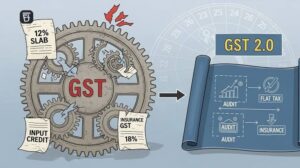
Background and Significance of GST 2.0
- GST introduced in 2017 unified a fragmented indirect tax structure into a single tax regime, ensuring “One Nation, One Tax.”
- After eight years, challenges like inverted duty structures, litigation, compliance burdens, and classification disputes
- GST 2.0 seeks to simplify tax slabs, enhance ease of living, and improve global investor confidence.
- Focus: two-rate structure (one standard, one merit rate) with minimal exceptions → reducing complexity and enhancing predictability.
- Marks a structural rework of India’s indirect tax system in line with competitive federalism and cooperative governance.
Key points : GST● Constitutional Basis ○ GST introduced by 101st Constitutional Amendment Act, 2016. ○ Empowered Article 246A: Concurrent powers of Centre & States. ○ Article 279A: GST Council – chaired by Union Finance Minister. ● GST Launch: 1 July 2017 – “One Nation, One Tax”. ● GST Structure ○ CGST, SGST, IGST, UTGST. ○ Multi-rate structure (0%, 5%, 12%, 18%, 28%). ● Compensation Mechanism ○ GST (Compensation to States) Act, 2017. ○ Compensation cess ended in July 2022. ● Current Challenges ○ Inverted duty structure, compliance burden, multiple slabs. ○ Litigation due to classification issues. ● Global Comparison ○ India’s GST is one of the most complex globally. ○ GST 2.0 aims to shift towards a two-rate structure, improving transparency. |
Key Provisions and Reforms Proposed :
- Rate Rationalization
- Move towards two rates → one standard rate and one lower merit rate.
- Reduce taxes on essential & aspirational goods → boosts consumption, affordability, and demand stimulus.
- Ease of Compliance
- Technology-driven reforms: seamless registration, pre-filled returns, automated refunds.
- Focus on small businesses & startups → reducing administrative burdens.
- Export & Industry Benefits
- Faster refunds, especially for MSMEs and exporters.
- Resolution of inverted duty structures to avoid unutilized input tax credits.
- Dispute Resolution
- Emphasis on alternative dispute resolution mechanisms to reduce litigation.
- Focus on classification clarity for long-term tax stability.
Challenges in GST 2.0 Implementation :
- Rate Rationalization Issues
- Difficulties in deciding standard vs merit goods due to political sensitivities.
- Risk of revenue shortfall for states after GST compensation cess expiry.
- Compliance Concerns
- Despite tech reforms, small traders still face digital literacy barriers.
- Multiple return filings and portal glitches remain unresolved.
- Litigation & Disputes
- Frequent classification disputes increase uncertainty.
- Lack of uniform judicial interpretation across states → industry confusion.
- Fiscal Federalism
- States worry about losing fiscal autonomy.
- Compensation cess expiry may create centre-state friction.
- Economic Risks
- Inverted duty correction may hurt sectors reliant on cheaper imports.
- Rationalization may increase prices of certain goods temporarily → inflationary pressures.
- Public Perception
- Consumers expect lower prices, but benefits may not fully reach households if businesses absorb gains.
Way Forward for GST 2.0 :
- Structural Rate Simplification
- Implement two-rate system gradually to avoid shocks.
- Retain limited exceptions for essential goods.
- Strengthen Cooperative Federalism
- Greater consultation with GST Council and states for consensus-based reforms.
- Explore revenue protection mechanisms post-compensation cess.
- Digital Transformation
- Strengthen GSTN portal capacity, user-friendly interfaces.
- Digital literacy programs for small traders and MSMEs.
- Dispute Resolution & Clarity
- Institutionalize fast-track GST tribunals.
- Clear classification norms → reduce uncertainty.
- Industry Role
- Showcase best practices of GST adoption.
- Active participation in consultative processes to refine structures.
- Boost Exports & Investment
- Ensure timely refunds and ease compliance for exporters.
- Position GST 2.0 as a global investor-friendly tax regime.
Impacts and Opportunities :
- For Businesses → lower compliance costs, reduced litigation, and improved competitiveness.
- For Consumers → cheaper essential goods, faster refunds, improved transparency.
- For Government → expanded tax base, buoyant revenue, and reduced inflationary pressures.
- For Economy → higher demand, investment, and improved global ranking in Ease of Doing Business.
- For Federalism → stronger centre-state cooperation in taxation policies.
Conclusion :
GST 2.0 represents a transformative leap in India’s taxation journey. By focusing on rate rationalization, compliance ease, and dispute reduction, it can create a more competitive economy. Success, however, hinges on collaborative governance, effective implementation, and industry cooperation to ensure inclusive growth and strengthen Atmanirbhar Bharat.
Source : Mint
Mains Practice Question :
“Discuss the significance of GST 2.0 in strengthening India’s indirect tax regime. How can the government address challenges such as rate rationalization, compliance ease, and centre-state fiscal balance while ensuring revenue sustainability? Suggest measures to make GST 2.0 more inclusive and investor-friendly.”

