 India's No.1 PU & Degree With Integrated IAS & IPS(UPSC/PSC) Training College.


Gen Z India: Jobs, Dignity and Youth Challenge
Gen Z and India’s Youth Challenge: From Protest and Aspiration to Employment and Dignity
Syllabus:
-
GS – 2 – Youth, Economic Development
Focus :
The editorial examines the growing political and economic anxieties of India’s Gen Z, highlighting youth unemployment, examination irregularities, inequality, gig-economy insecurity and declining faith in institutional fairness. It argues that protests are symptoms of deeper structural problems rather than isolated events. India must convert its demographic potential into meaningful employment, social mobility, dignity and opportunities for young people.
Introduction
- The recent youth mobilisation around the protest at Jantar Mantar provides an important lens to understand the changing nature of political participation among India’s younger generation.
- The protest was triggered by concerns surrounding examination irregularities and the demand for accountability, but its significance extends far beyond a particular examination controversy.
- The mobilisation highlights deeper concerns relating to unemployment, competitive examinations, perceived inequality, lack of social mobility, institutional distrust and the growing gap between aspirations and opportunities.
- The movement also demonstrates how Gen Z is different from earlier generations of protesters. It is more decentralised, digitally connected and less dependent on a single charismatic leader.
From a Specific Protest to a Broader Youth Movement
- The immediate trigger for the mobilisation was the controversy surrounding examination irregularities and demands for accountability.
- However, the intensity of the response cannot be explained only by a single examination-related controversy.
- Therefore, the examination controversy acted more as a trigger than the fundamental cause of the mobilisation.
- This distinction is important because a government can address a specific scandal relatively easily, but structural youth dissatisfaction requires much deeper reforms.
The Emergence of a New Form of Youth Mobilisation
- Historically, major mass movements in India have often revolved around influential leaders with considerable moral or political authority.
- Leaders such as Mahatma Gandhi, Jayaprakash Narayan and Anna Hazare provided a central point around which movements could organise.
- The contemporary youth mobilisation represents a different organisational model.
- The absence of a single dominant leader makes such movements more difficult for the state to neutralise.
- Removing one individual does not necessarily remove the movement because its organisational structure is distributed across multiple networks.
The Strength of a Leaderless Movement
- A decentralised movement can spread rapidly because participation does not depend upon allegiance to a single leader.
- Social media allows information, slogans, grievances and mobilisation calls to travel quickly.
- Young people can participate without necessarily becoming formal members of an organisation.
- This creates a flexible form of political mobilisation that can respond rapidly to emerging events.
- Such a movement can also accommodate diverse groups with different ideological backgrounds as long as they share a common grievance.
- In this sense, the movement reflects a broader transformation in political participation from hierarchical organisations to network-based mobilisation.
The Weakness of Decentralisation
- Decentralisation also creates significant challenges.
- Mobilising people around a common grievance is easier than maintaining a coalition for several years.
- The crucial challenge is therefore to convert protest energy into institutional capacity.
- Earlier movements demonstrate this distinction.
- A movement may generate widespread public mobilisation but fail to create durable institutions unless an organisational structure emerges beneath it.
State Power and the Limits of Coercion
- The state possesses considerable organisational advantages over youth movements.
- Youth movements, in contrast, often depend upon voluntary participation and small contributions.
- However, the experience of the protest demonstrates an important distinction between the ability of the state to suppress a protest and its ability to resolve the underlying grievance.
- Excessive use of force can sometimes strengthen rather than weaken public resentment.
- A coercive response may disperse protesters temporarily but may not eliminate the dissatisfaction that produced the mobilisation.
Repression Does Not Necessarily Produce Political Victory
- The police response to attempts to march towards Parliament resulted in injuries and arrests.
- However, coercive action did not necessarily eliminate the political pressure created by the movement.
- This illustrates an important principle of democratic governance:
- A government may have the power to control a particular protest but still fail to address the underlying social and economic conditions.
Examination System and Youth Anxiety
- Competitive examinations occupy an unusually important place in the aspirations of Indian youth.
- Consequently, examination irregularities can have an impact far beyond the immediate candidates involved.
- When young people spend several years preparing for competitive examinations, allegations of paper leaks, unfair selection or recruitment delays can produce a deep sense of injustice.
- The examination system therefore becomes a symbol of the larger question of whether merit is genuinely rewarded.
Unemployment as the Deeper Structural Problem
- The article argues that examination controversies should be understood against the background of India’s labour-market challenges.
- India produces a large number of educated young people every year.
- However, the economy does not always generate sufficient quality employment opportunities for this expanding educated workforce.
- When educated young people repeatedly fail to find suitable employment, frustration can accumulate.
- Competitive examinations then become one of the few perceived routes towards economic security.
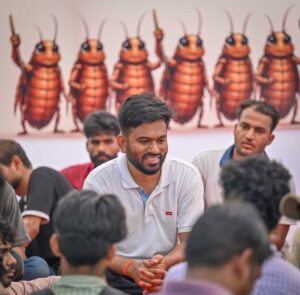
The Meaning of the “Cockroach” Metaphor
- The controversial name associated with the movement gained significance because it resonated with a pre-existing sense of exclusion and frustration.
- The metaphor became a way of expressing the belief that ordinary young people are being overlooked by systems of power.
- It reflected a broader perception that merit, effort and aspiration do not always translate into opportunities.
- Thus, the movement’s identity became more than a slogan.
- It provided young people with a common vocabulary through which they could express dissatisfaction that had previously remained individual and fragmented.
From Individual Frustration to Collective Identity
- One of the most important features of social movements is their ability to transform individual dissatisfaction into collective political action.
- A young person who fails an examination may initially perceive the problem as personal.
- However, when thousands experience similar problems, individual disappointment can become a collective grievance.
- Social media accelerates this process.
- Individuals can discover that their experiences are shared by people across different cities, campuses and social backgrounds.
- This creates a sense of solidarity and collective identity.
The Digital Generation and Politics
- Gen Z has grown up in an environment dominated by smartphones, social media and constant digital connectivity.
- As a result, political mobilisation increasingly takes place simultaneously in physical and digital spaces.
- A protest at Jantar Mantar is no longer confined to the protesters physically present there.
- Photographs, videos, slogans and speeches can reach millions of people online.
- Protesters therefore increasingly understand that a placard or slogan must be designed not merely for people at the protest site but also for digital circulation.
- This has changed the language and visual culture of political movements.
The Gen Z That Remained Outside the Protest
- However, it would be a mistake to assume that the young people visible at Jantar Mantar represent the entire Indian Gen Z.
- A much larger section of young Indians remains outside visible political mobilisation.
- These young people may experience similar frustration but lack the resources, time, social networks or vocabulary necessary to organise themselves politically.
The Contradiction of the Gig Economy
- The traditional employment model involved an identifiable employer, a relatively stable workplace and the possibility of gradually improving one’s position.
- The gig economy presents itself as flexible and entrepreneurial.
- Workers are often described as independent partners rather than employees.
- However, the flexibility may coexist with economic insecurity.
- A worker may have the freedom to decide when to log in, but may also need to work longer hours to compensate for uncertain income.
- This raises important questions about the future of labour rights in India’s platform economy.
The Digital Revolution and Inequality of Experience
- India has always experienced economic and social inequality.
- What has changed is the way inequality is experienced.
- Smartphones and social media have dramatically expanded people’s exposure to lifestyles far beyond their immediate economic circumstances.
- Aspirations have therefore become increasingly global even when opportunities remain local.
Consumer Culture and Youth Identity
- Consumption has also become an important component of youth identity.
- Products such as sneakers, cafés, smartphones and start-up culture increasingly function as social symbols.
- Social media continuously exposes young people to idealised versions of success.
- This can generate a feeling that one is constantly falling behind.
- The individual is not merely consuming products but also comparing their identity and social position with others.
- Consequently, economic inequality increasingly becomes a question of dignity and recognition.
When Economic Mobility Becomes Difficult
- When economic pathways towards social mobility become narrow, young people may search for alternative sources of identity and status.
- These identities can provide a sense of belonging and recognition even when economic mobility remains limited.
- Therefore, economic insecurity can have significant social and political consequences.
India’s Demographic Dividend: Opportunity or Liability?
- India has frequently described its large youth population as a demographic dividend.
- However, a young population does not automatically generate economic growth.
- Without these conditions, a large young population can instead generate frustration and social instability.
- The article therefore suggests that youth should be viewed not as an automatic dividend but as a social and economic responsibility that requires investment.
Is Gen Z Actually Unhappy?
- The more meaningful question is not whether young people are simply unhappy.
- Young people have always experienced uncertainty and disappointment.
- The deeper question is whether they believe that their future remains negotiable and achievable.
- Hardship is easier to tolerate when individuals believe that effort can eventually improve their circumstances.
- The problem emerges when young people begin to believe that structural barriers, privilege and institutional failures permanently determine their future.
- In such a situation, frustration can become political.
Need for Institutional Dialogue
- Youth movements should not be treated merely as law-and-order problems.
- Democratic institutions should create channels through which young people can communicate their concerns.
- Such mechanisms can help transform protest energy into constructive democratic participation.
Broader Implications for Indian Democracy
- Youth mobilisation is not necessarily a sign of democratic instability.
- In a healthy democracy, peaceful protest can serve as an important mechanism for expressing dissatisfaction.
- At the same time, governments must recognise that democratic legitimacy depends not merely on controlling protests but on responding meaningfully to citizens’ concerns.
Way Forward
Reform the Examination Ecosystem
- Examination bodies should adopt stronger cybersecurity, transparent procedures and independent oversight.
- Recruitment calendars should be predictable, and examination-related grievances should be resolved quickly.
Create Quality Employment
- India’s economic strategy should focus not merely on employment numbers but on productive and dignified employment.
- Labour-intensive manufacturing, services and modern agriculture can play an important role.
Address Rural Youth Distress
- Rural employment diversification should be prioritised.
- Skill development should be connected to actual local and national labour-market demand.
Protect Gig Workers
- Platform workers require appropriate social-security mechanisms and transparent rules regarding algorithmic management and deactivation.
Conclusion
- The mobilisation at Jantar Mantar should not be viewed merely as a temporary youth protest.
- It represents a deeper transformation in how India’s younger generation experiences inequality, expresses political dissatisfaction and organises collectively.
- Gen Z is more digitally connected, more aware of global possibilities and more willing to challenge institutions, but its aspirations often exceed the opportunities available to it.
- The most important challenge before India is therefore not simply how to manage protests but how to convert India’s enormous youth population into a genuine demographic dividend.
- This requires credible examinations, transparent institutions, productive employment, social mobility and dignity of work.
- Thus, the lesson from Jantar Mantar is not merely that Gen Z can protest.
- It is that India must create institutions capable of listening to, engaging with and providing meaningful opportunities to Gen Z.Top of For
Mains UPSC Question GS 2
India’s demographic dividend can become a demographic liability if aspirations are not matched by employment, social mobility and institutional fairness.” In this context, examine the structural factors driving youth discontent in India and suggest measures to harness the potential of Gen Z.

