India's No.1 PU & Degree With Integrated IAS & IPS(UPSC/PSC) Training College.


Employment-Linked Incentive Scheme Explained
EMPLOYMENT-LINKED INCENTIVE SCHEME FOR FORMAL JOB CREATION
Why in the News?
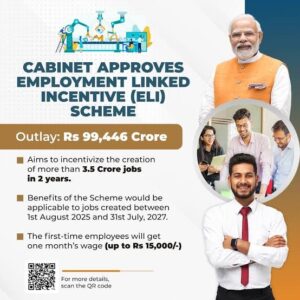
- Cabinet approval: The Union Cabinet approved the Employment-Linked Incentive (ELI) scheme to boost formal job creation, especially in manufacturing. This represents one of the most significant policy changes in recent years aimed at employment generation.
- Massive outlay: With a budget of ₹99,446 crore, the scheme aims to generate 3.5 crore jobs between 2025 and 2027, addressing the challenge of informal employment in India.
- Budget initiative: Announced in Union Budget 2024–25 under the PM’s Employment and Skilling Package, demonstrating the government’s commitment to job creation and skill development.
Key Features of Part A (First-Time Employees)
- Wage subsidy: Offers 1-month EPF wage up to ₹15,000, in two installments, encouraging formal employment.
- Eligibility: Employees earning up to ₹1 lakh/month and newly registered under EPFO, promoting the transition from informal to formal employment.
- Incentive structure: First installment after 6 months, second after 12 months and financial literacy training, ensuring sustained formal employment.
- Savings boost: A portion of the incentive is deposited in a fixed account to promote long-term savings, enhancing financial security for employees.
- DBT mode: Payments directly transferred via Direct Benefit Transfer to the employee, ensuring transparency and efficiency.
Key Features of Part B (Incentives for Employers)
- Sustained hiring: Employers receive up to ₹3,000/month per employee for 2 years; extended to 4 years for manufacturing, encouraging long-term formal employment.
- Wage slabs: ○ Up to ₹10,000 → ₹1,000/month ○ ₹10,001–₹20,000 → ₹2,000/month ○ ₹20,001–₹1,00,000 → ₹3,000/month
- Hiring conditions: ○ Employers (<50 workers) must hire minimum 2 new employees. ○ Employers (≥50 workers) must hire at least 5 employees.
- PAN-linked payments: Incentives transferred directly to employer’s account, ensuring accountability and ease of transaction.
FORMAL EMPLOYMENT IN INDIA |
| ● Definition: Employment with job security, social protection, and coverage under EPFO/ESIC, representing a shift from informal to formal work arrangements. |
| ● Current challenge: India’s informal workforce still forms over 80% of total employment, highlighting the need for schemes like ELI. |
| ● Government steps: Schemes like PMRPY, EPFO subsidies, and now ELI, aim to increase formalization of the workforce, addressing long-standing employment challenges. |
| ● Significance: Formal jobs improve social security, boost tax revenues, and ensure economic resilience, contributing to overall economic growth and stability. |