 India's No.1 PU & Degree With Integrated IAS & IPS(UPSC/PSC) Training College.


ECI Appointments: SC Scrutiny & Independence
ELECTION COMMISSION APPOINTMENTS: JUDICIAL SCRUTINY AND INSTITUTIONAL INDEPENDENCE
WHY IN THE NEWS ?
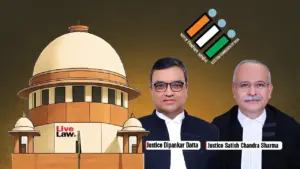
The Supreme Court has delivered a split verdict on whether challenges to the Chief Election Commissioner and Other Election Commissioners Act, 2023 should be examined by a larger Constitution Bench. The disagreement concerns the constitutional safeguards required to ensure the independence and perceived impartiality of the Election Commission of India (ECI).
2023 LAW AND THE DISPUTE OVER APPOINTMENT OF ELECTION COMMISSIONERS
- Selection Panel: The 2023 law provides for a selection committee comprising the Prime Minister, Union Cabinet Minister and Leader of Opposition in the Lok Sabha.
- Earlier Framework: In Anoop Baranwal v. Union of India (2023), the Supreme Court had directed that appointments be made on the recommendation of a committee comprising the Prime Minister, Leader of Opposition and Chief Justice of India until Parliament enacted a law.
- Key Change: The 2023 legislation replaced the Chief Justice of India with a Union Cabinet Minister, substantially altering the composition of the appointment mechanism.
- Executive Role: Critics of the arrangement argue that the presence of the Prime Minister and Cabinet Minister gives the executive side greater numerical influence over the selection process.
- Constitutional Question: The challenge raises questions about whether Parliament can design an appointment mechanism that potentially affects the institutional independence and perceived neutrality of the ECI.
SPLIT VERDICT AND THE PRINCIPLE OF ECI INDEPENDENCE
- Judicial Difference: Justice Dipankar Datta declined to refer the challenge to a larger bench, while Justice Satish Chandra Sharma considered the constitutional questions sufficiently significant for Constitution Bench examination.
- Direct Reference: Because of the split, both judges directed the matter to the Chief Justice of India for consideration of an appropriate Constitution Bench rather than prolonging the process through another bench.
- Institutional Independence: The controversy highlights that electoral institutions require not only functional independence but also public confidence that their decision-making is free from executive influence.
- Perceived Neutrality: The observation that independence must also “appear to be independent” highlights the importance of institutional design, transparency and public trust in election administration.
- Constitutional Balance: The case involves balancing Parliament’s legislative authority with constitutional requirements concerning free and fair elections and the institutional autonomy of the Election Commission.
ELECTION COMMISSION OF INDIA● Constitutional Basis: Article 324 vests the superintendence, direction and control of elections in Parliament, State legislatures, and the offices of President and Vice-President in the Election Commission of India. ● Appointment: The Constitution provides for appointment of the CEC and Election Commissioners by the President, while Parliament may regulate their conditions of service and tenure through legislation. ● Removal Safeguard: The Chief Election Commissioner enjoys a removal process broadly comparable to that applicable to a Supreme Court judge, providing an important institutional safeguard. ● Electoral Integrity: ECI independence is essential for conducting free and fair elections, maintaining the electoral roll and ensuring compliance with election-related constitutional and statutory requirements. ● Democratic Trust: The effectiveness of the ECI depends not only upon its formal constitutional powers but also upon institutional autonomy, transparency, impartiality and public confidence in the electoral process. |

