 India's No.1 PU & Degree With Integrated IAS & IPS(UPSC/PSC) Training College.


Does Inflation Targeting Work in India?
DOES INFLATION TARGETING WORK IN INDIA?
Syllabus:
GS-2:
- Government Policies and Interventions
GS-3 :
- Inflation and inflation targeting
Why in the News?
India has completed a decade of its formal Inflation Targeting (IT) framework, under which the RBI targets 4% CPI inflation within a ±2% tolerance band. Recent research questions its effectiveness, arguing that India’s Phillips curve is flat and household inflation expectations remain above RBI projections, potentially making monetary tightening costly for output and employment.
FLEXIBLE INFLATION TARGETING FRAMEWORK IN INDIA● Institutional Framework: India formally adopted Flexible Inflation Targeting (FIT) in 2016, making price stability the primary objective while recognising growth considerations. ● Inflation Target: The government notified a 4% CPI inflation target, with an upper tolerance limit of 6% and lower tolerance limit of 2%. ● Monetary Committee: The Monetary Policy Committee (MPC) determines the policy rate through a statutory framework, enhancing transparency and collective decision-making. ● Failure Accountability: Persistent inflation outside the prescribed tolerance range for the specified period triggers an obligation on the RBI to explain the reasons and corrective measures. ● Constitutional Context: Monetary policy operates within India’s broader framework of economic governance, where price stability must coexist with growth, employment and financial stability objectives. |
INFLATION TARGETING: THE BASIC FRAMEWORK
- Policy Mandate: India’s monetary policy framework requires the RBI to maintain headline CPI inflation at 4%, with a tolerance band of 2% to 6%.
- Interest Channel: The RBI primarily changes the repo rate, influencing commercial-bank lending costs and consequently household consumption and business investment.
- Demand Compression: Higher interest rates discourage borrowing, reduce consumption and investment, weaken aggregate demand and theoretically moderate demand-pull inflation.
- Expectation Channel: Inflation targeting also attempts to anchor inflation expectations, encouraging households, workers and firms to incorporate the central bank’s inflation target into economic decisions.
- Theoretical Foundation: These mechanisms are substantially associated with the New Keynesian Phillips Curve, which assumes a relationship between economic activity, wages and inflation.
THE PHILLIPS CURVE AND ITS POLICY SIGNIFICANCE
- Core Relationship: The Phillips curve traditionally proposes an inverse relationship between inflation and unemployment, implying that stronger economic activity can generate greater inflationary pressure.
- Wage Mechanism: The New Keynesian framework assumes higher output and employment strengthen workers’ bargaining positions, raising wages and consequently increasing production costs and prices.
- Expectation Effect: Higher expected future inflation can influence present wage negotiations and pricing decisions, causing inflation expectations to become embedded in current inflation.
- Policy Tradeoff: If the curve is upward sloping, monetary authorities can reduce inflation by accepting some decline in output and employment.
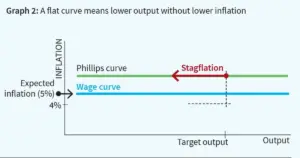
- Indian Challenge: The article’s empirical evidence suggests India’s Phillips curve is flat, questioning whether sacrificing economic activity produces a meaningful reduction in inflation.
WHY INDIA’S PHILLIPS CURVE MAY BE FLAT
- Labour Structure: Around 92% of Indian workers are estimated to operate without significant bargaining power, weakening the assumed relationship between employment, wages and inflation.
- Informal Employment: India’s large informal sector contains predominantly price-taking workers whose wages may not automatically increase when aggregate output expands.
- Weak Bargaining: Unlike the theoretical worker-capitalist model, employment growth may not substantially strengthen labour’s ability to negotiate higher real or nominal wages.
- Cost Structure: Indian inflation frequently reflects food prices, imported inputs, supply disruptions and commodity shocks, which monetary policy cannot directly control.
- Structural Factors: Consequently, changes in aggregate demand may have limited influence over inflation when supply-side constraints dominate price formation.
INFLATION EXPECTATIONS: THE SECOND CHANNEL
- Expectation Gap: RBI household surveys indicate that people’s inflation expectations have remained consistently higher than the central bank’s projections.
- Persistent Difference: According to the article, household expectations exceed RBI projections by approximately four percentage points on average, weakening the anchoring mechanism.
- Behavioural Response: Households expecting higher prices may demand greater wages, accelerate purchases or alter saving decisions, potentially sustaining inflationary pressures.
- Credibility Problem: Persistent divergence between public expectations and official projections can indicate limitations in the central bank’s ability to anchor expectations.
- Policy Implication: If expectations do not respond sufficiently to monetary guidance, raising interest rates may reduce economic activity without producing an equivalent reduction in inflation.
COSTS OF AGGRESSIVE MONETARY TIGHTENING
- Employment Impact: Higher borrowing costs can discourage private investment, reduce production and ultimately weaken employment generation, particularly in interest-sensitive sectors.
- Investment Decline: Expensive credit may cause firms to postpone capacity expansion, affecting capital formation, productivity and long-term economic growth.
- Household Burden: Higher loan rates increase repayment obligations for households, potentially reducing disposable income available for consumption and welfare.
- Distributional Effect: Monetary tightening can disproportionately affect ordinary workers, small businesses and borrowers, while financially stronger groups may better absorb higher interest rates.
- Stagflation Risk: If inflation is driven predominantly by supply shocks and the Phillips curve remains flat, demand compression could produce lower output without commensurate disinflation.
RECONCILING INFLATION CONTROL WITH GROWTH
- Supply Management: Inflation arising from food, fuel and supply disruptions requires complementary fiscal, agricultural, logistics and trade policies, rather than relying exclusively on interest rates.
- Policy Coordination: Monetary policy should operate alongside supply-side interventions, especially when inflation originates from factors outside the influence of aggregate demand.
- Flexible Targeting: India’s Flexible Inflation Targeting Framework already recognises a tolerance band, allowing monetary authorities some space to accommodate temporary deviations.
- Employment Consideration: While price stability remains crucial, monetary policy assessment should also consider employment, investment and output losses associated with prolonged tightening.
- Evidence-Based Policy: Continuous empirical evaluation of India-specific relationships among inflation, wages, employment and output is necessary instead of mechanically applying assumptions developed elsewhere.
CONCLUSION
India’s decade of inflation targeting demonstrates the importance of price stability, but its effectiveness cannot be judged solely through theoretical assumptions. A flat Phillips curve, persistent expectation gaps and supply-driven inflation suggest monetary tightening can impose substantial employment and output costs. India therefore requires a more context-sensitive, evidence-based and coordinated inflation-management framework..
SOURCE: The Hindu
MAINS PRACTICE QUESTION
Inflation targeting in India may impose significant output and employment costs when the Phillips curve is flat and inflation expectations remain poorly anchored.” Critically examine the effectiveness of India’s Flexible Inflation Targeting Framework, highlighting the structural characteristics of the Indian economy and suggesting measures for achieving price stability without compromising inclusive economic growth.(250 words).

