 India's No.1 PU & Degree With Integrated IAS & IPS(UPSC/PSC) Training College.


Rajasthan High Court Controversy Explained
Rajasthan High Court Controversy
Syllabus
GS 2: Judiciary
Why in the News?
Recently, reports about Justice Sandeep Mehta’s three letters seeking Justice Sanjeev Prakash Sharma’s immediate transfer have raised serious concerns about judicial accountability and institutional trust across India’s higher judicial system.
Introduction
- Reports about serious allegations against Rajasthan High Court’s Acting Chief Justice have raised concerns about judicial accountability and institutional trust.
- A Supreme Court judge reportedly sought his immediate transfer through three letters.
- The episode also exposes wider weaknesses in judicial appointments, disciplinary procedures, transparency, and mechanisms for addressing alleged misconduct.
Allegations Raised by Justice Mehta
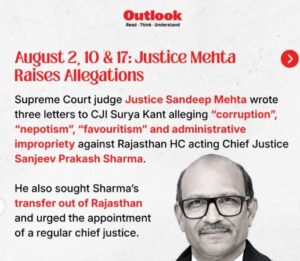
- Supreme Court judge Justice Sandeep Mehta reportedly wrote three letters to the CJI on August 2, 10, and 17.
- Justice Mehta previously served in the Rajasthan High Court and is regarded for integrity, discipline, and upright conduct.
- The letters reportedly described complaints about Justice Sharma’s functioning and several alleged administrative and judicial irregularities.
- Reported allegations included victimisation of judges, maladministration, improper shifting of cases, and nepotism in Permanent Lok Adalat appointments.
- Justice Sharma was also accused of intimidating colleagues through possible retaliatory transfers, allegedly citing his closeness to the CJI.
- The letters reportedly mentioned alleged favouritism towards selected lawyers and misuse of authority as the master of the roster.
- Justice Mehta’s final letter reportedly questioned the CJI’s alleged inaction, especially because Justice Sharma would retire on September 26.
- No official denial of the reported letter contents has emerged, while Justice Sharma has publicly rejected the accusations as baseless.
Concerns About Rajasthan High Court
- Rajasthan High Court functioned without a regular Chief Justice for nearly 11 months, creating an undesirable institutional situation.
- Justice Sharma moved to the Patna High Court in 2022, but the Collegium rejected his repatriation request in 2023.
- Instead, the Collegium had proposed his transfer to the Punjab and Haryana High Court during 2023.
- Justice Mehta reportedly questioned how Justice Sharma returned to Rajasthan High Court in 2025 and became Acting Chief Justice.
- The concern became sharper because an Acting Chief Justice exercises extensive judicial and administrative powers within the High Court.
Recent Developments
- Lawyers at the Rajasthan High Court later held a sit-in protest inside the High Court premises against the situation.
- Following the protest, Justice Sharma reportedly chose not to hear cases, reflecting the seriousness of the institutional dispute.
- On August 31, the Supreme Court Collegium recommended Justice Sanjay Agrawal as Rajasthan High Court’s new Chief Justice.
- Justice Agrawal was subsequently appointed, bringing the prolonged Acting Chief Justice arrangement to an end.
Why the Episode Matters
- Allegations of corruption against sitting judges are neither new nor unprecedented within India’s higher judiciary.
- However, this case has an unusual feature because a sitting Supreme Court judge reportedly alerted the CJI directly.
- Justice Mehta’s concerns were reportedly supported by verifiable material, making the allegations particularly significant for institutional accountability.
- Yet, several weeks reportedly passed without decisive action from the CJI on the concerns raised through these letters.
- The CJI reportedly stated that allegations could not be treated as findings and required handling through established institutional mechanisms.
- Earlier action might have reduced subsequent disturbances, especially because Justice Sharma’s retirement was approaching rapidly.
Judiciary and Public Trust
- Transparency International has previously highlighted a growing trust deficit in India’s judiciary through its corruption-related assessments.
- Its 2002 household survey identified the judiciary as the second-most corrupt institution in several South Asian countries, including India.
- Such findings are disturbing, but they should not unfairly damage the reputation of honest judges.
- India has many capable judges whose integrity and public standing should remain protected from isolated institutional failures.
Structural Problems in Higher Judiciary
Opaque Judicial Appointments
- The present Collegium system lacks clear, objective criteria and requires unavoidable interaction with the Union Executive during judicial appointments.
- This arrangement can make appointments appear opaque, partisan, and arbitrary, while limiting systematic identification of the cleanest candidates.
- Therefore, judicial corruption cannot be separated completely from the process through which candidates enter higher judicial office.
- Canada uses a system involving applications, while the United Kingdom has an independent judicial selection body.
- Such transparent selection methods remain difficult to establish within India’s present political and institutional framework.
Weak Accountability Mechanisms
- India still lacks an effective mechanism for addressing corruption allegations involving judges of the higher judiciary.
- The Judges (Inquiry) Act, 1968 has proved inadequate and has become practically ineffective for this purpose.
- In K. Veeraswami versus Union of India (1991), CJI permission preceded any FIR against a higher judiciary judge.
- Prashant Bhushan argued that police need strong evidence before seeking permission, although obtaining such evidence requires investigation first.
- The Judicial Standards and Accountability Bill was passed by the Lok Sabha in 2012 during the United Progressive Alliance government.
- However, the Bill lapsed after the 15th Lok Sabha dissolved in 2014, while later revival efforts also failed.
- Constitutional impeachment under Articles 124(4) and 217(1)(b) has also failed as an effective accountability route.
- The Supreme Court’s in-house mechanism, adopted in 1999, has likewise faced criticism for being neither fully effective nor error-free.
Lessons from Earlier Judicial Crises
- These structural weaknesses should not prevent the CJI from taking timely remedial action within existing institutional powers.
- Instead, the absence of a permanent solution makes prompt and responsible intervention even more necessary.
- The situation therefore demanded judicial statesmanship, particularly when allegations could reportedly be verified without prolonged delay.
- In 1990, CJI Sabyasachi Mukharji advised Justice V. Ramaswami to take leave during an inquiry into alleged misconduct.
- After Parliament’s impeachment motion failed because Congress strategically abstained, Justice Ramaswami sought to resume judicial work.
- However, CJI Venkatachaliah reportedly refused to assign him cases, despite around nine months remaining in his tenure.
- Justice K. Chandru records this episode in his 2026 book, Who Will Judge the Judges?
- In 2025, partly burnt currency notes were reportedly found at Justice Yashwant Varma’s Delhi residence outhouse.
- Then CJI Sanjiv Khanna promptly transferred Justice Varma to the Allahabad High Court, where he practically received no judicial work.
- In the reported 2025 decision, XXX versus Union of India, the Supreme Court stressed the CJI’s responsibility regarding judicial integrity.
- The judgment also highlighted the CJI’s role when allegations involving corrupt practices arise against members of the higher judiciary.
Need for Timely Institutional Action
- Justice Sharma allegedly claimed proximity to the CJI, which created avoidable speculation about institutional protection and administrative influence.
- Such perceptions can damage public confidence even before allegations are finally established through an appropriate process.
- Therefore, the CJI needed to respond promptly and convincingly while respecting the principle that allegations are not proven findings.
- Timely action, transparent procedures, and institutional fairness could have reduced the damage caused to judicial credibility.
- The larger lesson is that judicial independence must operate alongside accountability, ethical standards, and public confidence.
- India therefore needs stronger appointment standards, credible complaint mechanisms, and timely internal responses without compromising judicial independence.
Conclusion
Judicial independence requires accountability and public trust. India needs transparent appointments, effective complaint systems, and timely action. These safeguards must protect honest judges, strengthen institutions, and preserve constitutional autonomy through fair processes for everyone concerned.
Source :The Hindu
Mains Practice Question
Examine the need to balance judicial independence with institutional accountability while dealing with allegations against constitutional court judges.


