 India's No.1 PU & Degree With Integrated IAS & IPS(UPSC/PSC) Training College.



Daily Current Affairs Digest | 21st July 2026
Daily Current Affairs Digest | 21st July 2026
1. Semicon 2.0: Strengthening India’s Semiconductor Self-Reliance
The Union Cabinet has approved Semicon 2.0 with a total financial outlay of ₹1,27,500 crore. The programme seeks to strengthen India’s semiconductor ecosystem by supporting chip design, fabrication facilities, advanced packaging, specialised equipment, semiconductor-grade materials, research and workforce development.
Semiconductors are essential components used in smartphones, automobiles, artificial intelligence systems, telecommunications, medical equipment, satellites, defence platforms and renewable-energy technologies. Their strategic importance has increased because the global semiconductor supply chain remains concentrated in a limited number of countries.
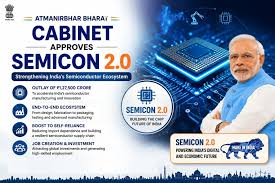 Semicon 2.0 proposes a six-pillar approach:
- Supporting domestic chip-design companies and startups
- Localising semiconductor equipment, gases, chemicals and materials
- Establishing additional fabrication facilities
- Expanding advanced chip packaging facilities
- Strengthening research and development
- Creating a specialised semiconductor workforce
The programme represents a transition from attracting individual semiconductor projects to building an integrated and resilient domestic ecosystem. It is expected to reduce India’s dependence on imported chips, improve domestic value addition and support strategic sectors such as defence, space, telecommunications and digital infrastructure.
Key Challenges
Semiconductor fabrication requires enormous capital investment, uninterrupted electricity, ultra-pure water, highly specialised equipment and a technically skilled workforce. India also continues to depend on foreign companies for advanced lithography, process tools and critical manufacturing technologies.
The success of Semicon 2.0 will therefore depend on domestic value addition, technology partnerships, research collaboration, reliable infrastructure and measurable outcomes rather than merely the number of projects approved.
Examination Relevance
- GS Paper III: Science and technology, industrial policy and infrastructure
- Prelims Fact: ATMP means Assembly, Testing, Marking and Packaging
- Prelims Fact: OSAT means Outsourced Semiconductor Assembly and Test
2. Draft National Health Research Policy 2026 Released
The Department of Health Research has released the Draft National Health Research Policy 2026 for stakeholder consultation. The proposed policy seeks to establish a unified national framework covering biomedical science, clinical research, epidemiology, public health, behavioural science, health systems, digital health and emerging technologies.
A major proposal is to increase government expenditure on health research from approximately 0.024% of GDP to 0.072% by 2037 and 0.15% by 2047.
 The policy proposes a three-tier governance structure involving:
- A National Health Research Stewardship Committee
- The Department of Health Research as the nodal implementation agency
- The Indian Council of Medical Research as the scientific and technical leader
The policy also emphasises artificial intelligence, digital health platforms, indigenous vaccines, medical devices, diagnostics, affordable therapeutics and stronger state-level participation.
India faces a dual disease burden. Communicable diseases continue to affect several regions, while non-communicable diseases, mental-health conditions, antimicrobial resistance, injuries and climate-sensitive illnesses are increasing. A coordinated research system can improve disease surveillance, pandemic preparedness and evidence-based policymaking.
Key Challenges
The implementation of the policy may be affected by fragmented institutional responsibilities, unequal research capacity across states, weak research infrastructure in medical colleges and limited translation of research findings into public-health programmes.
The use of artificial intelligence and health data also raises concerns regarding privacy, informed consent, algorithmic bias, cybersecurity and the commercial misuse of sensitive medical information.
Examination Relevance
- GS Paper II: Health governance and government policies
- GS Paper III: Biotechnology, artificial intelligence and data governance
- The Department of Health Research functions under the Ministry of Health and Family Welfare
- ICMR is India’s apex body for biomedical research
3. NIPU-2026: India’s New Strategy for Urea Self-Reliance
The Cabinet Committee on Economic Affairs has approved the National Investment Policy for Urea-2026 for Atmanirbhar Bharat, commonly known as NIPU-2026.
The policy is intended to attract investment in new gas-based urea manufacturing facilities. It is expected to support the establishment of approximately eight to nine plants, with a combined production capacity of nearly one crore tonnes.
Urea is India’s most widely used nitrogenous fertiliser and is essential for crops such as rice, wheat, maize, sugarcane and cotton. Although domestic production has expanded, demand continues to exceed indigenous supply, resulting in dependence on imports and exposure to international price fluctuations.
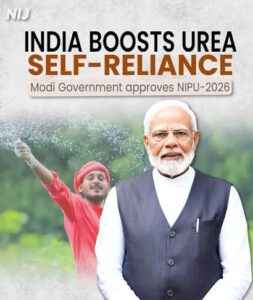 Major features of NIPU-2026 include:
- Establishment of new gas-based urea plants
- Separation of fixed and variable costs
- Return on equity between 12% and 16%
- Measures to reduce long-term foreign-exchange risks
- Improved transparency in subsidy calculations
- Estimated savings of more than ₹250 crore per plant compared with the earlier policy
The policy could improve fertiliser availability during peak agricultural seasons, reduce import vulnerability and strengthen food security.
Capacity Expansion Is Not Enough
India’s fertiliser problem is not limited to insufficient production. Heavy subsidies make urea comparatively cheaper than phosphatic and potassic fertilisers, encouraging excessive nitrogen application.
Overuse of urea can lead to soil degradation, groundwater contamination, eutrophication and emissions of nitrous oxide, a powerful greenhouse gas. India must therefore move beyond urea self-sufficiency towards comprehensive nutrient security.
Balanced fertilisation, Soil Health Cards, precision application, biofertilisers, digital tracking and reform of the fertiliser-subsidy system must complement the expansion of production capacity.
Examination Relevance
- GS Paper III: Agriculture, subsidies, food security and energy security
- NIPU-2026 applies to new gas-based urea manufacturing units
- Urea is a nitrogenous fertiliser
- Excess nitrogen can contribute to nitrate pollution and eutrophication
4. NAMASTE Scheme Expands Protection for Sanitation Workers
The National Action for Mechanised Sanitation Ecosystem, or NAMASTE Scheme, has expanded worker identification, personal protective equipment distribution, health coverage and mechanised sanitation infrastructure.
By July 2026:
- More than 89,000 sewer and septic-tank workers had been validated
- Over 2.81 lakh waste pickers had been validated
- More than 87,000 personal protective equipment kits had been distributed
- Health cards had been issued to over 76,000 workers
- Around 753 Emergency Response Sanitation Units had been equipped
NAMASTE is a Central Sector Scheme aimed at protecting the safety, dignity and social security of sewer and septic-tank workers. Waste pickers were later included within its coverage.
The scheme promotes mechanised sewer cleaning, occupational-safety training, health protection, emergency-response systems, skill development and alternative livelihood opportunities.
 Constitutional Importance
 Constitutional Importance
The scheme is connected with several constitutional provisions:
- Article 14: Equality before law
- Article 17: Abolition of untouchability
- Article 21: Right to life and dignity
- Article 23: Protection against forced labour
- Articles 39(e), 42 and 46: Protection of workers and weaker sections
It also complements the Prohibition of Employment as Manual Scavengers and their Rehabilitation Act, 2013.
However, the success of NAMASTE should not be measured only through the distribution of PPE kits. The ultimate objective must be to eliminate hazardous human entry into sewers and septic tanks and achieve zero sanitation-related fatalities.
Examination Relevance
- GS Paper II: Welfare schemes, social justice and urban governance
- NAMASTE is a Central Sector Scheme
- ERSU means Emergency Response Sanitation Unit
- Urban local bodies play a central role in sanitation management
5. Fifth BIMSTEC National Security Chiefs’ Meeting
India hosted the Fifth BIMSTEC National Security Chiefs’ Meeting in New Delhi on 16 July 2026. The meeting was attended by security representatives from Bangladesh, Bhutan, India, Myanmar, Nepal, Sri Lanka and Thailand.
Discussions focused on cooperation against:
- Terrorism and violent extremism
- Cyberattacks and financial fraud
- Transnational organised crime
- Narcotics and arms trafficking
- Human trafficking
- Maritime threats and illegal fishing
- Natural disasters and climate-related emergencies
- Security challenges associated with emerging technologies
The Bay of Bengal Initiative for Multi-Sectoral Technical and Economic Cooperation, or BIMSTEC, was established through the Bangkok Declaration in 1997. It connects South Asia with Southeast Asia and has seven member countries.
BIMSTEC’s institutional position was strengthened through its Charter, which was signed in 2022 and entered into force in 2024. India leads the security sector under BIMSTEC’s rationalised sectoral framework.
 Significance for India
 Significance for India
BIMSTEC brings together India’s Neighbourhood First Policy and Act East Policy. It provides a platform for cooperation in maritime security, counter-terrorism, disaster management, cyber security, connectivity and regional development.
The grouping is also significant because the Bay of Bengal connects the Indian Ocean with the Malacca Strait and carries important trade and energy routes.
However, political instability, institutional weakness, inadequate connectivity, different threat perceptions and slow implementation continue to limit BIMSTEC’s effectiveness.
Examination Relevance
- GS Paper II: India and its neighbourhood and regional organisations
- GS Paper III: Cyber security, maritime security and organised crime
- BIMSTEC was established in 1997
- BIMSTEC has seven members
- Its Secretariat is located in Dhaka, Bangladesh
- India leads BIMSTEC’s security sector




