 India's No.1 PU & Degree With Integrated IAS & IPS(UPSC/PSC) Training College.


Community-Led Solutions for Rural Waste
Rural Waste Management Needs Community-Led Solutions
Syllabus:
GS-2: Government Policies & Interventions
GS-3: Environmental Pollution & Degradation, Issues Arising Out of Design & Implementation of Policies
Why in the News ?
Recent initiatives in Majuli, Assam, and Tawang, Arunachal Pradesh, demonstrate innovative approaches to rural solid-waste management. The examples are significant because rural India faces inadequate collection, weak infrastructure, poor data, high transportation costs and growing plastic waste. They highlight how community participation, segregation, decentralised facilities and sustainable financing can create workable solutions.
India’s Rural Waste Challenge and the Data Gap:
- India generates nearly 7 lakh tonnes of waste every day, according to the Central Pollution Control Board (CPCB).
- Around 22% of this waste reaches landfills, while approximately 17% remains unaccounted for, indicating gaps in collection, treatment and disposal.
- However, the problem becomes more serious in rural areas because reliable rural waste-generation and disposal data are largely unavailable.
- Rural local bodies are responsible for solid-waste management and data collection, but many lack the institutional capacity, manpower and technical resources necessary to perform these functions effectively.
- The absence of reliable data creates a policy problem:
- Waste generation cannot be accurately estimated.
- Infrastructure requirements remain unclear.
- Budget allocation becomes difficult.
- Performance of local bodies cannot be properly assessed.
- India’s rural consumption patterns have changed substantially with rising incomes, market penetration and improved connectivity.
- Products such as:
- Food items,
- Beverages,
- Personal-care products,
- Hygiene products,
- Packaged consumer goods
increasingly reach remote villages.
- Consequently, plastic and multi-layered packaging waste has expanded even where formal waste-management systems remain weak.
- Traditionally, rural waste consisted largely of biodegradable material, which could be used as animal feed, compost or manure.
- Increasing quantities of non-biodegradable plastics have changed this traditional waste cycle.
- In the absence of collection systems, rural communities often resort to:
- Open dumping,
- Burning,
- Disposal in rivers and streams,
- Dumping on agricultural land.
- Such practices create risks of:
- Soil contamination,
- Water pollution,
- Air pollution from open burning,
- Plastic leakage into rivers and oceans,
- Public-health hazards.
- Globally, the UN Environment Programme (UNEP) estimates that approximately 7 billion people lack waste collection, of whom nearly 2 billion live in rural areas.
- Thus, rural waste management is not merely an urban governance issue; it is increasingly a development, environmental and public-health challenge.
Understanding Rural Solid Waste Management:Constitutional and Governance Framework● 73rd Constitutional Amendment Act, 1992 ○ Gave constitutional status to Panchayati Raj Institutions. ○ The Eleventh Schedule contains subjects that may be devolved to Panchayats. ○ Rural sanitation and local infrastructure are closely linked to effective Panchayati Raj governance. ● 74th Constitutional Amendment ○ Provides the constitutional framework for urban local bodies. ○ Important for comparison between urban and rural waste governance. ● Article 243G ○ Enables State legislatures to devolve powers and responsibilities to Panchayats. Solid Waste Management Rules● Solid Waste Management Rules, 2016 ○ Replaced the Municipal Solid Wastes Rules, 2000. ○ Promote: ■ Source segregation, ■ Door-to-door collection, ■ Processing, ■ Recycling, ■ Scientific disposal. ○ Responsibilities are assigned to local authorities and other stakeholders. ● Central Pollution Control Board (CPCB) ○ National-level environmental regulatory body. ○ Plays a key role in monitoring and implementing waste-management regulations. Plastic Waste Management● Plastic Waste Management Rules, 2016 ○ Provide the regulatory framework for plastic waste. ○ Emphasise collection, segregation, recycling and environmentally sound disposal. ● Extended Producer Responsibility (EPR) ○ Places responsibility on producers, importers and brand owners for managing plastic packaging waste. ○ Important for addressing the problem of packaged consumer goods entering remote rural markets. Swachh Bharat Mission● Swachh Bharat Mission-Gramin (SBM-G) ○ Focuses on rural sanitation and cleanliness. ○ Phase II places greater emphasis on ODF sustainability and solid/liquid waste management. ○ Rural waste-management infrastructure such as collection and processing facilities can be supported through the programme. Circular Economy● Circular economy seeks to minimise waste by: ○ Reduce, ○ Reuse, ○ Repair, ○ Recycle, ○ Recover resources. ● Rural waste systems can create: ○ Green jobs, ○ Local enterprises, ○ Recycling markets, ○ Resource recovery opportunities. Important Institutions● Ministry of Jal Shakti ○ Important role in rural sanitation through SBM-G. ● Ministry of Panchayati Raj ○ Strengthens Panchayati Raj institutions and local governance. ● CPCB ○ Environmental regulation and monitoring. ● State Pollution Control Boards ○ State-level implementation and monitoring of environmental regulations. ● Gram Panchayats ○ Critical frontline institutions for rural sanitation and local waste management. ● Self-Help Groups ○ Can contribute to segregation, collection, awareness and recycling-linked livelihoods. |
Majuli Shows How Existing Infrastructure Can Be Revived
- Majuli, an island district in Assam, provides an important example of converting existing but underutilised infrastructure into a functioning waste-management system.
- Between 2017 and 2022, authorities established:
- Central Material Collection Facilities (CMCFs) in 19 of 20 panchayats.
- Mini-collection facilities across most of the district’s villages.
- However, merely constructing infrastructure did not automatically create an effective system.
- Many facilities remained unused, while sanitation workers were not adequately mobilised.
- In 2024, the non-profit Sahaas collaborated with government departments to operationalise the system.
- The experience demonstrated that waste management requires much more than physical infrastructure.
- Important components included:
- Community awareness,
- Household-level segregation,
- Collection arrangements,
- Transportation,
- Staffing,
- Training of sanitation workers,
- Operation of collection centres,
- Identification of recyclers,
- Financial resources.
- Village leaders, schools, self-help groups, homestay operators and hotel owners participated in awareness campaigns.
- Households were encouraged to store and segregate waste before collection.
- Despite challenges created by floods and river erosion, waste collection has now been established across 19 of 20 panchayats.
- The model also addressed the crucial problem of moving recyclable waste from a geographically isolated area to recycling markets.
- On April 30, 2025, approximately one tonne of waste was transported out of Majuli by boat across the Brahmaputra rather than being dumped into the river.
- Between April 2025 and May 2026, Majuli transferred approximately 78 tonnes of waste and generated around ₹1.47 lakh in revenue.
- Since 2024, the initiative reportedly collected around 4 tonnes of waste, preventing it from entering the Brahmaputra and ultimately the ocean.
- The example demonstrates that institutional convergence + community participation + logistics + recycling linkages can make rural waste management operational.
Tawang Demonstrates the Power of Community-Led Collection
- Tawang district of Arunachal Pradesh presents a different challenge from Majuli.
- Its settlements are:
- Mountainous,
- Scattered,
- Remote,
- Difficult to access.
- Conventional door-to-door collection by sanitation workers is therefore expensive and operationally difficult.
- In 2024, the Himalayan Fringes Project, local officials and village leaders experimented with a community-led waste-management model.
- Under this approach:
- Every household segregates biodegradable and non-biodegradable waste.
- Waste is initially stored within households.
- Villagers bring the accumulated waste to a designated collection point once every month.
- The monthly collection event is called ‘Swachchata Divas’ or Cleanliness Day.
- Villagers collectively:
- Bring their waste,
- Segregate it,
- Clean surrounding areas,
- Sort waste into multiple categories.
- In some villages, waste is divided into as many as 22 categories at the primary level.
- The system avoids the high recurring cost of conventional door-to-door collection.
- The collected material is subsequently transported to Material Recovery Facilities (MRFs).
- MRFs have been established in places such as:
- Zemithang,
- Lumla,
- Daporijo.
- Smaller community-based MRFs also operate in Chullyu and Gobuk.
- At these facilities, secondary sorting is undertaken into around 35 categories.
- The model has involved women from self-help groups, creating both environmental and livelihood benefits.
- Around 26 villages have organised more than 150 Swachchata Divas and collected approximately 30 tonnes of waste.
- More than 20 tonnes of recyclable waste have reportedly been sold to recyclers, generating approximately ₹3.53 lakh.
- Multi-layered plastics have also been transported to processing facilities and converted into paver blocks.
- The Tawang experience shows that rural waste systems need not simply replicate urban models.
- Instead, solutions should be geography-sensitive, decentralised and community-owned.
Financing and Logistics Remain the Critical Bottlenecks
- One of the biggest obstacles to rural waste management is financial sustainability.
- According to UNEP, collection is generally the most expensive stage of the waste-management chain.
- Major costs include:
- Worker wages,
- Fuel,
- Vehicle maintenance,
- Insurance,
- Transportation,
- Administrative expenses.
- A Centre for Science and Environment (CSE) analysis also found that primary collection and transportation constitute a substantial portion of waste-management expenditure.
- Rural areas face an additional disadvantage because recyclable waste often has to travel long distances to reach viable markets.
- This makes rural waste less attractive to scrap dealers and recycling companies.
- In Tawang, transporting one truckload of waste to Assam can cost approximately ₹45,000.
- Fuel and driver expenses for a trip alone can amount to around ₹20,000.
- Initially, local residents volunteered their vehicles, but as the model expanded, the State government provided a truck.
- To make the system financially sustainable:
- Households are charged around ₹50 per month.
- Shops and cafés contribute around ₹100 per month.
- Local institutional structures have also been created.
- Regional committees involve:
- Circle Officers,
- Religious leaders such as Lamas.
- Village-level committees include:
- Gaon buras/village heads,
- These committees establish:
- Waste-management rules,
- Responsibilities,
- Fines,
- Financing mechanisms.
- Such arrangements create local accountability rather than depending entirely on government grants.
- The lesson is that rural waste management requires a combination of public funding, user charges, recycling revenue and community ownership.
Collection Infrastructure Must Cover the First and Last Mile
- Establishing a waste facility alone does not solve the problem.
- A functional system must cover the entire chain:
Household → Segregation → Collection → Transportation → Material Recovery → Recycling/Processing → Final Disposal. - Majuli illustrates the importance of strengthening this complete chain.
- Approximately 67 lakh people are served by around 37 sanitation workers and 19 sorting staff.
- Although segregation has improved, behavioural gaps remain.
- Some households continue to provide mixed waste, making subsequent sorting more expensive and difficult.
- To strengthen collection, government departments and panchayats acquired:
- 21 electric vehicles,
- 15 tricycles,
- Additional funds for collection workers.
- This demonstrates the importance of appropriate technology in remote locations.
- However, transportation remains a major challenge.
- Rural recyclable waste often has low economic value relative to transport costs.
- Consequently, certain categories of waste may accumulate even after successful collection.
- Majuli has experienced difficulty finding buyers for:
- Black polythene,
- Certain textile waste.
- Several CMCFs are also becoming full because collected material is accumulating faster than it can be sold or processed.
- One plastics-management facility in Majuli has remained non-functional and requires repairs.
- Therefore, rural waste management must focus not merely on collection rates, but also on downstream processing capacity and market linkages.
- Otherwise, waste may simply move from open dumping sites to overloaded collection centres.
Challenges in Building Sustainable Rural Waste Management
- Lack of reliable data
- Rural waste generation, composition and disposal data remain inadequately documented.
- Without data, planning and monitoring become difficult.
- Weak institutional capacity
- Gram panchayats and other rural local bodies frequently lack technical personnel, trained workers and financial resources.
- Infrastructure may remain underutilised without operational planning.
- Geographical isolation
- Himalayan, island, tribal and border regions face difficult terrain and dispersed settlements.
- Conventional door-to-door collection can become prohibitively expensive.
- High transportation costs
- Recyclable material often has to travel hundreds of kilometres to reach processing units.
- Transportation can exceed the market value of waste.
- Growing plastic consumption
- Packaged goods are penetrating remote markets faster than waste-management infrastructure.
- Multi-layered plastics are particularly difficult to recycle.
- Behavioural challenges
- Household segregation requires sustained awareness and participation.
- Even a minority of households providing mixed waste can undermine the efficiency of the system.
- Weak recycling markets
- Certain categories of collected waste may have no immediate buyers.
- This results in accumulation at collection and recovery facilities.
- Financial sustainability
- Rural waste systems cannot depend permanently on government grants.
- User fees and recycling revenues need to be balanced with the ability of poorer households to pay.
- Infrastructure-maintenance gaps
- Existing CMCFs and processing facilities may deteriorate when maintenance budgets and operational responsibility are unclear.
- Regulatory implementation
- The Solid Waste Management Rules require effective institutional mechanisms, but implementation remains uneven.
- Recent judicial concern over inadequate institutionalisation underscores the need for stronger regulatory capacity.
Way Forward — From Waste Collection to Circular Rural Economy
- Build reliable rural waste databases
- Every panchayat should maintain periodic data on waste generation, composition, collection and disposal.
- Digital monitoring can support evidence-based allocation of funds.
- Adopt decentralised models
- Remote villages should not be forced to replicate urban door-to-door systems.
- Community collection days, village-level sorting and decentralised MRFs can be more suitable.
- Strengthen Gram Panchayats
- Panchayats should receive adequate funds, functions and functionaries for waste management.
- Capacity-building should include technical training and financial management.
- Promote source segregation
- Household-level separation into biodegradable, recyclable and residual waste should become the foundation of rural waste systems.
- Local awareness campaigns should involve schools, SHGs and community leaders.
- Create regional recycling hubs
- Instead of transporting small quantities over hundreds of kilometres, neighbouring districts can establish shared Material Recovery Facilities.
- This can reduce transportation costs and improve economies of scale.
- Support circular-economy enterprises
- Waste should be treated as a potential economic resource.
- Recycling, composting, plastic processing and reuse enterprises can create rural employment.
- Use appropriate technology
- Electric vehicles, tricycles, decentralised composting and small-scale processing units can be better suited to rural geography.
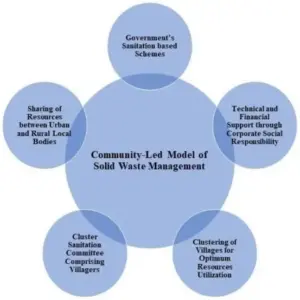
- Create sustainable financing
- A combination of:
- Government support,
- User fees,
- Recycling revenue,
- Corporate Social Responsibility,
- Producer responsibility mechanisms
can make systems financially viable.
- Strengthen Extended Producer Responsibility (EPR)
- Producers of plastic-packaged goods should contribute to collection and recycling, particularly where their products penetrate remote markets.
- Ensure convergence
- Swachh Bharat Mission (Gramin), Panchayati Raj institutions, State departments, CPCB/SPCBs, SHGs and civil society organisations should work through integrated district-level plans.
- Focus on outcomes
- Success should not be measured only by tonnes collected.
- Indicators should include:
- Percentage of households segregating waste,
- Recycling rate,
- Reduction in open dumping,
- Reduction in river/ocean leakage,
- Financial sustainability,
- Worker safety.
- Replicate successful models
- The experiences of Majuli and Tawang can serve as adaptable templates for other geographically difficult rural regions.
- The objective should be to develop locally appropriate solutions rather than a single uniform national model.
- A combination of:
Conclusion:
India’s rural waste crisis demands a shift from infrastructure-centric schemes to community-owned, decentralised systems. Majuli and Tawang demonstrate that source segregation, local participation, appropriate technology, sustainable financing and recycling linkages can deliver results. Strengthening Panchayats, EPR and circular-economy mechanisms can make rural waste management environmentally sustainable and financially viable.
Source:TH
Mains Practice Question :
“Rural India’s waste-management challenge is increasingly a consequence of rising consumption without corresponding institutional capacity.” Examine the lessons from community-led initiatives in Majuli and Tawang. Discuss the role of Panchayati Raj Institutions, Extended Producer Responsibility, decentralised infrastructure and circular-economy approaches in developing sustainable rural waste-management systems.

