 India's No.1 PU & Degree With Integrated IAS & IPS(UPSC/PSC) Training College.


CEC ≠ Election Commission of India | UPSC Polity
CHIEF ELECTION COMMISSIONER IS NOT THE ELECTION COMMISSION OF INDIA
Syllabus:
GS-2:
- Constitutional Bodies
- Chief election Commissioner
- Transparency and Accountability
Why in the News?
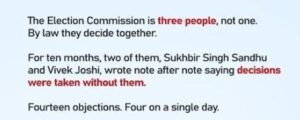
Recent disclosures concerning the Special Intensive Revision (SIR) of electoral rolls have highlighted reported disagreements within the three-member Election Commission. Election Commissioners Sukhbir Singh Sandhu and Vivek Joshi reportedly recorded objections at least 14 times over 10 months regarding decisions they said were taken without their knowledge, raising questions about collective decision-making, institutional accountability and electoral integrity.
ELECTION COMMISSION OF INDIA UNDER ARTICLE 324● Constitutional Basis: Article 324 establishes the Election Commission and vests it with superintendence, direction and control over elections to Parliament, State legislatures and the offices of President and Vice-President. ● Electoral Rolls: Under the constitutional and statutory framework, the ECI oversees electoral-roll preparation and revision, while Electoral Registration Officers perform specified statutory functions. ● Independence: The ECI’s credibility depends upon institutional independence, impartiality, transparency and procedural integrity, enabling it to administer elections without improper external influence. ● CEC Position: The CEC has a distinct constitutional position, particularly regarding removal protections, but within a multi-member Commission the office is not synonymous with the institution itself. ● Democratic Significance: An independent Election Commission is fundamental to free and fair elections, political equality and the constitutional principle that every eligible citizen should have an effective opportunity to participate in representative government. |
ECI AS A COLLECTIVE CONSTITUTIONAL BODY
- Constitutional Design: Article 324 vests the superintendence, direction and control of elections in the Election Commission, establishing the institution rather than an individual office-holder as the constitutional authority.
- Three-Member Structure: The present Commission comprises the Chief Election Commissioner and Election Commissioners, who participate collectively in the functioning of the constitutional body.
- First Among Equals: The CEC functions as the Chairman, but the institutional design does not make the office-holder an independent decision-making authority superior to other Commissioners.
- Judicial Principle: In N. Seshan v. Union of India (1995), the Supreme Court emphasised that elections were entrusted to the Commission and cautioned against projecting an individual in a manner that eclipses the institution.
- Institutional Integrity: Collective functioning is particularly important because the ECI exercises extensive powers affecting voter registration, electoral rolls and the conduct of democratic elections.
SECTION 18 AND COLLECTIVE DECISION-MAKING
- Statutory Requirement: Section 18(2) of the 2023 Act provides that ECI business should, as far as possible, be transacted unanimously, with disagreement resolved through the majority view.
- Majority Principle: Where Commissioners disagree, the statute expressly provides that the matter must be decided according to the opinion of the majority, preventing unilateral determination.
- Procedural Safeguard: Section 18(1) further provides that the Commission can regulate its business and allocate work only through a unanimous decision.
- Institutional Balance: The framework therefore seeks to combine consensus-building with a clear mechanism for resolving disagreement without allowing one member to dominate the institution.
- Legal Question: If a substantive decision assigned to the Commission is issued without lawful institutional approval, questions may arise regarding its statutory authority and validity, although the ultimate legal determination would depend on the specific facts.
SIR AND THE INTERNAL DISAGREEMENTS
- Recorded Objections: The Indian Express investigation reported that Sandhu and Joshi made at least 14 formal objections over 10 months, concerning several aspects of electoral-roll management.
- Form 6: Both Commissioners reportedly objected to changes in Form 6, arguing that the statutory form could not be altered without amendment of the relevant rules.
- Voter Restoration: Their concerns reportedly extended to the addition, deletion and restoration of voters, directly involving the integrity of electoral rolls.
- Database Control: The Commissioners also reportedly raised concerns about the centralisation of electoral-roll databases and limitations on access available to ground-level Electoral Registration Officers.
- Institutional Significance: These reported disagreements shift part of the debate from the substantive merits of SIR towards the broader question of how decisions within a constitutional authority are made and recorded.
ELECTORAL ROLLS AND STATUTORY AUTHORITIES
- ERO Authority: Electoral Registration Officers (EROs) are statutory authorities responsible for preparing and revising electoral rolls within their respective constituencies.
- Decentralised Safeguard: Decentralised electoral-roll administration can provide an important institutional safeguard because decisions remain connected to local verification and statutory procedures.
- Digital Transformation: Digitisation through platforms such as ECINet can improve efficiency, standardisation and data management but also creates new questions regarding access, auditability and accountability.
- Goa Example: The investigation reported that 97 voters found eligible by EROs were nevertheless left off the final roll after technical problems prevented their restoration.
- Technology Limits: Digital systems should function as administrative tools supporting statutory authorities; software architecture cannot independently replace or override powers granted by electoral law.
TRANSPARENCY AND ACCOUNTABILITY OF THE ECI
- Public Confidence: Electoral institutions depend heavily on public trust, because citizens must accept electoral outcomes as legitimate even when their preferred candidates or parties lose.
- Decision Records: Maintaining clear records of deliberations, approvals, dissent and allocation of responsibilities can strengthen institutional accountability without compromising necessary administrative confidentiality.
- Internal Dissent: Genuine disagreement within a constitutional body need not undermine democracy; appropriately recorded dissent can provide an important institutional check.
- External Scrutiny: Courts, Parliament, statutory procedures and transparent institutional practices provide different layers of accountability for constitutional authorities.
- Current Disclosure: The ECI has reportedly not disputed the existence, dates or contents of the 14 notes but has described them as “suggestions” and stated that decisions during the period were unanimous, leaving important questions about the internal process unresolved.
WAY FORWARD FOR ELECTORAL INSTITUTIONAL REFORM
- Decision Disclosure: The Commission could clearly document which major SIR decisions were reached through unanimity, majority decision or an established allocation of business.
- Legal Review: Decisions specifically challenged as lacking proper approval should undergo an appropriate legal and institutional review before their continuing implementation.
- Technical Audit: Electoral databases and software should undergo regular independent technical and legal audits, particularly where automated systems influence voter inclusion or exclusion.
- ERO Empowerment: Statutory EROs should retain effective ability to exercise their legally assigned functions, with digital systems designed to support rather than displace statutory decision-makers.
- Institutional Protocol: The ECI should strengthen internal procedures for recording dissent, authorising communications and litigation, and ensuring that actions taken in the Commission’s name have clear institutional authority.
CONCLUSION
The central issue is not whether Election Commissioners can disagree, but whether the Election Commission functions through legally authorised collective decision-making. The constitutional design, statutory framework and judicial precedent emphasise the institution rather than an individual office-holder. Strengthening recorded deliberation, transparency, technical accountability and statutory compliance is essential for preserving electoral credibility and democratic trust.
SOURCE: Indian Express
MAINS PRACTICE QUESTION
“The Election Commission of India is a constitutional institution, not merely an aggregation of individual office-holders.” Discuss this statement with reference to Article 324, Section 18 of the 2023 Act, the principle of collective decision-making and recent concerns surrounding electoral-roll revision.

