 India's No.1 PU & Degree With Integrated IAS & IPS(UPSC/PSC) Training College.


Can Youth Redefine India’s Ballot?
Beyond Caste and Community: Can India’s Young Demographics Redefine the Ballot?
Syllabus:
-
GS – 2 – Election Commission of India, Voter awareness
Focus :
The article highlights how political parties in India aggressively court Generation Z amid growing unemployment and education concerns. However, despite their massive demographic weight, young voters remain electorally fragmented—unlike traditional voting blocs based on caste, community, or gender—making their power an evolving force that has yet to fully consolidate.
Introduction
- India stands at a unique demographic moment in its history.
- The nation holds the largest population of young people in the world, with roughly 65% of its 1.5 billion citizens aged under 35.
- Despite this immense demographic weight, young voters have not yet formed a single, unified voting bloc.
- Political parties across the country are investing heavily to capture the imagination of Generation Z, yet traditional factors like caste, religion, gender, and regional identity continue to determine real-world election outcomes.
The Unprecedented Political Courtship of Generation Z
- Political entities across India are engaging in an intense effort to connect with the nation’s youngest citizens.
- Leaders and strategists recognize that young people represent a massive portion of potential voters, leading to a visible shift in political communication and outreach methods.
Digital Media Expansion and Online Outreach
- Political parties are redirecting significant portions of their campaign budgets toward digital platforms where young citizens spend their time.
- Campaign strategists actively create content tailored for platforms like Instagram, YouTube, and short-form video apps to stay relevant.
- Senior politicians are deliberately updating their speaking styles, discarding overly formal rhetoric in favor of candid, direct language popular among Generation Z (those aged 14 to 29).
- Online political messaging relies increasingly on memes, live interactive streams, and informal podcasts to make political figures seem accessible and relatable.
Campus Outreach and Institutional Engagement
- Leaders from across the political spectrum are visiting college campuses, universities, and coaching hubs with unprecedented frequency.
- Political parties are organizing campus town halls, youth parliaments, and interactive debates to build direct relationships with first-time voters.
- Party student wings are actively campaigning on campus issues, attempting to convert local student dissatisfaction into broader political support.
- The intensity of these campus visits reflects a sense of urgency among political strategists who fear losing touch with the younger demographic.
Public Scrutiny of Educational and Exam Systems
- National attention has turned toward the integrity of competitive examination systems, entrance tests, and public recruitment processes.
- Systemic flaws, such as question paper leaks, official delays in exam schedules, and administrative corruption, have become top-tier political debate topics.
- The private coaching industry, which trains millions of students for engineering, medical, and civil service exams, is facing increased government and media scrutiny.
- Politicians are forced to address student anxiety directly, as failures in the examination system quickly lead to widespread public anger.
Policy Initiatives Versus Structural Economic Realities
- Over the past decade, successive governments have introduced a wide array of programs designed to empower young citizens.
- However, a persistent gap remains between public policy goals and the daily economic realities faced by job seekers.
A Decade of Focused Youth Schemes
- Over the last 12 years, the central government has launched numerous flagship programs targeting skill development, entrepreneurship, and employment.
- Initiatives such as Skill India, Startup India, and national internship portals aim to provide young people with practical training and business funding.
- Specialized programs support youth involvement in sports through schemes like Khelo India, alongside structured volunteering networks.
- These policies seek to convert India’s youth population into a productive workforce capable of driving long-term economic growth.
The National Education Policy 2020 and Future Vision
- The National Education Policy (NEP) 2020 represents a major attempt to overhaul the country’s traditional educational framework.
- While the policy has faced criticism regarding its implementation and regional adaptation, it aims to shift focus from rote learning to critical thinking and practical skills.
- NEP 2020 promotes interdisciplinary study, early exposure to vocational training, and flexible degree options to better prepare students for modern industry needs.
- In parallel, the proposed National Youth Policy 2026 focuses on gearing young citizens aged 15 to 29 toward the emerging digital economy, artificial intelligence, and green technologies.
The Challenge of the NEET Population
- A report by NITI Aayog highlights that approximately 8.7 crore young individuals aged 15 to 29 fall into the category of NEET (Not in Education, Employment, or Training).
- The government has clarified that falling under the NEET category does not automatically mean total joblessness, as many individuals are involved in informal work or domestic responsibilities.
- Despite official clarifications, the high number of NEET youth indicates that a massive amount of productive energy remains untapped and unanchored.
- Policy experts argue that failing to integrate this group into the formal economy risks converting India’s potential demographic dividend into a demographic challenge.
The Degree-to-Job Disconnect
- A major structural challenge in India is the widening gap between earning a formal academic degree and securing suitable employment.
- Universities produce millions of graduates each year, but industry leaders frequently report a shortage of candidates with job-ready practical skills.
- Many educated young people find themselves underemployed, taking low-paying gig work or spending years preparing for limited government jobs.
- This disconnect creates deep frustration among young citizens who feel that their academic achievements do not translate into financial stability.
Street Ferment, Student Protests, and Political Realpolitik
- In recent years, public demonstrations led by students and young workers have signaled growing impatience with slow economic mobility.
- Political parties have responded to these events with a mix of opportunistic messaging and strategic risk management.
Recent Protests as a National Wake-Up Call
- Street protests in major urban centers like Delhi, along with demonstrations across various state capitals, have drawn urgent attention to youth grievances.
- Young protesters have taken to the streets to demand timely job recruitments, fair examination processes, and better working conditions.
- While these street demonstrations remain distinct from extreme political instability seen in other South Asian nations, they serve as a clear warning to political leaders.
- The visible anger on the streets has forced political parties to place youth-centric economic issues at the center of their public platforms.
Opposition Narratives and Strategy
- Opposition political parties have leveraged recent youth unrest to build a strong narrative against the ruling administration.
- Opposition leaders argue that current policies have failed to generate adequate employment opportunities for the educated youth.
- However, policy analysts question whether opposition parties possess a realistic, comprehensive economic blueprint to solve employment challenges or are simply capitalizing on immediate anger.
- The focus of political opposition often remains on criticizing existing government performance rather than presenting detailed alternative job-creation models.
Strategic Mitigation by Ruling Entities
- In response to public agitation, ruling parties are adopting swift damage-control measures to prevent losing young voters.
- Government authorities often respond to protests by announcing fast-tracked recruitment drives, launching new skill schemes, and promising stricter laws against exam leaks.
- Political strategists view increased engagement with youth issues as a necessary measure to cut prospective losses in upcoming elections.
- Engagement with young people is often driven by realpolitik—a pragmatic calculation to manage voter discontent rather than a fundamental change in party ideology.
Demographic Weight on Paper
- Despite their overwhelming numbers, India’s young citizens do not cast their votes as a single, coordinated political force. Traditional identity categories continue to fragment the youth vote across every state.
- India’s total population stands at approximately 1.5 billion people, with 65% under the age of 35.
- Citizens aged between 18 and 29 account for roughly 23% of the total national electorate, making them a crucial demographic on paper.
- In theory, if this 23% voted together around shared issues like jobs and education, they could determine the outcome of almost any election.
- In practice, this group is divided by geography, language, social class, caste, and religion, preventing the formation of a unified political voice.
The Persistence of Traditional Identity Matrices
- For over 75 years of independent Indian electoral history, voting patterns have organized around broad identity labels rather than age cohorts.
- Voters routinely align with established groups based on community, caste, language, or trade, such as Scheduled Castes (SC), Scheduled Tribes (ST), Other Backward Classes (OBC), or farming communities.
- When a young person enters the voting booth, their identity as a member of a specific caste or community often overrides their identity as a member of Generation Z.
Case Studies from Recent State Assembly Elections
- Tamil Nadu: Recent assembly elections showed slight indications of young voters seeking change, but their votes were still largely distributed among established regional coalitions rather than a distinct youth platform.
- Bihar: Political parties made explicit promises regarding government job creation to attract young voters, yet traditional social engineering and community alignments ultimately determined the election results.
- West Bengal, Kerala, Assam, and Puducherry: Across these diverse states, young voters showed no distinct, uniform trend, dividing their support among ruling and opposition parties based on local factors.
- National General Elections: While studies indicate that young voters supported the ruling party in higher proportions during the 2014 and 2019 national elections, they did so as part of broader national political trends rather than as an independent youth movement.
The Unification of the Women’s Vote
- Over the past decade, female voters in India have emerged as a powerful, recognizable voting bloc that political parties treat with great focus.
- Women have shown a willingness to vote across traditional caste and class lines when presented with policies designed specifically for their well-being.
- Political parties actively court women because their electoral participation rates have increased dramatically, often surpassing male turnout in several states.
The Role of Concrete Welfare Deliverables
- The consolidation of the women’s vote is driven by tangible, immediate welfare benefits delivered directly to households.
- Specific programs—such as direct cash transfers to bank accounts, subsidized cooking gas cylinders, piped water connections, electricity, and housing ownership—provide clear benefits.
- Female voters express their approval for these direct, life-improving measures directly through the ballot box.
- Because these benefits are concrete and easy to measure, parties can easily communicate their achievements to women.
Why Youth Demands Are Harder to Consolidate
- In contrast to welfare benefits, the primary demands of young voters—such as quality job creation, fair economic competition, and educational reform—are complex and structural.
- Government policies targeting youth employment take years to show results and cannot be delivered as immediate household items.
- Because structural economic solutions are difficult to deliver quickly, young voters often become disillusioned with general political promises.
- As a result, when election day arrives, the abstract promise of “better job opportunities” loses ground to local community relationships and caste considerations.
The Turnout Gap Among Young Voters
- Historically, voter registration and polling day turnout among young people, particularly first-time voters aged 18 to 21, have lagged behind older age groups.
- Many young citizens move away from their hometowns for education or employment, making it difficult for them to vote in their home constituencies.
- A sense of political detachment leads some young voters to stay away from the voting process entirely, viewing politics as ineffective at changing their personal circumstances.
- Political strategists recognize that high engagement on digital platforms does not automatically mean high turnout at actual polling booths.
The Role of the Election Commission of India (ECI)
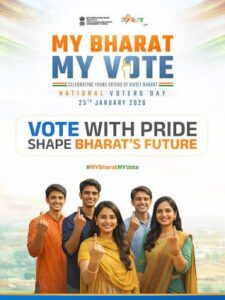
- The Election Commission of India (ECI) has launched campaigns to increase youth voter registration and polling turnout.
- Through the Systematic Voters’ Education and Electoral Participation (SVEEP) program, the ECI conducts registration drives directly on college and university campuses.
- Electoral Literacy Clubs (ELCs) have been set up in educational institutions across the country to teach students about voter registration, balloting procedures, and the importance of informed voting.
- Advance application processes now allow 17-year-olds to register in advance so they receive their voter ID cards immediately upon turning 18.
The Reality of “Instagram Residency”
- Campaign managers distinguish between a voter’s online presence and their real-world political actions.
- While young voters are active on social media platforms, political strategists refer to this as an “Instagram residency” that may not reflect actual voting behavior.
- Liking a political post, sharing a video, or participating in an online trend requires minimal effort compared to standing in line at a polling booth.
- Consequently, political parties remain hesitant to base their entire campaign strategy on online youth enthusiasm, choosing instead to focus resources on traditional ground-level mobilization.
The Influence of Narrow Electoral Margins
- In state assembly elections, a large proportion of seats are decided by small margins.
- In politically significant states like Uttar Pradesh, roughly 25% of assembly seats are won by voting margins of 5% or less.
- Because these margins are small, even a slight shift among young voters could alter the political outcome of an entire election.
- However, because young voters are split across local lines, political parties treat them as a factor to be managed rather than the sole driver of strategy.
Divergent State-Level Realities
- Uttar Pradesh: Youth priorities focus heavily on public sector recruitment schedules, administrative exam integrity, state-funded higher education, and moving from farm work to formal jobs.
- Punjab: Young citizens are focused on issues surrounding agricultural stability, local economic opportunities, substance abuse prevention, and securing visas for higher education and work opportunities abroad.
- Goa and Manipur: In smaller states like Goa, young voters focus on environmental preservation, sustainable tourism development, and local employment, while in Manipur, stability and social safety are primary concerns.
- Gujarat and Himachal Pradesh: In industrial states like Gujarat, youth issues center on private sector wage growth and entrepreneurship, whereas in Himachal Pradesh, state employment and pension systems remain top priorities.
The Lack of a National Platform
- Because state-level realities are so different, a young voter in an urban center in western India shares few political priorities with a young voter in a rural district in the north or east.
- National political parties struggle to create a single youth manifesto that appeals equally to all regions.
- Local issues, state-level governance, and regional leadership figures routinely play a larger role in shaping a young person’s vote than national youth policies.
The Primacy of Booth-Level Mobilization
- On election day, political parties rely on local booth management, door-to-door campaigning, and traditional social math to secure votes.
- Experienced political operatives understand that family networks, local community leaders, and caste alignments remain the most reliable ways to get voters to the polls.
- While parties adjust their messaging to include youth-friendly language, they rarely abandon proven community-based voter turnout models.
- Digital campaigns targeting Gen Z serve as a secondary strategy to support traditional ground campaigns rather than replace them.
‘Amrit Peedhi’ Vision Versus Immediate Polling Realities
- In official national policy narratives, India’s youth are referred to as the Amrit Peedhi—the generation responsible for driving the nation toward becoming a fully developed economy by 2047.
- Government literature highlights the long-term potential of young citizens in technology, research, space exploration, and economic manufacturing.
- In contrast, realpolitik focuses on immediate election cycles, short-term welfare promises, and local social equations.
- The challenge for Indian democracy lies in bridging the gap between this lofty 2047 national vision and the practical realities of local state elections.
Conclusion
- Drawing from Swami Vivekananda’s historic emphasis on the transformative power of young people, the potential of India’s youth remains undeniable.
- In an electoral context, this power is still taking shape rather than functioning as an established force.
- As literacy rates rise, digital connectivity spreads, and economic aspirations grow, young voters may gradually move past traditional identity divisions.
- Until that transformation occurs, political parties will continue to court the youth dynamic online while relying on proven, traditional voter mobilization strategies at the ballot box.
Mains UPSC Question GS 2
“Despite possessing the world’s largest youth population, India’s young voters have yet to consolidate into a unified electoral bloc. Critically analyze the socio-political factors responsible for this fragmentation, and examine how it influences youth-centric policymaking in the country.” (15 Marks | 250 Words)

