 India's No.1 PU & Degree With Integrated IAS & IPS(UPSC/PSC) Training College.


Before Rebuilding Delhi, a Warning from Gurugram
Before Rebuilding Delhi, a Warning from Gurugram
Syllabus:
-
GS – 3– Sustainable development of cities
Focus :
The article focuses on Delhi’s Master Plan 2047 and the challenges of infrastructure-led urbanisation. It examines higher-density development, redevelopment, affordable housing, transit-oriented growth, water security, drainage, green spaces and urban governance. Using Gurugram as a cautionary example, it highlights the need to ensure that public infrastructure, institutional coordination and climate resilience precede large-scale urban development.
Introduction
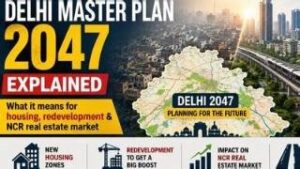
- Delhi is entering a crucial phase in its urban development. The Master Plan for Delhi 2047 (MPD-2047) proposes a major transformation of the capital over the next two decades.
- The plan seeks to accommodate a population of around 3.2 crore people, create approximately 40 lakh additional homes, and promote redevelopment and higher-density construction, particularly around public transport corridors.
- At first glance, these proposals represent a necessary shift in the way Delhi has traditionally expanded.
- The city has limited land, a rapidly growing population and an increasing demand for housing, employment, mobility and public services.
- Continuing to expand outward is neither practical nor sustainable. Redeveloping existing neighbourhoods and making better use of land is therefore unavoidable.
MPD-2047 and the Need for Urban Regeneration
- Delhi can no longer depend on outward expansion to meet its housing needs. Large quantities of vacant land within the city are limited, while the population continues to grow.
- The logical alternative is to regenerate existing neighbourhoods and use land more efficiently.
- MPD-2047 recognises this reality and proposes several important changes.
- Existing housing areas can be redeveloped at a smaller scale.
- Higher-density development can be encouraged near public transport.
- Unauthorised colonies can be brought into the formal urban system.
- Affordable and rental housing can receive greater attention.
- Integrated transport planning can improve mobility.
- Parking can be managed more systematically.
- Selected areas can support 24-hour economic and social activity.
- Mixed-use development can reduce the distance between homes, workplaces and services.
The Importance of Higher Floor Area Ratios
- MPD-2047 proposes higher Floor Area Ratios, or FAR, in several areas. FAR determines how much floor space can be constructed on a given plot of land.
- Increasing FAR allows more homes and commercial space to be created without proportionately increasing the city’s geographical footprint.
- Higher FAR is understandable in a land-constrained city such as Delhi. It can help accommodate a larger population, encourage redevelopment and support transit-oriented development.
- The danger is that planning authorities may calculate the capacity of the plot without adequately calculating the capacity of the surrounding city.
- A high-rise building may have enough internal infrastructure to serve its residents, but its residents still have to travel on public roads, use public drainage networks, obtain water from the wider system and depend on electricity infrastructure beyond the property boundary.
Gurugram’s Experience Offers a Warning
- Gurugram provides a useful example of what can happen when private construction advances faster than public infrastructure.
- The city has witnessed enormous development over the past few decades. Large gated communities, office complexes and commercial centres have transformed its skyline.
- Some of the most expensive residential developments are located along major roads such as Golf Course Road.
- Yet the presence of sophisticated private developments has not automatically produced equally sophisticated public infrastructure.
Delhi’s Water Challenge
- One of the biggest concerns surrounding MPD-2047 is water availability.The plan estimates that Delhi’s potable-water demand could rise to around 1,600 million gallons per day by 2047, compared with present availability of approximately 1,000 MGD.
- The proposed augmentation of around 401 MGD would still leave a potential shortfall of nearly 199 MGD.
- A city cannot sustainably accommodate millions of additional residents without a reliable water supply. Water shortages can directly affect households, industries, hospitals, schools and commercial establishments.
- The plan also expects a significant quantity of additional water from the Renukaji, Lakhwar and Kishau projects. However, these projects depend on interstate cooperation and are described in the plan itself as highly tentative.
- Urban development cannot be based entirely on infrastructure that may or may not become available in the future.
- The principle should therefore be straightforward: additional population capacity should be matched by assured infrastructure capacity.
Drainage Must Be Treated as Essential Infrastructure
- Water supply is only one side of the problem. Drainage is equally important.
- Delhi’s vulnerability to heavy rainfall and waterlogging has become increasingly visible.
- Rapid construction and the loss of natural drainage areas can increase runoff and put additional pressure on existing stormwater systems.
- MPD-2047 appears to contain some uncertainty regarding the applicable drainage framework. At one point, the plan refers to a Delhi Drainage Master Plan being under preparation.
- Elsewhere, it refers to implementing the Drainage Master Plan of the Irrigation and Flood Control Department.This ambiguity needs to be resolved.
- Before large-scale densification begins, Delhi should have a clearly established drainage strategy that reflects the population and density projections contained in MPD-2047.
Infrastructure Must Come Before Development
- MPD-2047 describes itself as an infrastructure-led plan. If that principle is to be meaningful, infrastructure must genuinely lead development rather than follow it.
- The land required for these facilities should also be identified in advance.
- A common mistake in urban development is to approve buildings first and attempt to solve infrastructure problems later.
- By that stage, the surrounding land may already have been developed, making it difficult or impossible to acquire the space needed for roads, drains, substations or public facilities.
- This creates a serious coordination problem. A master plan can establish where development should occur, but it cannot succeed unless the agencies responsible for implementing its infrastructure requirements work together.
- Earlier experience in Delhi demonstrates the difficulty. More than two decades ago, during administrative discussions concerning an earlier Master Plan, different departments dealing with water, sewerage, drainage and roads often operated independently of the Delhi Development Authority’s planning process.
- MPD-2047 has involved wider consultation and has engaged the principal implementing agencies. This is a positive development.
But consultation is not the same as coordination.
Redevelopment of Unauthorised Colonies
- The proposed regeneration of unauthorised colonies is both necessary and humane.
- Millions of people live in areas that have developed outside the formal planning system. Many buildings are old, overcrowded or poorly served by public infrastructure.
- Residents should not be indefinitely denied safe buildings, proper sewerage, drainage, roads and public facilities simply because the neighbourhood developed outside the formal planning framework.
- MPD-2047’s attempt to bring such areas into a planned redevelopment framework is therefore important.
- Many existing structures were constructed before effective structural, fire-safety and seismic standards were properly enforced. Increasing density without addressing these weaknesses could increase risks rather than reduce them.
- The objective should not merely be to replace old buildings with taller buildings. It should be to create safer and more liveable neighbourhoods.
Preventing the Growth of New Unauthorised Colonies
- Regenerating existing unauthorised colonies will have limited value if new unauthorised development continues to emerge.
- Delhi has experienced unauthorised construction for decades. Once such settlements become established, political, social and humanitarian pressures make enforcement increasingly difficult.
- These tools can significantly improve detection. But detection is not enforcement.
- The plan needs to establish a clear chain of responsibility. Without clear responsibility, technology alone will not solve the problem.
Green Spaces and Public Areas
- Delhi’s green spaces are unevenly distributed. Some neighbourhoods have substantial parks and open areas, while others are severely deficient.
- MPD-2047 recognises the importance of green-blue infrastructure, parks, walking and cycling. This is encouraging.
- However, as population density rises, the plan should provide clearer standards for residents’ access to usable neighbourhood green space.
- A city cannot measure quality of life merely by calculating the total number of hectares of green space. What matters to residents is whether they can actually reach a safe, usable park within a reasonable distance of their homes.
- These spaces provide: When land values rise, public open spaces face constant pressure. The planning system must therefore protect them firmly rather than treating them as residual land left after construction.
Parking Reform Alone Will Not Solve Congestion
- MPD-2047 also proposes reforms in parking management. This is important because unrestricted road parking consumes valuable public space.
- Roads designed for movement often become informal parking lots, while pavements are occupied by parked vehicles.
- However, parking reform will succeed only if it is accompanied by strong enforcement and better alternatives.
- If parking on public roads remains free or poorly regulated, residents may continue to use roads as private parking spaces.
- The objective should not simply be to build more parking spaces. It should be to reduce dependence on private vehicles wherever practical.
Public Transport Must Lead High-Density Development
- High-density development works best when it is closely connected to public transportation.
- The principle is simple: if many people live and work around reliable transit, fewer trips need to be made by private vehicles.
- Delhi already possesses a significant public transportation network, particularly its Metro system. MPD-2047’s emphasis on transport-oriented development can build on this foundation.
- However, public transport must be integrated with the entire journey.
- Walking, cycling, buses, metro services and other forms of mobility should therefore operate as parts of one system rather than as separate projects.
Affordable and Rental Housing
- One of MPD-2047’s strengths is its recognition of the importance of affordable and rental housing.
- Delhi’s housing demand is not limited to people who can purchase expensive apartments.
- Students, workers, migrants, young professionals, families and economically weaker households all require different forms of accommodation.
- Rental housing can provide flexibility to people who cannot or do not want to purchase property.
- Affordable housing can also reduce the pressure that pushes lower-income households toward distant peripheral areas.
A Stronger Accountability Framework Is Needed
- The success of MPD-2047 will ultimately depend less on the quality of its language and more on its implementation framework.
- A master plan can establish broad objectives, but implementation requires measurable responsibilities.
- The approval of additional construction capacity should be linked to measurable infrastructure milestones.
- This would change the approach from build first and upgrade later to upgrade first and then build.
How Should MPD-2047 Be Rated?
- MPD-2047 should be viewed as an important and necessary step forward, but it should not be considered complete simply because it identifies the right broad objectives.
- These shortcomings do not make the plan undesirable. They make its implementation more demanding.
The Central Lesson from Gurugram
- The most important lesson from Gurugram is that urban development cannot be measured by the number of buildings constructed.
- Private developers can build impressive structures, but many of these systems require public investment and coordinated government action.
- Gurugram’s experience shows that when construction moves faster than public infrastructure, the consequences eventually become visible through traffic congestion, waterlogging, inadequate drainage and pressure on civic services.
- Delhi has an opportunity to avoid repeating that pattern.
Building the City Beneath the Buildings
- The debate over MPD-2047 should therefore not be framed as a choice between development and no development.
- It needs more housing. It needs better buildings. It needs regeneration of old neighbourhoods.
- It needs affordable accommodation. It needs stronger public transport. It needs new economic centres and better use of land.
- The real question is how this development should be sequenced.
- Higher-density construction can be an effective solution to Delhi’s land constraints. But it must be accompanied by sufficient infrastructure.
- Before approving additional FAR, authorities should establish whether water, sewage, drainage, electricity, roads, transport and public facilities can support the resulting population.
Conclusion
- MPD-2047 presents Delhi with a significant opportunity. It recognises that the capital cannot continue to grow through endless outward expansion and that redevelopment, higher density and better use of public transport must form part of its future.
- The proposed reduction in the redevelopment threshold can make regeneration more practical. Higher FAR can create additional housing. Transit-oriented development can bring homes and jobs closer together.
- Rental housing can support a more mobile population. Regeneration of unauthorised colonies can improve the lives of millions of residents.
- Delhi must therefore learn from Gurugram before embarking on its next phase of construction.
- That is not an argument against builders, migrants, high-rise housing or redevelopment. It is an argument for doing development in the right order.
- If MPD-2047 can combine its ambitious vision for housing and redevelopment with firm infrastructure commitments, clear agency coordination, reliable funding, strict enforcement and measurable accountability, it can help Delhi become denser without becoming less liveable.
Mains UPSC Question GS 3
The experience of Gurugram demonstrates that rapid real-estate development without adequate public infrastructure can undermine urban sustainability. In the context of the Master Plan for Delhi 2047, critically examine the need for infrastructure-led and transit-oriented urban development in Indian cities. (15 marks, 250 words)

