 India's No.1 PU & Degree With Integrated IAS & IPS(UPSC/PSC) Training College.


Atmanirbhar Bharat: Path to Viksit Bharat
Atmanirbhar Bharat and Path to Viksit Bharat
Syllabus:
GS Paper – 3
Growth & DevelopmentGS
Paper – 2
Government Policies & Interventions
Why in the News ?
- On August 15, 2024, Prime Minister Narendra Modi addressed the nation from the Red Fort.
- He emphasized self-reliance (Atmanirbharta) as the foundation for building a Viksit Bharat by 2047.
- The speech focused on defence preparedness, energy independence, technological leadership, and “Vocal for Local” as guiding mantras for the next 25 years.
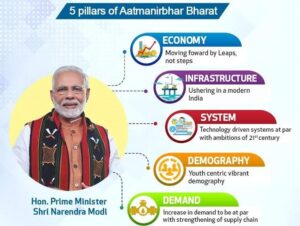
Importance of Atmanirbharta (Self-Reliance)
- Self-reliance is not only about imports and exports but about national capability.
- The PM stressed that dependency reduces freedom, whereas self-reliance enhances national confidence.
- The success of Operation Sindoor showcased how India’s indigenous defence capacity ensured swift retaliation against cross-border terrorism.
- Sectors emphasized:
- Defence manufacturing
- Energy security (solar, hydro, nuclear, hydrogen)
- MSMEs & local industries
- Semiconductors & technology-driven growth
- Defence manufacturing
Key government mission :● Atmanirbhar Bharat Abhiyan (2020) – ₹20 lakh crore package for self-reliance. ● Make in India (2014) – Boost manufacturing & FDI. ● National Solar Mission (2010) – Renewable energy expansion. ● National Hydrogen Mission (2021) – Green fuel initiative. ● Defence Procurement Procedure (DPP 2016, DAP 2020) – Indigenous procurement emphasis. ● Semiconductor Mission (2021) – $10 billion package for chip industry. ● Articles 19, 21, 301 – Link with economic freedom & self-reliance. ● Five-Year Plans & NITI Aayog – Frameworks for industrial and economic growth. |
National Security and Demography Concerns
- A High-Power Demography Mission announced to counter threats posed by illegal infiltration in border states.
- Concerns highlighted:
- Loss of youth employment due to infiltrators.
- Targeting of women and tribal communities by outsiders.
- Land grabbing and demographic imbalance, leading to potential national security crises.
- Linking demography with security reflects the government’s holistic approach to national integrity.
Energy Independence and Clean Energy Drive
- India spends lakhs of crores annually on fuel imports.
- Major strides in renewable and clean energy:
- Solar energy: 30-fold growth in the last 11 years.
- Hydropower: Expansion with new dams.
- Mission Green Hydrogen: Large-scale investment to reduce fossil fuel dependence.
- Nuclear power: 10 new reactors in progress, with capacity targeted to increase tenfold by 2047.
- Objective: Achieve energy self-reliance by the centenary of Independence.
Manufacturing and Technology Push
- Emphasis on National Manufacturing Mission to strengthen MSMEs.
- Vision: Zero Defect, Zero Effect → globally competitive products with high quality standards.
- Semiconductor sector:
- Idea existed 50–60 years ago but delayed.
- Now, 4 semiconductor units approved, marking India’s entry into the global tech race.
- Recognizing the 21st century as technology-driven, PM urged Indian youth to lead innovation.
Role of Society and Institutions
- Tribute to the Rashtriya Swayamsevak Sangh (RSS) for its 100 years of nation-building.
- Farmers recognized as pillars of food security, ensuring survival of independent India.
- Call for every trader, shopkeeper, and citizen to promote Swadeshi products → “Vocal for Local” should be a lifestyle mantra, not compulsion.
- Message: Collective responsibility in building a Viksit Bharat.
Challenges :
- Energy Dependency: Despite progress, India still imports large amounts of oil and gas.
- Defence Sector Gaps: Indigenous production is growing but reliance on imports for critical technology remains.
- Technology Backlog: Delay in adopting semiconductors and AI-based innovations hampers global competitiveness.
- MSME Constraints: Many small industries lack access to finance, global supply chains, and advanced tech.
- Demographic Issues: Illegal migration, uneven population growth, and pressure on border states threaten social harmony and national security.
- Climate Commitments: Balancing rapid industrialization with Paris Agreement goals poses a dilemma.
- Societal Mindset: People often prefer foreign brands over local products, slowing “Vocal for Local”.
- Policy Implementation: Previous policies show gaps between announcements and ground-level execution.
Way Forward :
- Energy Roadmap: Expand renewable mix (solar, wind, nuclear, hydrogen) to reduce fossil dependency.
- Defence Modernization: Incentivize private sector and startups in defence R&D for next-gen weapons.
- Semiconductor Push: Ensure fast execution of approved units; promote chip design & fabrication ecosystem.
- MSME Empowerment: Provide easy credit, skill training, and global market linkages.
- Border Security: Strengthen surveillance, fencing, and legal mechanisms against illegal migration.
- Technological Leap: Invest in AI, robotics, EVs, biotechnology for global competitiveness.
- Quality Standards: Establish strict testing and certification norms to push Indian goods into global supply chains.
- Public Participation: Campaigns to build consumer trust in Swadeshi products.
- Institutional Role: Strengthen institutions like NITI Aayog for long-term planning and mission-mode governance.
Conclusion :
India’s journey to Viksit Bharat by 2047 hinges on Atmanirbharta across defence, energy, technology, and manufacturing. The vision is not of isolation but of resilient self-reliance, ensuring sovereignty, security, and prosperity. Collective efforts of citizens, institutions, and government will decide whether India rises as a true global power.
Source :IE
Mains Practice Question :
“Atmanirbhar Bharat is not just an economic slogan but a strategic necessity for India’s security, energy independence, and global leadership. Discuss in the context of recent policy initiatives and challenges in achieving the vision of Viksit Bharat by 2047.”

