 India's No.1 PU & Degree With Integrated IAS & IPS(UPSC/PSC) Training College.


AstroRad Vest Boosts Astronaut Radiation Safety
AstroRad Vest May Improve Astronaut Radiation Protection
Why in the News ?
A recent Science Advances study found that NASA-tested AstroRad, a radiation-protection vest developed by StemRad and Lockheed Martin, could significantly reduce astronauts’ exposure to intense solar radiation during future lunar and Mars missions.
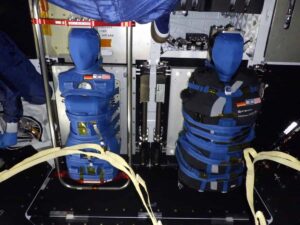
Radiation Challenge in Human Spaceflight
- Earth’s magnetic field protects humans from much of the harmful radiation in space. Beyond this protective field, astronauts face increased risks of cancer and other serious health effects.
- Conventional radiation protection relies on adding more shielding to spacecraft. However, every additional kilogram increases launch costs and makes it difficult to provide sufficient protection against powerful solar storms.
- AstroRad, developed by Israel-based StemRad with Lockheed Martin, offers a lighter and more targeted approach.
- Unlike conventional dense materials such as lead, the vest uses hydrogen-rich polymers, which are effective at slowing energetic particles through collisions.
- Greater protection is provided around the chest, abdomen and pelvis, where sensitive organs and large quantities of bone marrow are located.
- Astronauts tested the vest aboard the International Space Station (ISS) during 2019–20, providing feedback on comfort and functionality.
Significance for Future Lunar and Mars Missions
- AstroRad could enable astronauts to continue limited activities during solar storms, rather than remaining confined to heavily shielded shelters throughout the event.
- This could improve crew safety, mission flexibility and operational efficiency during long-duration missions.
- Targeted protection may help reduce the need for extremely heavy spacecraft-wide shielding, supporting more practical human exploration of the Moon and Mars.
- However, the vest primarily protects against solar particle radiation and does not adequately solve the challenge posed by galactic cosmic rays.
- Therefore, long-duration interplanetary missions will still require a combination of spacecraft shielding, radiation monitoring, forecasting, mission planning and protective habitats.
About Space Radiation and AstroRad Technology:● Solar radiation consists of energetic particles released by the Sun, particularly during solar flares and coronal mass ejections. ● Galactic cosmic rays (GCRs) originate outside the Solar System and are considerably more difficult to shield against. ● During NASA’s Artemis I mission in 2022, human-tissue-equivalent dummies named Helga and Zohar were equipped with radiation sensors. ● Zohar wore AstroRad, while Helga served as an unprotected comparison. ● Analysis published in Science Advances used Artemis I data to model the impact of historical solar storms. ● The study estimated that AstroRad could reduce effective radiation doses by about 60% during the August 1972 solar storm and 40% during the October 1989 storm. ● This represents approximately 193 and 131 fewer days of equivalent deep-space radiation exposure, respectively. |

