 India's No.1 PU & Degree With Integrated IAS & IPS(UPSC/PSC) Training College.


A Malacca–Singapore Model for Resolving Hormuz Crisis
A MALACCA-SINGAPORE MODEL FOR RESOLVING HORMUZ
Syllabus:
GS Paper – 2: Effect of Policies & Politics of Countries on India’s Interests
WHY IN THE NEWS ?
- Strategic Crisis: The ongoing Strait of Hormuz crisis has disrupted global energy and maritime security, reviving debates over cooperative arrangements for reopening critical chokepoints.
- Historical Parallel: The Malacca-Singapore Straits demonstrate how littoral states and major maritime powers can develop cooperative mechanisms balancing sovereignty with navigational freedom.
- Legal Framework: UNCLOS provides the concept of transit passage through international straits, offering an important legal reference for managing strategically significant waterways.
- Regional Cooperation: Discussions involving Iran, Oman and Gulf states have highlighted whether lessons from the Malacca-Singapore arrangement can contribute to resolving the Hormuz impasse.
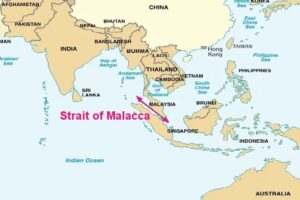
MALACCA-SINGAPORE STRAITS: GEOGRAPHY AND STRATEGIC SIGNIFICANCE
- Geographical Linkage: The Strait of Malacca extends approximately 800 km between the Malay Peninsula and Sumatra, connecting the Andaman Sea with the Strait of Singapore.
- Eastern Extension: The approximately 105-km Strait of Singapore connects the Malacca Strait with the South China Sea, creating an important maritime corridor linking the Indian and Pacific Ocean regions.
- Littoral States: Indonesia, Malaysia and Singapore constitute the principal littoral states, whose territorial waters significantly influence navigation and maritime governance.
- Strategic Chokepoint: The combined straits constitute a crucial global maritime artery because substantial commercial shipping and energy transportation pass between the Indian Ocean and East Asia.
- Territorial Waters: Their narrow geography means that 12-nautical-mile territorial seas of neighbouring states can meet, eliminating intervening areas of high seas or EEZ.
KEY LAW OF THE SEA AND INTERNATIONAL STRAITS:● Territorial Sea: Under UNCLOS, coastal states generally exercise sovereignty over territorial seas extending up to 12 nautical miles from their baselines. ● Transit Passage: Part III of UNCLOS establishes transit passage through straits used for international navigation connecting two areas of high seas or EEZs. ● Innocent Passage: Innocent passage permits navigation through territorial waters provided activities remain non-prejudicial to coastal-state peace, security and good order. ● Archipelagic Regime: UNCLOS Part IV recognises special rights and responsibilities of archipelagic states, including archipelagic waters and designated sea-lane passage. ● Strait Governance: International straits demonstrate the continuing balance between coastal-state sovereignty, navigational freedom, environmental protection and global maritime commerce. |
UNCLOS AND THE EVOLUTION OF TRANSIT PASSAGE
- Territorial Claims: Indonesia’s 1957 Archipelagic Declaration asserted extensive maritime jurisdiction around its islands, reflecting concerns regarding territorial integrity and external interference.
- Legal Innovation: During UNCLOS negotiations, the concept of transit passage emerged for straits connecting areas of high seas or exclusive economic zones.
- Transit Rights: Transit passage permits ships and aircraft to navigate continuously and expeditiously through qualifying international straits, extending beyond traditional innocent passage.
- Submarine Navigation: Unlike innocent passage, transit passage permits submarines to navigate in their normal mode, an important distinction for naval powers.
- Negotiating Balance: Indonesia accepted the transit-passage formulation with reservations after obtaining safeguards addressing its broader concerns regarding archipelagic security.
THE MALACCA MODEL: COOPERATION OVER INTERNATIONALISATION
- Regional Initiative: In 1971, Indonesia, Malaysia and Singapore proposed a coordinating arrangement, reflecting an attempt to manage the straits without complete internationalisation.
- External Cooperation: Japan supported cooperation through the Malacca Strait Council, demonstrating how user states can contribute to maritime safety without acquiring territorial control.
- Great-Power Interest: The United States and Soviet Union broadly supported continued navigational freedom because unrestricted maritime transit served wider strategic and commercial interests.
- Cooperative Mechanism: The 2007 Cooperative Mechanism brought littoral states, user states and industry together for navigation safety, environmental protection and maritime infrastructure.
- Financial Support: The Aids to Navigation Fund receives voluntary contributions for navigation aids, hydrographic surveys and safety projects without imposing tolls on ships exercising transit-passage rights.
STRAIT OF HORMUZ: SECURITY, SOVEREIGNTY AND GEOPOLITICS
- Geographical Parallel: The Strait of Hormuz similarly contains overlapping territorial waters of Iran and Oman, creating comparable legal and geographical complexities.
- Iranian Position: Iran’s 1993 legislation requires foreign warships to obtain authorisation for passage, creating continuing disagreement regarding navigational rights.
- Security Priority: Unlike Malacca-Singapore, where navigation and environmental safety dominated negotiations, Iran’s security concerns constitute a central dimension of the Hormuz dispute.
- Strategic Dependence: Hormuz is crucial for global energy security because it connects the Persian Gulf with the Gulf of Oman and wider maritime routes.
- External Constraint: Even if Gulf countries establish a mutually acceptable arrangement, acceptance by external powers, particularly the United States, remains an important geopolitical challenge.
WHY THE MALACCA MODEL CANNOT BE COPIED MECHANICALLY
- Different Contexts: The Malacca-Singapore settlement emerged alongside the development of UNCLOS, whereas Hormuz negotiations occur amid an acute security and geopolitical confrontation.
- Different Priorities: Malacca negotiations emphasised navigation safety, environmental protection and commercial shipping, while Hormuz involves deeper military and national-security concerns.
- Legal Divergence: Iran has not ratified UNCLOS, limiting the extent to which UNCLOS-based arrangements can automatically resolve its interpretation of navigational rights.
- Power Politics: The involvement of external military powers makes Hormuz substantially more geopolitically contested than the cooperative framework developed among Malacca’s littoral states.
- Trust Deficit: Successful maritime cooperation requires sustained confidence among stakeholders, whereas prolonged regional tensions create difficulties in establishing credible and mutually accepted security guarantees.
COOPERATIVE FRAMEWORK FOR HORMUZ: POSSIBLE POLICY RESPONSE
- Littoral Dialogue: Iran and Oman could strengthen direct maritime dialogue while involving other Gulf states in arrangements focused specifically on navigational safety.
- Shared Financing: A voluntary navigation and safety fund could finance hydrographic surveys, maritime communication systems, navigational aids and emergency-response capabilities.
- Traffic Management: A mutually accepted traffic separation scheme could reduce collision risks while facilitating predictable commercial movement through strategically congested waters.
- Security Guarantees: Any sustainable framework would require credible mechanisms addressing Iran’s security concerns alongside assurances protecting legitimate commercial and navigational interests.
- Inclusive Mechanism: A cooperative institution involving littoral states, user states and maritime industry could institutionalise consultations without unnecessarily undermining coastal-state sovereignty.
CHALLENGES IN ADAPTING THE MALACCA MODEL TO HORMUZ:
- Geopolitical Rivalry: Persistent tensions involving Iran, Gulf states and external military powers make sustained maritime cooperation considerably more difficult.
- Security Concerns: Iran’s emphasis on national security creates complications because navigational arrangements cannot be separated from broader regional military calculations.
- Legal Differences: Since Iran has not ratified UNCLOS, reliance solely on UNCLOS provisions may not provide a mutually accepted legal foundation.
- Trust Deficit: Years of confrontation and competing strategic interests can undermine confidence in monitoring arrangements, security guarantees and compliance mechanisms.
- External Acceptance: A regional agreement may remain ineffective if influential maritime powers reject its provisions or interpret navigational rights differently.
WAY FORWARD: BUILDING A COOPERATIVE HORMUZ
- Regional Dialogue: Iran and Oman could strengthen direct maritime negotiations while involving other Gulf states in narrowly defined navigational and safety arrangements.
- Safety Mechanism: A jointly administered maritime safety mechanism could coordinate navigation warnings, hydrographic surveys, emergency response and navigational infrastructure.
- Traffic Management: A mutually accepted traffic separation scheme could improve predictability and reduce collision risks without compromising legitimate navigational rights.
- Shared Financing: User states, shipping companies and international organisations could voluntarily finance aids to navigation and environmental protection.
- Security Assurance: Any durable framework should simultaneously address Iran’s security concerns, protect commercial shipping and establish transparent procedures for resolving maritime incidents.
CONCLUSION:
The Malacca-Singapore experience demonstrates that maritime chokepoints can be governed through cooperation, legal accommodation and shared responsibility without eliminating littoral-state sovereignty. However, Hormuz requires adaptation rather than replication because its geopolitical environment is fundamentally different. A durable arrangement would need to reconcile Iranian security concerns, navigational freedoms and global energy interests.
Source: TH
MAINS PRACTICE QUESTION:
The Malacca-Singapore Straits offer important lessons for resolving maritime disputes, but their institutional model cannot be mechanically replicated in the Strait of Hormuz. Critically examine the legal, strategic and geopolitical challenges involved and suggest a cooperative framework for ensuring freedom of navigation. (15 marks, 250 words)

