 India's No.1 PU & Degree With Integrated IAS & IPS(UPSC/PSC) Training College.


Article 371(K) for Ladakh Explained | UPSC & KPSC Current Affairs
WHAT IS ARTICLE 371(K), AND WHAT COULD IT MEAN FOR LADAKH?
Why in the News?
- The Centre has proposed the introduction of a new constitutional provision — Article 371K — for Ladakh.
- The proposed provision aims to provide special constitutional safeguards to protect Ladakh’s land, culture, environment and local interests.
- The proposal follows an “in-principle understanding” between the Ministry of Home Affairs (MHA) and representatives of the Apex Body, Leh (ABL) and Kargil Democratic Alliance (KDA).
- The proposal envisages a directly elected Union Territory-level body for Ladakh.
- This proposed body is expected to have legislative, executive, financial and planning powers.
- The development has brought renewed attention to Article 371 and its various forms of special constitutional arrangements for different states and regions of India.
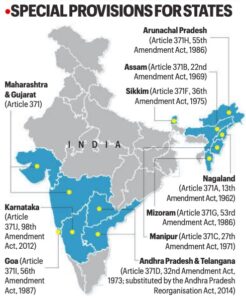
What is Article 371?
- Origin: Article 371 was not initially designed to provide special protection to the Northeastern or tribal regions.
- Post-Independence Context: After Independence, India comprised both:
- Former British-administered provinces, and
- Numerous princely states that had acceded to India under different historical and administrative conditions.
- Part B States: The Constitution placed several erstwhile princely states, such as Hyderabad, Mysore, Jammu & Kashmir and Rajasthan, under the category of Part B States.
- Need for Transitional Arrangement: Constitution-makers felt that these newly integrated states could not immediately be governed under exactly the same framework as the former British provinces.
- Original Article 371 (1950): It was therefore introduced as a transitional provision providing for greater Central supervision over the administration of Part B States.
- Presidential Control: The governments of Part B States were placed under the general control of the President for a period of 10 years, or for such shorter or longer period as Parliament could prescribe.
- States Reorganisation, 1956: The States Reorganisation Act and the Seventh Constitutional Amendment Act, 1956 abolished the classification of states into Part A, Part B and Part C and introduced a more uniform structure of States and Union Territories.
- Evolution of Article 371: The original Article 371 consequently ceased to operate in its earlier form. Article 371 was subsequently retained in a different form, providing special arrangements for Maharashtra and Gujarat.
- Present Purpose: The provision focuses particularly on equitable development and opportunities in specified regions, including Vidarbha and Marathwada in Maharashtra, and Saurashtra and Kutch in Gujarat.
How did Article 371 become associated with special protection?
- Flexible Constitutional Framework: The Constitution allows special arrangements for regions with distinct historical, social, cultural or political circumstances.
- Regional Needs: Over time, Parliament introduced different provisions under Article 371 (371A–371J) to address the specific concerns of particular States and regions.
- Different Forms of Protection: These provisions deal with issues such as:
- Customary laws and practices
- Land and natural resources
- Tribal administration
- Regional development
- Education and employment
- Law and order
- Political representation
- Not a Uniform Model: Each provision was created in response to a different historical or political context. Therefore, Article 371 does not provide the same type or level of protection to every State.
Nagaland — Article 371A
- Background: Naga political movements challenged the integration of Naga-inhabited areas with India.
- 16-Point Agreement (1960): The agreement paved the way for the creation of Nagaland as a separate State.
- Article 371A: Inserted through the 13th Constitutional Amendment, 1962.
- Key protections:
- Naga religious and social practices
- Customary laws and procedures
- Administration of civil and criminal justice according to customary law
- Ownership and transfer of land and its resources
- Parliamentary laws relating to these matters generally require the consent of the Nagaland Legislative Assembly to apply.
Assam — Article 371B
- Background: Assam had significant tribal and hill areas, many of which were already covered by the Sixth Schedule.
- Key concern: Providing greater political representation to tribal areas within the State.
- Article 371B: Inserted through the 22nd Constitutional Amendment, 1969.
- Provision: Enables the President to constitute a committee of the Assam Legislative Assembly consisting of members elected from the tribal areas specified under the Sixth Schedule.
- Purpose: To provide a distinct institutional mechanism for representation of tribal areas.
Manipur — Article 371C
- Background: Manipur’s tribal hill areas had distinct political and administrative concerns compared with the Imphal Valley.
- Article 371C: Introduced through the 27th Constitutional Amendment, 1971, when Manipur became a full State.
- Key provision: Provides for a Hill Areas Committee in the State Legislative Assembly.
- Governor’s role: The Governor has a special responsibility to report to the President on the administration of the hill areas.
- Purpose: To provide institutional protection and representation for the hill areas.
Andhra Pradesh & Telangana — Article 371D
- Background: Regional tensions between Telangana and Andhra led to political agitations.
- Six-Point Formula (1973): Sought to address concerns relating to education, public employment and regional development.
- Article 371D: Introduced through the 32nd Constitutional Amendment, 1973.
- Key provisions:
- Equitable opportunities in education
- Equitable opportunities in public employment
- Measures to address regional disparities
- Nature of protection: Unlike provisions focused primarily on ethnicity, culture or customary law, Article 371D mainly addresses regional equality and socio-economic opportunities.
Sikkim — Article 371F
- Background: Sikkim was earlier a separate political entity and was integrated into the Indian Union in 1975.
- Statehood: Sikkim became India’s 22nd State in 1975.
- Article 371F: Inserted through the 36th Constitutional Amendment, 1975.
- Purpose: To provide special constitutional arrangements for Sikkim’s transition and integration into the Indian Union.
- Significance: It contains provisions relating to the Legislative Assembly, representation and continuity of existing laws and arrangements.
Mizoram — Article 371G
- Background: The Mizo Peace Accord of 1986 between the Government of India and the Mizo National Front paved the way for Mizoram’s transition to statehood.
- Article 371G: Introduced through the 53rd Constitutional Amendment, 1986.
- Key protections:
- Mizo religious and social practices
- Customary laws and procedures
- Administration of civil and criminal justice according to customary law
- Ownership and transfer of land
- Special feature: Parliamentary laws relating to these matters generally require the consent of the Mizoram Legislative Assembly to apply.
Arunachal Pradesh — Article 371H
- Background: Arunachal Pradesh became a full-fledged State in 1987.
- Article 371H: Provides the Governor with a special responsibility with respect to law and order in the State.
- Key feature: The Governor may exercise individual judgment in matters concerning law and order, subject to the constitutional framework.
- Nature: Unlike Article 371A or 371G, the provision focuses primarily on special responsibility for law and order.
Goa — Article 371I
- Background: Goa became a State in 1987.
- Article 371I: Introduced through the 56th Constitutional Amendment, 1987.
- Key provision: The Goa Legislative Assembly must consist of not less than 30 members.
- Nature: Compared with several other Article 371 provisions, its special constitutional arrangement is relatively limited.
Karnataka — Article 371J
- Background: Certain regions of the then Hyderabad-Karnataka region faced concerns regarding regional backwardness.
- Article 371J: Added through the 98th Constitutional Amendment, 2012.
- Key provisions:
- Establishment of a development board for the region
- Equitable allocation of funds for development
- Reservation of opportunities in public employment
- Special provisions for education and vocational training
- Present terminology: The region is now officially known as Kalyana Karnataka.
In essence
Article 371 evolved from a transitional constitutional provision into a broader framework for accommodating India’s regional diversity. Its different clauses were introduced at different times and address very different concerns—from customary law and land protection in Nagaland and Mizoram to regional development in Karnataka and law-and-order arrangements in Arunachal Pradesh.
Article 371K and Ladakh
- New Constitutional Proposal: Ladakh is seeking a new Article 371K, as its demands do not fit neatly within the existing special provisions under Article 371.
- Unique Context: Unlike most regions covered by Articles 371A–371J, Ladakh is a Union Territory without a legislature. The proposed framework would therefore create a special governance structure specifically suited to its status.
- Directly Elected Body: The proposal envisages a directly elected Union Territory-level body.
- Proposed Powers: The body is expected to have significant:
- Legislative powers
- Executive powers
- Budgetary powers
- Planning powers
- Financial powers
- Subjects under its Jurisdiction: According to the proposal, the body could have powers over:
- Land
- Culture and language
- Forests
- Environment
- Natural resources
- Other subjects currently reserved for the Union Territory under Article 240.
- Demand for Law & Order: Ladakh’s representatives have also sought control over law and order.
- This is notable because Article 371H gives the Governor special responsibility for law and order in Arunachal Pradesh.
- In Ladakh’s proposed model, the demand is instead for greater authority with the elected local institution.
- Land Protection: The demand for protection of land and customary practices has similarities with Articles 371A (Nagaland) and 371G (Mizoram).
- These provisions provide special protection to customary laws, practices and land-related matters.
- Certain Parliamentary laws concerning these subjects do not automatically apply without the required State-level consent.
- What Makes Ladakh Different?
- The Ladakh proposal combines constitutional protection of land, culture and natural resources with a demand for a substantial elected governing institution having legislative, executive and financial powers.
- Thus, the proposed Article 371K would potentially combine elements found across several existing Article 371 provisions into a framework specifically designed for a Union Territory without a legislature.
What will be written into Article 371K?
- Extent of Protection: The actual strength of Article 371K will depend on the powers and safeguards ultimately incorporated into the provision.
- Basic Model: If Article 371K only:
- Establishes an elected body, and
- Specifies the subjects on which it can legislate,
its constitutional protection would be relatively limited.
- Experience of Manipur: The experience of Article 371C is relevant here. The Hill Areas Committee was created to provide institutional protection to the hill areas, but concerns have been raised that it has not provided sufficient meaningful autonomy.
- Stronger Model for Ladakh: Article 371K could provide stronger safeguards if the proposed elected body receives constitutional authority over:
- Land
- Natural resources
- Recruitment
- Local administration
- Law & Order and Bureaucracy: If the provision also places law and order and the local bureaucracy under the elected executive, the proposed Ladakh government would have substantially greater executive authority.
- Key Issue: Therefore, the significance of Article 371K would depend not merely on creating an elected institution, but on how much constitutional authority and protection is actually given to that institution.
Source: https://indianexpress.com/article/explained/ladakh-article-371-k-constitutional-safeguards-10871064/
Mains question
Discuss the evolution of Article 371 as an instrument of asymmetric federalism. Examine how the proposed Article 371K could address Ladakh’s demands for constitutional safeguards and greater self-governance. (150 words)

