 India's No.1 PU & Degree With Integrated IAS & IPS(UPSC/PSC) Training College.


India’s Green Law: Baselines, Not Snapshots
INDIA’S GREEN LAW NEEDS BASELINES, NOT SNAPSHOTS
SYLLABUS:
- GS-2: Statutory bodies, judicial interventions, environmental governance and accountability.
- GS-3: Environmental conservation, pollution, degradation, environmental impact assessment and sustainable development.
- GS-4: Environmental ethics, accountability, public trust and intergenerational equity.
WHY IN THE NEWS?
- Supreme Court Verdict:On August 22, the Supreme Court set aside the NGT’s December 2017 judgment holding organisers of the 2016 World Culture Festival responsible for damage to the Yamuna floodplain.
- Financial Relief: The Court directed the refund of the ₹5 crore environmental compensation deposited by the organisers.
- Legal Debate: The judgment highlighted the importance of proving responsibility for environmental damage before imposing liability under the Polluter Pays Principle.
- Governance Gap: The case exposed the absence of systematic baseline environmental surveys before public land is allotted for large events or other activities.
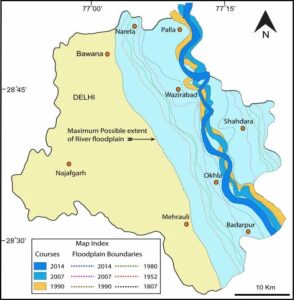
YAMUNA FLOODPLAIN CASE: BACKGROUND AND KEY DEVELOPMENTS
- World Culture Festival: The event was organised from March 11–13, 2016, across approximately 25 hectares of active Yamuna floodplain in Delhi.
- NGT Intervention: On March 9, 2016, the National Green Tribunal allowed the event subject to a ₹5 crore deposit and the organisers bearing restoration costs if damage was established.
- Earlier Degradation: An April 2014 expert report and subsequent NGT proceedings had already indicated serious degradation of the concerned floodplain.
- Conflicting Findings: A committee initially described extensive damage but later stated that it could not assess the site’s ecological condition before the event.
- Supreme Court Decision: The Court found that the NGT had not adequately established additional damage attributable to the organisers and set aside its 2017 judgment.
KEY ENVIRONMENTAL LAW AND PRINCIPLES:● National Green Tribunal Act, 2010: Establishes the NGT for effective and expeditious disposal of environmental disputes; Sections 15 and 17 deal with relief, restitution and liability. ● Polluter Pays Principle: Makes the party responsible for pollution bear the costs of environmental damage and remediation. ● Precautionary Principle: Requires preventive measures against potential environmental harm even where complete scientific certainty is unavailable. ● Public Trust Doctrine: Recognises that the State is a trustee of natural resources and must protect them for public use and future generations. ● Article 21: The Supreme Court has interpreted the right to life to include the right to a clean and healthy environment. |
POLLUTER PAYS PRINCIPLE AND ENVIRONMENTAL LIABILITY
- Core Principle: The Polluter Pays Principle requires those responsible for environmental pollution or damage to bear the cost of preventing, controlling and remedying it.
- Attribution Requirement: Environmental liability must be connected to identifiable activities and responsible parties rather than imposed merely because someone occupied a particular site.
- Supreme Court Recognition: The principle was recognised in cases such as Indian Council for Enviro-Legal Action v. Union of India (1996).
- Environmental Justice: It prevents the financial burden of environmental degradation from being transferred to taxpayers and affected communities.
- Legal Limitation: Where several activities contribute to damage, determining individual responsibility becomes difficult and requires scientific evidence and appropriate apportionment.
NATIONAL GREEN TRIBUNAL ACT AND SECTION 17(2)
- Section 15: Empowers the NGT to provide relief, compensation and restitution of damaged property and the environment.
- Section 17(1): Deals with liability for compensation or relief where death, injury or damage results from an accident or other specified environmental circumstances.
- Section 17(2): Provides for equitable apportionment of liability when environmental damage results from the combined effect of several activities and cannot be attributed to one activity alone.
- Missed Legal Mechanism: The Supreme Court reproduced Section 17 but did not substantially examine why Section 17(2) could not address the difficulty of determining additional damage.
- Restoration versus Upgrade: Restoration seeks to return an environment to its previous condition, whereas an ecological upgrade improves it beyond that baseline. Section 15 supports restitution rather than an unrelated improvement project.
BASELINE ENVIRONMENTAL DATA: IMPORTANCE AND LIMITATIONS
- Meaning of Baseline: Baseline data records the environmental condition of a site before a proposed activity or intervention begins.
- Scientific Parameters: It includes soil density, water absorption, land elevation, vegetation, wetlands, biodiversity and water bodies.
- Causal Assessment: Comparing baseline conditions with post-activity observations helps identify additional environmental damage attributable to a particular activity.
- Evidence Reliability: Satellite images, photographs and site inspections must be supported by reliable dates, methods and scientific verification.
- Administrative Accountability: Jointly signed surveys by the land-allotting authority and the recipient can prevent later disputes about the original condition of public land.
EVIDENCE, SCIENTIFIC ASSESSMENT AND JUDICIAL SCRUTINY
- First Committee’s Findings: The initial committee reported serious floodplain damage, but later questioned its ability to establish the site’s pre-event ecological condition.
- Second Committee’s Report: A committee constituted in July 2017 reported grass, standing water, absence of debris and no significant soil compaction.
- Weak Satellite Evidence: The comparison of Google Earth images was problematic because the September 2015 image had already been considered unreliable by the Court.
- Scientific Verification: Soil compaction, water absorption and changes in land levels require engineering tests and measurable comparisons, not merely visual inspection.
- Missing Documentation: Construction contracts, earth-filling bills, machinery logs and compaction specifications could have helped establish the extent of damage caused by preparatory work.
ENVIRONMENTAL GOVERNANCE AND PROTECTION OF COMMONS
- Degraded Commons: Poorly protected public resources such as rivers, wetlands and forests become more vulnerable to further exploitation when their original condition is undocumented.
- Administrative Failure: Authorities must ensure that environmental safeguards are implemented before granting permission for activities on ecologically sensitive land.
- Precautionary Principle: Preventive action should be taken where activities pose a risk of serious or irreversible environmental damage, even when scientific certainty is incomplete.
- Public Trust Doctrine: The State holds natural resources such as rivers and floodplains in trust for the public and future generations.
- International Precedent: In the 2018 Costa Rica–Nicaragua compensation case, the International Court of Justice awarded compensation despite uncertainty about the precise earlier condition of the damaged environment.
CHALLENGES:
- Absence of Baselines: Environmental damage becomes difficult to quantify when the original condition of a site is not scientifically documented.
- Cumulative Damage: Multiple activities over several years make it difficult to identify the contribution of each responsible party.
- Weak Monitoring: Inadequate inspections, unreliable photographs and inconsistent committee reports weaken environmental adjudication.
- Institutional Delays: Prolonged litigation and delayed restoration allow environmental degradation to continue without timely accountability.
- Misuse of Degradation: Existing damage may become a convenient defence for further exploitation, allowing new environmental injuries to escape liability.
WAY FORWARD:
- Mandatory Surveys: Conduct scientific baseline surveys before allotting floodplains, wetlands, forests or other ecologically sensitive public land.
- Joint Certification: Require the land-allotting authority and the recipient to jointly sign and certify baseline records, including photographs and scientific measurements.
- Scientific Audits: Use independent experts, standardised testing methods and transparent monitoring to assess environmental damage.
- Liability Apportionment: Apply Section 17(2) of the NGT Act wherever multiple activities contribute to environmental harm, with liability distributed on an equitable and evidence-based basis.
- Time-Bound Restoration: Establish clear deadlines for environmental assessment, compensation and restoration, with regular compliance monitoring by responsible authorities.
CONCLUSION:
The Yamuna floodplain verdict reinforces an essential principle: environmental liability must be based on demonstrable responsibility. However, accountability cannot disappear because the original condition of a degraded site was never recorded. Mandatory baseline surveys, scientific evidence and effective use of Section 17(2) can make India’s environmental law more credible and enforceable.
SOURCE: The Indian Express
MAINS PRACTICE QUESTION:
“Effective environmental governance requires scientific baseline data to establish accountability for ecological damage.” Discuss in the context of the Yamuna floodplain case. Examine the role of the Polluter Pays Principle and Section 17(2) of the National Green Tribunal Act, 2010.

