 India's No.1 PU & Degree With Integrated IAS & IPS(UPSC/PSC) Training College.


Cyclone Akvan May Intensify Before Landfall
CYCLONIC STORM AKVAN MAY INTENSIFY BEFORE LANDFALL
WHY IN THE NEWS ?
- Cyclonic Storm Akvan, currently over the Bay of Bengal, is forecast to intensify into a severe cyclonic storm by November 19 and a very severe cyclonic storm by November 20.
- It may cross the Andhra Pradesh–Yanam coast with winds reaching 130 kmph.
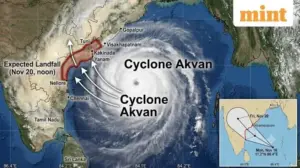
CURRENT POSITION AND EXPECTED TRACK OF AKVAN:
- Current Location: Akvan has remained nearly stationary for nine hours over the central parts of the South and adjoining West-Central Bay of Bengal.
- Distance from Chennai: The storm is located approximately 610 km east of Chennai.
- Regional Proximity: Its reported position is around 630 km northeast of Trincomalee (Sri Lanka), 670 km southeast of Visakhapatnam (Andhra Pradesh) and 790 km south of Gopalpur (Odisha).
- Direction of Movement: The cyclone is expected to move in a north-northwestward direction, potentially bringing it closer to the eastern coastline.
- Intensification: It is forecast to become a severe cyclonic storm by November 19, followed by further intensification on November 20.
EXPECTED LANDFALL AND POTENTIAL IMPACTS
- Landfall Forecast: Akvan is expected to cross the Andhra Pradesh and Yanam coasts between Nellore and Tuni around noon on November 20.
- Wind Speed: At landfall, wind speeds may reach 120–130 kmph, with gusts of up to 145 kmph.
- Rainfall Warning: Light to moderate rainfall, with heavy rainfall at isolated locations, has been forecast over North Tamil Nadu until November 19.
- Coastal Risks: Strong winds and heavy rainfall may cause coastal flooding, damage to houses and infrastructure, uprooting of trees and disruption of transport and power supply.
- Disaster Preparedness: Coastal authorities need to strengthen evacuation arrangements, cyclone shelters, early-warning dissemination and emergency response systems.
ABOUT TROPICAL CYCLONES AND DISASTER MANAGEMENT:● Formation: Tropical cyclones develop over warm ocean waters, generally requiring sea-surface temperatures of around 26.5°C or higher, sufficient moisture and favourable atmospheric conditions. ● Coriolis Force: Earth’s rotation gives cyclones their rotational movement; they generally do not form directly over the equator. ● Bay of Bengal: It is highly vulnerable to cyclones due to warm waters, favourable atmospheric conditions and coastal population exposure. ● IMD Classification: The India Meteorological Department classifies cyclonic systems based on sustained wind speeds, ranging from depression to super cyclonic storms. ● Disaster Management: The Disaster Management Act, 2005, NDMA, NDRF and IMD play important roles in cyclone preparedness, forecasting, evacuation and relief operations. |

