 India's No.1 PU & Degree With Integrated IAS & IPS(UPSC/PSC) Training College.


5 New Marine Nematodes Found in Kerala
FIVE NEW MARINE NEMATODE SPECIES DISCOVERED ALONG KERALAM COAST
WHY IN THE NEWS ?
- Scientific Discovery: Researchers from the University of Kerala have discovered five new species of free-living nematodes in mangrove sediments along the Kerala coast.
- Research Significance: The discovery marks the first confirmed record of the genus Pseudochromadora in the Arabian Sea, expanding knowledge of marine biodiversity.
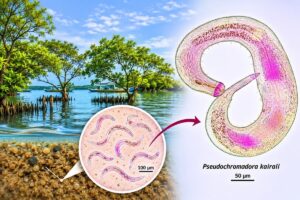
DISCOVERY OF FIVE NEW NEMATODE SPECIES:
- Research Institution: Scientists from the Department of Aquatic Biology and Fisheries, University of Kerala, conducted the research along the mangrove ecosystems of Kerala.
- New Species: Researchers identified five previously unknown species of free-living marine nematodes, adding new organisms to scientific biodiversity records.
- First Regional Record: The study documented the first confirmed occurrence of the nematode genus Pseudochromadora in the Arabian Sea.
- Research Publication: The findings were published in the international scientific journal Marine Biodiversity, published by Springer Nature.
- Research Gap: The study highlights that species-level identification and documentation of marine nematodes remain limited, indicating the need for further taxonomic research.
ECOLOGICAL SIGNIFICANCE OF MARINE NEMATODES
- Basic Characteristics: Nematodes are microscopic, elongated, cylindrical roundworms that generally measure only a few millimetres in length.
- Free-Living Nature: The newly discovered species are free-living, meaning they survive independently rather than depending on other organisms as parasites.
- Sediment Habitat: Marine nematodes are abundant in marine and estuarine sediments, particularly in ecologically productive habitats such as mangroves.
- Nutrient Cycling: They contribute to the decomposition of organic matter and facilitate nutrient recycling, supporting the functioning of aquatic ecosystems.
- Ecosystem Health: Their presence and diversity can provide useful information about sediment conditions and changes in marine environmental quality.
ABOUT NEMATODES AND MANGROVE ECOSYSTEMS:● Nematodes: Nematoda is a major phylum of roundworms found in marine, freshwater and terrestrial environments. Some species are free-living, while others are parasitic. ● Mangroves: Mangroves are salt-tolerant trees and shrubs growing in tropical and subtropical coastal intertidal regions. ● Ecological Functions: Mangroves protect coastlines from erosion, act as carbon sinks, support fisheries and provide breeding and nursery habitats for marine organisms. ● Indian Distribution: Major mangrove regions in India include the Sundarbans, Bhitarkanika, Mahanadi delta, Godavari-Krishna delta, Pichavaram and Gulf of Kachchh. ● Conservation Importance: Mangroves are threatened by coastal development, pollution, aquaculture expansion, habitat destruction and climate change. Their conservation is essential for marine biodiversity and coastal resilience. |

