 India's No.1 PU & Degree With Integrated IAS & IPS(UPSC/PSC) Training College.


Gravitational Wave Astronomy: Statistical Era
GRAVITATIONAL WAVE ASTRONOMY ENTERS ITS STATISTICAL ERA
WHY IN THE NEWS ?
- New Development: Gravitational-wave astronomy is entering a statistical era as improved detectors collect data on hundreds of black-hole mergers.
- New Catalogue: An international scientific collaboration released an expanded catalogue containing 390 candidate events, helping researchers understand black-hole populations, their formation and evolution, and test Einstein’s General Theory of Relativity.
GRAVITATIONAL WAVES: CONCEPT AND RECENT DEVELOPMENTS:
- Basic Concept: Gravitational waves are ripples in spacetime produced when massive objects, such as black holes and neutron stars, accelerate rapidly.
- Scientific Detection: These waves were first directly detected in 2015 by the Laser Interferometer Gravitational-Wave Observatory (LIGO), confirming an important prediction of Einstein’s General Theory of Relativity.
- Major Observation: On January 14, 2025, LIGO detected signal GW250114, generated by the merger of two black holes approximately 34 and 32 times the Sun’s mass, located around 1.3 billion light-years away.
- Expanded Catalogue: Released on May 26, the latest catalogue contained 390 candidate events, including 161 new detections recorded between April 2024 and January 2025 by LIGO, Virgo and KAGRA.
- Statistical Era: Large datasets now enable scientists to identify patterns in black-hole masses, spins and formation mechanisms rather than studying individual gravitational-wave events alone.
SCIENTIFIC SIGNIFICANCE AND FUTURE DEVELOPMENTS
- Chirp Signal: As two black holes approach each other, their orbital speed and gravitational-wave frequency increase, producing a rising signal called a chirp.
- Ringdown Phase: After merging, the newly formed black hole settles into a stable state by emitting characteristic waves called ringdown, similar to the fading sound of a struck bell.
- Einstein’s Theory: Analysis of 168 gravitational-wave signals found no disagreement with General Relativity, strengthening confidence in its predictions under extreme gravitational conditions.
- Black-Hole Formation: Research indicates different formation pathways, including binary star evolution, interactions within dense star clusters and repeated black-hole mergers.
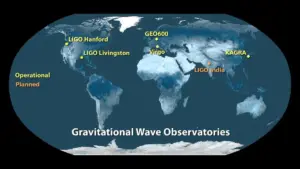
- Future Infrastructure: LIGO-India, proposed in Hingoli district of Maharashtra, is expected to improve source localisation. Its first observation run is planned for 2030. The proposed space-based LISA mission will detect lower-frequency gravitational waves.
ABOUT GRAVITATIONAL WAVES AND DETECTION:● General Relativity: Albert Einstein predicted gravitational waves in 1916 through his General Theory of Relativity, which describes gravity as the curvature of spacetime caused by matter and energy. ● LIGO: The Laser Interferometer Gravitational-Wave Observatory uses laser interferometry to detect extremely tiny changes in distance caused by passing gravitational waves. ● International Network: Major ground-based observatories include LIGO (USA), Virgo (Italy) and KAGRA (Japan). ● Neutron Stars: Gravitational waves can originate from merging neutron stars, offering insights into the properties and compressibility of extremely dense matter. ● Cosmological Importance: Gravitational-wave observations can help estimate the Hubble constant, understand cosmic expansion and investigate the evolution of galaxies and black holes. |

