 India's No.1 PU & Degree With Integrated IAS & IPS(UPSC/PSC) Training College.


Turning Battery Waste Into Mineral Wealth
TURNING BATTERY WASTE INTO STRATEGIC MINERAL WEALTH
SYLLABUS:
GS-2: Government Policies and Interventions, International Relations and Strategic Partnerships,India and Global Resource Security
GS-3: Science and Technology,Environmental Pollution and Degradation,Conservation of Natural Resources,Waste Management,Infrastructure and Industrial Development,Circular Economy
WHY IN THE NEWS?
At the 18th BRICS Summit in New Delhi on September 13, 2026, Prime Minister Narendra Modi highlighted concerns regarding the weaponisation of technology and critical minerals. With more than 8.7 million electric vehicles (EVs) operating on Indian roads in FY 2025–26, the increasing volume of discarded lithium-ion batteries presents an opportunity to recover valuable minerals, reduce import dependence and strengthen India’s strategic resource security.
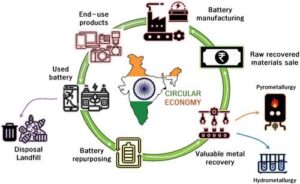
CRITICAL MINERALS AND INDIA’S STRATEGIC RESOURCE SECURITY
- Critical Minerals: Critical minerals are naturally occurring resources essential for economic development, national security and technological advancement, whose supply is vulnerable to geographical concentration and geopolitical disruptions.
- Key Minerals: Lithium, nickel and cobalt are important minerals used in lithium-ion batteries, electric vehicles, renewable energy storage systems and advanced electronics.
- Geopolitical Dependence: Global supplies of critical minerals and their processing facilities are concentrated in a limited number of countries, with China dominating several critical mineral processing supply chains.
- Import Vulnerability: India’s dependence on imported critical minerals exposes domestic industries to international price fluctuations, export restrictions, geopolitical tensions and supply-chain disruptions.
- Strategic Significance: Securing critical minerals is essential for India’s energy transition, electric mobility, manufacturing competitiveness and technological self-reliance.
GROWING ELECTRIC VEHICLE MARKET AND BATTERY WASTE GENERATION
- EV Expansion: India had more than 8.7 million electric vehicles operating on its roads by FY 2025–26, reflecting the growing adoption of electric mobility.
- Battery Demand: Increasing EV adoption, renewable energy storage and electronic device consumption are generating greater demand for lithium-ion batteries and their constituent minerals.
- End-of-Life Batteries: Lithium-ion batteries eventually lose their performance and become unsuitable for their original applications, creating a growing stream of end-of-life (EoL) batteries.
- Resource Opportunity: Discarded batteries contain economically valuable materials such as lithium, nickel and cobalt, which can be recovered and reused in manufacturing.
- Waste-to-Wealth Potential: Treating spent batteries as secondary mineral resources rather than ordinary waste can create domestic economic value, reduce environmental damage and strengthen resource security.
BATTERY RECYCLING AND THE CIRCULAR ECONOMY
- Circular Economy: A circular economy aims to minimise waste and maximise resource utilisation through reuse, repair, refurbishment, recycling and recovery of valuable materials.
- Mineral Recovery: Battery recycling enables the extraction of valuable metals from discarded batteries, reducing the need for fresh mineral extraction and dependence on imported raw materials.
- Black Mass: The recycling process often produces an intermediate material called black mass, which contains valuable battery metals and requires further processing to recover individual minerals.
- Resource Efficiency: Recovered minerals can be reintroduced into battery manufacturing, reducing pressure on natural resources and improving the long-term sustainability of industrial production.
- Economic Benefits: A domestic battery recycling ecosystem can generate employment, encourage technological innovation, attract investment and create new business opportunities in the green economy.
INDIA’S BATTERY RECYCLING POTENTIAL AND EXISTING GAPS
- Import Substitution: Analysis cited in the article suggests that battery recycling could meet approximately 10–12% of India’s lithium demand for electric vehicle battery manufacturing.
- Informal Recycling: Batteries from mobile phones and other electronic devices frequently enter informal recycling channels or landfills, resulting in the loss of valuable minerals.
- Recovery Inefficiency: Informal recycling methods reportedly recover only around 10–20% of valuable materials, compared with recovery rates exceeding 90% in formal recycling facilities.
- Environmental Risks: Unsafe manual dismantling and improper disposal can expose workers and surrounding communities to hazardous substances, chemical leakage and environmental contamination.
- Processing Deficiency: India needs greater domestic capacity to process black mass into high-purity individual minerals rather than depending primarily on intermediate products or imported processed materials.
POLICY FRAMEWORK: BATTERY WASTE MANAGEMENT RULES, 2022
- Regulatory Foundation: India’s Battery Waste Management Rules, 2022, establish a regulatory framework for the environmentally sound management and recycling of waste batteries.
- Extended Producer Responsibility: The rules introduce Extended Producer Responsibility (EPR), making battery producers responsible for ensuring the collection, recycling and environmentally sound management of batteries after their useful life.
- Recycling Obligations: Producers are required to meet prescribed recycling and recovery obligations through authorised recycling and refurbishment mechanisms.
- Formalisation of Industry: The framework encourages the development of registered recycling facilities, improved waste tracking and greater accountability across the battery value chain.
- Implementation Gaps: Despite the regulatory foundation, inadequate collection systems, limited processing capacity, financing constraints and the continued dominance of informal recycling prevent the full realisation of India’s battery recycling potential.
CHALLENGES IN DEVELOPING INDIA’S BATTERY RECYCLING ECOSYSTEM
- Technological Complexity: Different lithium-ion battery chemistries require different recycling processes, making mineral extraction technically challenging and increasing processing costs.
- Economic Viability: High initial investment, uncertain feedstock availability and long gestation periods can make recycling facilities financially unattractive, particularly during the early stages of EV adoption.
- Collection Infrastructure: The absence of accessible collection centres, organised transportation and effective take-back systems makes it difficult to bring retired batteries into formal recycling channels.
- Quality and Standardisation: Inadequate standards for battery characterisation, recycled mineral purity and second-life applications can affect the reliability and commercial acceptance of recovered materials.
- Informal Sector Dependence: The widespread presence of informal waste collectors and unsafe recycling practices creates difficulties in ensuring efficient recovery, worker safety, environmental protection and traceability.
STRATEGIC AND ECONOMIC SIGNIFICANCE OF BATTERY RECYCLING
- Supply Chain Resilience: Recovering critical minerals domestically can provide India with an additional source of raw materials and reduce vulnerability to international supply-chain disruptions.
- Strategic Autonomy: A domestic recycling ecosystem can strengthen India’s ability to meet its mineral requirements without excessive dependence on a limited number of foreign suppliers.
- Industrial Development: Investment in battery recycling can create new industries involving mineral processing, chemical engineering, battery refurbishment and advanced manufacturing.
- Environmental Sustainability: Recycling reduces the demand for fresh mining, conserves natural resources, minimises landfill waste and supports responsible management of hazardous battery materials.
- Energy Transition: Recovered minerals can support domestic EV manufacturing and renewable energy storage, contributing to India’s clean energy transition and long-term climate commitments.
WAY FORWARD: BUILDING A CIRCULAR BATTERY ECONOMY
- Strategic Resource Planning: Recycled critical minerals should be incorporated into India’s proposed national critical mineral stockpile. Mandating an appropriate share of recycled materials can create predictable demand and encourage investment in domestic recycling facilities.
- Research and Development: Government institutions, industries and research laboratories should invest in advanced recycling technologies capable of achieving higher mineral recovery rates, greater purity and lower environmental impacts across different battery chemistries.
- Quality Standardisation: India should establish uniform standards for battery characterisation, recycled mineral quality and second-life applications. Manufacturers should adopt a Design for Recycling and Repurposing approach to facilitate easier recovery of valuable materials.
- Efficient Collection Mechanism: EV manufacturers, dealerships and service networks should introduce attractive battery take-back and buy-back programmes. Accessible collection centres and public awareness campaigns can encourage consumers to return retired batteries through authorised channels.
- Financial and Institutional Support: Government should provide patient capital, financial incentives, concessional financing and policy certainty to recyclers. Investment should begin ahead of the expected surge in end-of-life batteries to develop adequate processing capacity and logistics infrastructure.
CONCLUSION:
Battery recycling represents an important opportunity for India to transform an emerging waste-management challenge into a strategic mineral resource. Although recycling cannot eliminate import dependence, it can provide a valuable secondary source of lithium, nickel and cobalt. By strengthening technology, infrastructure, regulation and investment, India can establish a circular battery economy that supports environmental sustainability, industrial development and national resource security.
SOURCE:TH
MAINS PRACTICE QUESTION:
“Battery recycling can transform India’s growing electric vehicle waste into a strategic resource for strengthening critical mineral security.” Examine the potential of battery recycling in reducing import dependence, discuss the challenges facing India’s recycling ecosystem and suggest measures to establish a sustainable circular battery economy.

