 India's No.1 PU & Degree With Integrated IAS & IPS(UPSC/PSC) Training College.


Marfan Syndrome: Causes, Signs & Aortic Risk
MARFAN SYNDROME: GENETIC CONNECTIVE-TISSUE DISORDER AND AORTIC RISK
Why in the News?
Researchers have recently published the first molecular characterization of Marfan syndrome in domestic cats, providing a new animal model for understanding the genetic and molecular mechanisms of this inherited connective-tissue disorder. The development may support future research into disease mechanisms, diagnosis and therapeutic approaches.
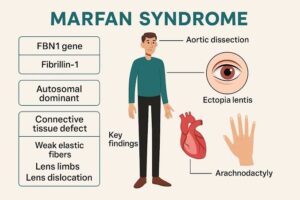
GENETIC BASIS AND CLINICAL FEATURES OF MARFAN SYNDROME
- Gene Mutation: Marfan syndrome is primarily associated with mutations in the FBN1 gene, which provides instructions for producing fibrillin-1, an important connective-tissue protein.
- Tissue Dysfunction: Defective fibrillin-1 affects the strength and elasticity of connective tissue, consequently influencing multiple organs and structural systems.
- Skeletal Features: Characteristic manifestations can include tall stature, long limbs and fingers, chest-wall abnormalities, spinal curvature and flat feet, although severity varies substantially.
- Ocular Effects: The disorder can affect the eyes, including severe nearsightedness and displacement of the eye’s natural lens, demonstrating its multisystem nature.
- Inherited Condition: Marfan syndrome is generally inherited in an autosomal dominant manner, although new mutations can also occur in individuals without an affected parent.
AORTIC COMPLICATIONS AND MANAGEMENT
- Major Risk: The most serious complication involves the aorta, where weakening of the vessel wall can result in progressive enlargement and potentially life-threatening dissection or rupture.
- Silent Progression: Cardiovascular complications may remain asymptomatic for considerable periods, making regular medical monitoring particularly important for affected individuals.
- Blood Pressure: Medicines such as beta-blockers or angiotensin-receptor blockers may be used to reduce cardiovascular stress and slow progression of aortic enlargement.
- Preventive Surgery: Individuals with significant aortic enlargement may require prophylactic aortic surgery to reduce the risk of catastrophic dissection or rupture.
- Multidisciplinary Care: Management generally requires coordinated monitoring of the cardiovascular, skeletal and ocular systems, because the disorder affects multiple connective-tissue structures.
GENETIC DISORDERS AND CONNECTIVE TISSUE● Connective Tissue: Connective tissue provides structural support, strength and elasticity to organs, blood vessels, bones and other components throughout the body. ● Fibrillin Protein: Fibrillin-1 is an extracellular-matrix protein that contributes to the structural integrity and elasticity of connective tissues. ● Autosomal Dominant: In an autosomal dominant disorder, a disease-associated variant in one copy of the relevant gene can be sufficient to produce the condition. ● Genetic Testing: Molecular testing can help identify disease-associated variants and support diagnosis and genetic counselling, particularly where clinical manifestations overlap with other disorders. ● Animal Models: Molecular characterization of Marfan syndrome in domestic cats can provide researchers with an additional model for studying disease mechanisms and evaluating potential therapeutic strategies. |

