 India's No.1 PU & Degree With Integrated IAS & IPS(UPSC/PSC) Training College.


What It Takes to Triple India’s Economy
WHAT WOULD IT TAKE TO TRIPLE THE SIZE OF INDIA’S ECONOMY
Syllabus:
GS-3:
- Indian economy
- Growth and development
- Effects of Liberalization on the Economy
Why in the News?
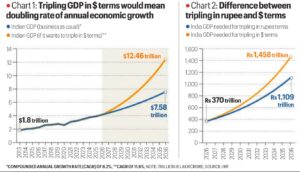
JPMorgan Chase Chairman and CEO Jamie Dimon recently suggested that India’s economy could become three times its current size over the next decade. The projection has renewed debate about India’s growth trajectory, particularly because achieving a threefold expansion to around $12.5 trillion by 2036 would require substantially higher nominal growth in dollar terms than India has achieved historically.
GDP, NOMINAL GROWTH AND REAL ECONOMIC GROWTH● GDP Definition: Gross Domestic Product (GDP) measures the monetary value of final goods and services produced within an economy during a specified period. ● Nominal GDP: Nominal GDP measures economic output at current prices and therefore reflects both changes in production and changes in the overall price level. ● Real GDP: Real GDP removes the effect of price changes, making it more useful for measuring actual changes in the volume of economic production. ● Dollar Conversion: International comparisons commonly convert GDP into US dollars, meaning exchange-rate movements can significantly influence a country’s measured global economic size. ● Per-Capita Perspective: GDP growth should be complemented by per-capita income, employment, productivity and human-development indicators to assess whether economic expansion translates into broader improvements in living standards. |
UNDERSTANDING INDIA’S GDP TARGETS
- Growth Ambition: India has progressively shifted from the earlier $5-trillion economy target towards the broader objective of becoming a Viksit Bharat by 2047.
- Earlier Target: The $5-trillion ambition was articulated around 2018 when India’s economy was approximately $2.7 trillion, with the target subsequently revised across different timelines.
- Current Scale: According to the figures cited in the article, India’s GDP was approximately $4.2 trillion in 2026, placing it among the world’s largest economies.
- Long-Term Vision: The current development narrative increasingly focuses on achieving a developed-economy status by 2047, requiring sustained productivity, investment and structural transformation.
- Dimon Projection: The suggestion of tripling GDP within a decade represents a highly ambitious trajectory requiring substantially faster growth than India has recorded over the preceding decade.
THE CURRENCY PROBLEM: RUPEE VERSUS DOLLAR
- Measurement Difference: India’s GDP is initially calculated in Indian rupees, whereas international comparisons convert national GDP into US dollars using prevailing exchange rates.
- Dollar Challenge: Tripling GDP in dollar terms requires not only strong domestic economic growth but also sufficient exchange-rate stability against the US dollar.
- Rupee Depreciation: According to the article, the rupee depreciated against the dollar by approximately 2% annually between 2014 and 2026, reducing the dollar value of rupee-denominated economic expansion.
- Investor Perspective: International investors generally assess their returns in foreign-currency terms, meaning strong domestic growth can produce weaker dollar returns if currency depreciation is substantial.
- Policy Implication: India’s dollar-denominated economic expansion therefore depends on the interaction between nominal domestic growth, inflation and exchange-rate movements.
THE GROWTH RATE REQUIRED FOR TRIPLING GDP
- Dollar Trajectory: At the historical dollar GDP growth rate of approximately 2% CAGR, India’s economy would reach only around $7.6 trillion by 2036 rather than approximately $12.5 trillion.
- Required Growth: Tripling GDP from approximately $4.2 trillion to $12.5 trillion over ten years requires around 6% annual growth in dollar terms.
- Rupee Requirement: To achieve this dollar-denominated trajectory, the article estimates that India’s nominal GDP in rupee terms would need to grow approximately 14.7% annually.
- Historical Comparison: India’s nominal rupee GDP grew at approximately 10% CAGR between 2014 and 2025, considerably below the rate required for the projected dollar trajectory.
- Ambition Gap: The challenge is therefore not simply maintaining high real GDP growth but sustaining a combination of real growth, inflation, currency stability and productivity gains over an extended period.
WHY TRIPLING IN RUPEE TERMS IS EASIER
- Lower Threshold: Tripling nominal GDP in rupee terms would require approximately 6% annual growth, which is substantially more achievable than the 14.7% nominal growth estimated for the dollar target.
- Inflation Component: Nominal GDP includes both real economic expansion and changes in prices, meaning moderate inflation contributes to nominal GDP growth even without equivalent increases in physical output.
- Exchange-Rate Effect: Rupee depreciation reduces the conversion value of domestic GDP when expressed in dollars, creating a significant difference between domestic and international GDP trajectories.
- Statistical Distinction: A threefold increase in nominal rupee GDP should therefore not automatically be interpreted as a threefold increase in India’s international economic weight or purchasing power.
- Development Quality: Policymakers must distinguish between nominal expansion and improvements in real income, productivity, employment and living standards when evaluating economic progress.
WHAT INDIA NEEDS FOR FASTER GROWTH
- Productivity Enhancement: Sustained high growth requires substantial increases in labour productivity, technological adoption and the efficiency of capital allocation across sectors.
- Manufacturing Scale: India needs deeper integration into global value chains, greater manufacturing competitiveness and stronger domestic production capabilities to create large-scale employment.
- Infrastructure Investment: Continued investment in transport, logistics, energy, digital infrastructure and urban systems can reduce transaction costs and raise economy-wide productivity.
- Human Capital: Better education, healthcare, vocational training and skill development are essential for converting India’s demographic scale into productive economic capacity.
- Investment Climate: Predictable regulations, efficient institutions and easier business operations can encourage greater private investment and entrepreneurship, complementing public capital expenditure.
MAJOR RISKS TO THE GROWTH TRAJECTORY
- Employment Challenge: Rapid GDP expansion without sufficient job creation can prevent India from fully exploiting its demographic dividend and may increase underemployment.
- External Vulnerability: Higher dependence on imported energy, technology and capital goods can expose growth to global commodity prices and external financial conditions.
- Currency Pressure: Persistent inflation differentials or external imbalances can contribute to rupee depreciation, making dollar-denominated GDP targets harder to achieve.
- Global Fragmentation: Protectionism, geopolitical tensions and disruptions to global trade and supply chains could constrain India’s ability to expand exports and attract investment.
- Unequal Growth: Aggregate GDP expansion does not automatically guarantee improvements in per-capita income, employment quality or distributional outcomes, making inclusive growth essential to the Viksit Bharat objective.
CONCLUSION
Tripling India’s economy within a decade is mathematically possible but requires a growth trajectory substantially above the country’s recent historical performance, particularly if measured in US dollars. The challenge extends beyond headline GDP to productivity, employment, manufacturing, investment and currency stability. Sustained structural reforms will determine whether ambitious growth projections become durable economic transformation.
SOURCE: Indian Express
MAINS PRACTICE QUESTION
“The challenge of tripling India’s economy is not merely achieving high real GDP growth, but sustaining rapid nominal expansion while managing inflation, exchange-rate movements and structural constraints.” Examine the feasibility of India’s ambitious growth trajectory and discuss the reforms required to achieve sustained and inclusive economic transformation.

