 India's No.1 PU & Degree With Integrated IAS & IPS(UPSC/PSC) Training College.


Caste and Science: Understanding the Incongruity
THE INCONGRUITY OF CASTE AND SCIENCE
Syllabus:
GS-2:
- Laws and regulations
- Government Policies and Interventions
- Society and social order
Why in the News?
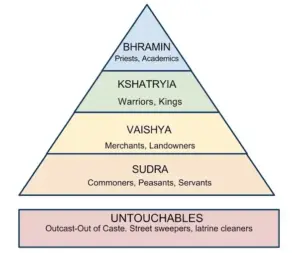
A caste-based poster reportedly appeared at IIT Mandi, assigning hereditary social roles to Brahmanas, Kshatriyas, Vaishyas and Shudras. The incident raises a deeper question about the compatibility of caste hierarchy with scientific reasoning, constitutional equality and human development, particularly when social environments can influence biological outcomes through health inequalities, epigenetics and neuroplasticity.
CONSTITUTIONAL PROVISIONS ON CASTE AND EQUALITY● Article 14: Article 14 guarantees equality before law and equal protection of laws, establishing equality as a foundational principle of India’s constitutional order. ● Article 15: Article 15 prohibits discrimination on grounds including caste and simultaneously enables special provisions for socially and educationally disadvantaged groups. ● Article 16: Article 16 guarantees equality of opportunity in public employment while permitting constitutionally recognised affirmative-action measures for disadvantaged communities. ● Article 17: Article 17 abolishes untouchability and prohibits its practice in any form, making eradication of caste-based exclusion an explicit constitutional commitment. ● Article 46: Article 46 directs the State to promote educational and economic interests of Scheduled Castes and Scheduled Tribes and protect them from social injustice and exploitation. |
CASTE VERSUS CONSTITUTIONAL EQUALITY
- Normative Principle: The principle that all humans deserve equal treatment is fundamentally a moral and constitutional proposition, rather than a conclusion that scientific methods independently establish.
- Constitutional Rights: The Indian Constitution attaches Fundamental Rights to individuals and citizens, rather than determining rights according to inherited social status or membership in a traditional hierarchy.
- Historical Transformation: Modern constitutionalism fundamentally departed from hereditary social ordering by recognising individuals as rights-bearing persons possessing legally protected freedoms.
- Equality Framework: Articles 14, 15 and 16 establish equality before law, prohibit discrimination and promote equality of opportunity, directly challenging hereditary allocation of social functions.
- Social Justice: Constitutional morality therefore rejects caste-based hierarchy because citizenship is founded upon individual dignity, equality and liberty, rather than birth-determined social obligations.
SCIENCE AND THE LIMITS OF ITS AUTHORITY
- Scientific Boundary: Science can investigate biological differences between populations, but it cannot scientifically determine whether human beings ought to possess equal rights or dignity.
- Species Unity: Scientific evidence establishes that all contemporary humans belong to the same species, Homo sapiens, despite variations in genetic ancestry.
- Genetic Diversity: Population genetics identifies differences among communities, but such differences do not scientifically establish any predetermined hierarchy of intelligence, occupation or social worth.
- Normative Distinction: Scientific facts and moral principles operate differently; the claim that biological differences justify social discrimination represents an ethical and political inference, not a scientific finding.
- Misuse Prevention: Scientific knowledge must therefore be distinguished from scientific racism or biological determinism, where empirical observations are improperly converted into hierarchical social prescriptions.
CASTE AND GENETIC DIFFERENTIATION
- Ancestral Mixing: Research has shown that present-day Indians descend from differentiated ancient populations that mixed extensively before widespread endogamy became established.
- Community Differences: Long histories of endogamy have subsequently produced substantial genetic differentiation among some Indian communities through restricted marriage networks.
- Founder Effects: Certain populations have experienced founder effects, where communities originating from relatively small groups inherit distinctive patterns of genetic variation.
- Causal Direction: Genetic differences between communities do not establish that caste hierarchy originated from biological superiority; rather, social practices themselves can shape population genetics.
- Scientific Inference: The existence of genetic variation cannot justify hereditary occupational roles because genes do not prescribe that particular communities are biologically ordained to perform specific social functions.
SOCIAL ENVIRONMENT AND BIOLOGICAL DEVELOPMENT
- Environmental Interaction: Human development occurs through continuous interaction between genes and environment, meaning social conditions can influence health, development and biological outcomes.
- Health Inequality: Caste-based discrimination can produce unequal access to healthcare, nutrition, education, sanitation and socioeconomic opportunities, creating different developmental environments.
- Social Epigenetics: Research in social epigenetics investigates how social circumstances can influence biological processes through mechanisms affecting gene regulation.
- Developmental Effects: Persistent disadvantage can therefore become embodied through physiological pathways, demonstrating how social structures can contribute to observed biological differences.
- Causal Reversal: Consequently, using existing biological differences to justify caste hierarchy reverses the causal relationship because social discrimination itself may contribute to those differences.
HUMAN NEUROPLASTICITY AND ABILITY
- Brain Plasticity: The human nervous system demonstrates substantial neuroplasticity, continuously adapting its structure and functioning in response to experiences throughout life.
- Environmental Influence: Cognitive development is shaped by an interaction among environment, education, experiences, interests, temperament and individual choices, rather than ancestry alone.
- Unequal Opportunities: Differences in educational resources and social opportunities can influence the development of capabilities, making hereditary explanations for individual ability scientifically inadequate.
- Cognitive Diversity: Human beings naturally possess diverse strengths and limitations, but individual variation cannot logically be converted into collective hereditary occupational classifications.
- Cultural Capacity: Neuroplasticity reinforces the importance of social environment because human capabilities develop through interaction with institutions, relationships and accumulated cultural knowledge.
CASTE, KNOWLEDGE AND SCIENTIFIC INSTITUTIONS
- Knowledge Restriction: Caste discrimination can restrict access to education and social networks, thereby limiting the circulation and accumulation of knowledge across communities.
- Cultural Learning: Humans possess an exceptional capacity to accumulate knowledge and transmit it across generations, allowing societies to progress beyond individual experience.
- Institutional Responsibility: Institutions dedicated to science, technology and higher education have a particular responsibility to protect evidence-based reasoning and equal intellectual opportunity.
- Merit Question: Hereditary assumptions about occupational suitability undermine the principle that intellectual capabilities develop through education, opportunity, experience and individual choice.
- Scientific Culture: The appearance of caste-reinforcing messaging within a scientific institution is therefore significant because it conflicts with the institutional values of critical inquiry, evidence and intellectual openness.
CONCLUSION
Caste cannot derive legitimacy from science merely because communities exhibit genetic differences shaped partly by historical endogamy. Constitutional equality establishes the normative commitment, while science demonstrates humanity’s shared species identity, environmental development and neuroplasticity. Scientific institutions must therefore challenge biological determinism and protect equal opportunity, dignity, critical inquiry and social mobility.
SOURCE: The Hindu
MAINS PRACTICE QUESTION
Caste-based hierarchy represents a social system of inherited status, whereas human development reflects a dynamic interaction between genes, environment and individual experience.” Discuss the scientific and constitutional arguments against biological determinism in caste, with special reference to genetic diversity, social epigenetics, neuroplasticity and the Fundamental Rights framework .(250 words).


