India's No.1 PU & Degree With Integrated IAS & IPS(UPSC/PSC) Training College.


Defence Tech Transfer Challenges Explained
Defence Technology Transfer Challenges
Syllabus
GS 3: Defence and technology
Why in the News?
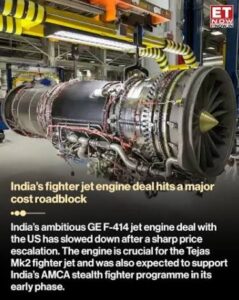
Recently, negotiations over the GE F414 fighter engine faced major difficulties, highlighting continuing challenges in India-United States defence technology cooperation, industrial collaboration, technology transfer, and joint manufacturing efforts.
Introduction
- India and the United States have steadily expanded defence cooperation through defence purchases, military exercises, and strategic agreements.
- However, industrial collaboration has progressed slowly.
- Recent difficulties surrounding the GE F414 fighter engine project have renewed discussions about technology transfer, defence manufacturing, and long-term strategic cooperation between both countries.
India–United States Defence Cooperation: Current Status
Expanding Defence Relations
- India and the United States have significantly strengthened defence relations during the last two decades through regular political engagement and strategic cooperation.
- Successive governments announced ambitious defence technology partnerships intending to transform bilateral military cooperation into long-term industrial collaboration.
- However, several announced projects have struggled because negotiations became lengthy and implementation remained incomplete.
Major Challenges
- Technology transfer disputes have repeatedly delayed defence projects despite strong political commitment from leadership in both countries.
- Export control regulations and differing commercial expectations have also prevented several initiatives from achieving their intended objectives.
- These issues created a gap between political announcements and practical industrial outcomes in bilateral defence cooperation.
India’s Defence Purchases from the United States
Growing Defence Procurement
- Since 2002, India has purchased more than 22 billion dollars’ worth of defence equipment from the United States.
- These acquisitions significantly strengthened India’s defence capabilities while expanding strategic cooperation between both democratic partners.
Major Defence Platforms
- Helicopters
- India inducted Apache attack helicopters and Chinook heavy-lift helicopters to improve operational capability across different military missions.
- Transport Aircraft
- India purchased C-17 Globemaster and C-130J transport aircraft to strengthen strategic and tactical airlift capabilities.
- Maritime Surveillance
- P-8I maritime patrol aircraft improved India’s ability to monitor maritime activities and protect national interests across the Indian Ocean.
- Artillery
- India also inducted M777 ultra-light howitzers to enhance artillery capabilities, particularly in difficult mountainous operational areas.
- Limited Industrial Progress
- Although defence procurement expanded considerably, meaningful technology transfer and co-production remained limited throughout the partnership.
GE F414 Fighter Engine: The Latest Challenge
Importance of the Project
- The GE F414 fighter engine project became the flagship defence initiative announced during Prime Minister Narendra Modi’s 2023 Washington visit.
- The project symbolised efforts to move beyond defence purchases towards deeper industrial and technological collaboration.
Rising Project Cost
- Reports suggest the estimated price of each GE F414 engine increased from approximately seventy to eighty crore rupees.
- The revised estimated cost reportedly exceeded two hundred crore rupees for every fighter engine.
Additional Investment Demand
- General Electric also reportedly requested nearly 800 million dollars of Indian investment for establishing a dedicated production facility.
Key Areas of Disagreement
Technology Transfer
- India seeks greater manufacturing expertise supporting long-term domestic defence production and technological capability development.
Intellectual Property
- Intellectual property rights remain another important issue preventing both sides from reaching an early agreement.
Export Controls
- American export control regulations continue limiting the transfer of advanced defence technologies despite broader strategic cooperation.
Multiple Agencies Involved
Hindustan Aeronautics Limited
- Hindustan Aeronautics Limited is negotiating licensed production and procurement of the GE F414 engine for the Tejas Mk-II programme.
DRDO and ADA
- The Defence Research and Development Organisation and Aeronautical Development Agency are separately discussing the same engine with General Electric.
- These discussions relate to the proposed Advanced Medium Combat Aircraft and the Navy’s Twin-Engine Deck-Based Fighter programme.
Complex Negotiations
- Simultaneous negotiations involving different organisations have created an interconnected process that remains difficult to resolve quickly.
From Political Vision to Limited Results
Launch in 2012
- The Defence Technology and Trade Initiative was introduced during 2012 to promote defence co-development and industrial co-production.
Limited Outcomes
- Despite several official meetings, the initiative failed to produce significant defence capability before gradually losing importance.
Initiative on Critical and Emerging Technologies
Expansion of Cooperation
- The Initiative on Critical and Emerging Technologies was launched during 2022 with a much broader strategic agenda.
Major Focus Areas
- The initiative covered semiconductors, artificial intelligence, quantum technologies, telecommunications, biotechnology, space technologies, drones, and resilient supply chains.
Defence Component
- The GE F414 fighter engine programme became the most important defence project under this wider technology cooperation framework.
- Continuing delays have made the project an example of implementation challenges affecting bilateral industrial cooperation.
INDUS-X Initiative
Objective
- The India-United States Defence Acceleration Ecosystem, known as INDUS-X, was launched during 2023.
- The initiative intended to connect defence start-ups, academic institutions, industries, and innovation ecosystems within both countries.
Present Status
- Although enthusiasm remained high, INDUS-X has not yet produced major defence co-development achievements.
Other Delayed Defence Projects
Javelin Anti-Tank Missile
- Discussions regarding joint production of the Javelin anti-tank guided missile have continued for more than one decade.
- Despite prolonged negotiations, both countries have not reached a successful industrial cooperation agreement.
Stryker Infantry Combat Vehicle
- Proposed collaboration involving the General Dynamics Stryker infantry combat vehicle also experienced similar implementation difficulties.
- This project now appears increasingly likely to remain inactive without substantial future progress.
MQ-9B Drone Acquisition
Defence Purchase
- India approved the purchase of thirty-one MQ-9B SkyGuardian and SeaGuardian remotely piloted aircraft during 2024.
- The acquisition occurred through the United States government’s Foreign Military Sales route for approximately 3.5 billion dollars.
Expected Industrial Benefits
- The project originally promised local assembly, partial manufacturing, and domestic maintenance, repair, and overhaul facilities.
Current Situation
- These industrial cooperation commitments have not yet materialised despite completion of the procurement arrangement.
Pattern Emerging in Defence Cooperation
Repeated Experience
- Many India-United States defence initiatives were announced as historic, transformational, and game-changing strategic partnerships.
- However, implementation repeatedly remained below political expectations because industrial cooperation progressed slowly.
- This recurring pattern has generated concerns regarding future defence technology collaboration between both countries.
Understanding the Technology Transfer Divide
India’s Perspective
- India views defence partnerships as opportunities for acquiring advanced technologies and strengthening domestic manufacturing capabilities.
- Greater technology transfer supports India’s objective of achieving defence self-reliance under the Atmanirbhar Bharat initiative.
United States Perspective
- The United States considers advanced defence technologies as sensitive strategic national assets requiring strict regulatory protection.
International Traffic in Arms Regulations
- International Traffic in Arms Regulations govern exports of defence technologies and technical information from the United States.
- These regulations prioritise national security considerations before commercial or strategic partnership objectives.
Impact on India’s Defence Goals
Limited Capability Development
- Continuing restrictions reduce opportunities for India to build independent manufacturing expertise through international defence partnerships.
- Procurement relationships therefore expand faster than domestic capability development and industrial strengthening.
Strategic Cooperation Continues
- Despite industrial challenges, military exercises, logistics agreements, and interoperability between both armed forces continue improving steadily.
- Strategic trust has therefore advanced faster than industrial collaboration within the bilateral defence relationship.
Reciprocal Defence Procurement Agreement
Proposed Agreement
- Officials increasingly consider the proposed Reciprocal Defence Procurement Agreement as the next important stage of bilateral cooperation.
Expected Benefits
- The agreement may provide reciprocal access to defence procurement opportunities within both national markets.
Possible Concerns
- India’s emerging defence manufacturers could face direct competition from larger and technologically advanced American defence companies.
- Policymakers must therefore carefully evaluate whether reciprocal access creates balanced opportunities or unequal competition.
Way Forward
Strengthening Industrial Cooperation
- Both countries should simplify negotiations and establish clear timelines for completing important defence industrial collaboration projects.
- Greater transparency regarding technology transfer expectations can reduce misunderstandings and improve long-term strategic confidence.
- Joint research and development should receive stronger institutional support beyond traditional defence procurement arrangements.
- India should continue strengthening domestic manufacturing while pursuing mutually beneficial international technology partnerships.
- Future defence cooperation should balance strategic trust, commercial interests, technological security, and industrial capability development.
Conclusion
India and the United States share strong strategic interests, yet industrial cooperation needs greater practical progress. Balanced technology sharing, transparent negotiations, stronger domestic manufacturing, and mutually beneficial agreements can create sustainable defence partnerships for future security.
Source:The Hindu
Mains Practice Question
Discuss the opportunities and challenges in India–United States defence technology cooperation. How can industrial collaboration be strengthened?