 India's No.1 PU & Degree With Integrated IAS & IPS(UPSC/PSC) Training College.


BHAVYA Portal for Employment and Economic Growth
BHAVYA Portal: Building India’s Next Generation Industrial Ecosystem
Introduction
India’s aspiration to become a developed economy by 2047 depends not only on services-led growth but also on the creation of a strong, competitive and employment-generating manufacturing base. In this context, the launch of the BHAVYA Portal marks an important step towards strengthening India’s industrial infrastructure.
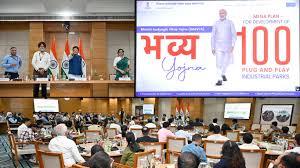
BHAVYA, or Bharat Audyogik Vikas Yojna, is aimed at developing 100 plug-and-play industrial parks across the country. The initiative reflects India’s attempt to move from fragmented industrial development to integrated industrial ecosystems where land, utilities, logistics, approvals and support facilities are made available in a planned manner.
For UPSC aspirants, BHAVYA must be understood not merely as an industrial scheme but as a policy intervention linked with manufacturing growth, ease of doing business, employment generation, cooperative federalism, regional development and India’s integration with global value chains.
What is BHAVYA?
BHAVYA is a major industrial infrastructure initiative approved with an outlay of ₹33,660 crore. Its objective is to develop 100 investment-ready, world-class industrial parks across India.
The scheme promotes the idea of plug-and-play industrial parks. This means that industries can start operations quickly because basic infrastructure such as land, internal roads, power, water, drainage, logistics connectivity, testing facilities, digital governance systems, worker housing and administrative support are already planned or developed.
Such parks can reduce delays caused by land acquisition, fragmented clearances and poor infrastructure. This is particularly important for manufacturing units, MSMEs, startups and global investors.
Role of the BHAVYA Portal
The BHAVYA Portal has been launched as a single digital platform for the implementation of the scheme. It will support the submission of Detailed Project Reports, appraisal of proposals, evaluation, real-time monitoring and coordination among stakeholders.
The portal is important because large infrastructure projects often suffer from delays, lack of transparency, weak monitoring and poor Centre-State coordination. A digital platform can improve accountability and help track the progress of projects from proposal stage to implementation.
In this sense, the portal is not only an administrative tool but also a governance reform. It brings together digital governance, industrial planning and infrastructure monitoring.
Cooperative Federalism and Competitive Federalism
One of the important features of BHAVYA is its challenge-based selection model. States and Union Territories are expected to submit project proposals based on land availability, industrial potential, investor interest and sectoral strength.
This creates an element of competitive federalism because states must present strong, reform-oriented and investment-ready proposals. At the same time, the scheme also promotes cooperative federalism because the Centre, states, NICDC and private sector players are expected to work together.
Land will be provided by state governments, while the Government of India will support infrastructure creation through the National Industrial Corridor Development Corporation. This makes BHAVYA a Centre-State partnership model rather than a purely central scheme.
Why Plug-and-Play Industrial Parks Matter
India has often faced challenges in industrial development due to delays in land acquisition, weak logistics, poor last-mile connectivity, uncertain approvals and inadequate worker facilities. These issues increase the cost of doing business and discourage investors.
Plug-and-play parks can address these problems by providing ready-to-use industrial ecosystems. Industries do not have to separately struggle for land, power, water, roads, digital connectivity and basic approvals.
This can improve ease of doing business and reduce the time between investment decision and production. For a manufacturing economy, speed of execution is crucial.
Economic Significance
BHAVYA can support India’s manufacturing-led growth in several ways.
First, it can attract domestic and foreign investment by creating reliable industrial infrastructure. Second, it can generate direct and indirect employment in manufacturing, logistics, construction, services and local supply chains.
Third, it can strengthen MSMEs by linking them with larger industrial clusters. Fourth, it can support exports by improving production efficiency and logistics integration. Fifth, it can contribute to regional development by taking industrial growth beyond traditional industrial centres.
If implemented effectively, BHAVYA can support the larger goals of Make in India, Atmanirbhar Bharat and Viksit Bharat 2047.
Link with Global Value Chains
In the current global economy, countries are trying to diversify manufacturing supply chains. India has an opportunity to attract investment from companies looking for alternatives to concentrated supply chains.
However, global investors require reliable infrastructure, transparent approvals, logistics efficiency and skilled labour. BHAVYA can help India become more competitive by creating industrial parks that meet international standards.
The scheme may also support sector-specific industrialisation in areas such as electronics, chemicals, food processing, textiles, data centres, deep-tech, startups and research-based industries.
Social and Regional Dimension
Industrial parks are not only about factories. They also affect workers, local communities and regional economies. BHAVYA includes worker-support facilities and social infrastructure, which are important for inclusive industrialisation.
If worker housing, transport, health facilities, skill centres and safety systems are properly developed, these parks can prevent the growth of unplanned industrial settlements and urban stress.
The scheme can also help less industrialised states and regions attract investment, provided they offer land, governance reforms and connectivity support.
Key Challenges
Despite its potential, BHAVYA faces several implementation challenges.
The first challenge is land. Industrial development requires clear land titles, proper compensation, environmental safeguards and social consent. Compliance with the Forest Conservation Act becomes crucial when industrial parks are proposed in ecologically sensitive areas.
The second challenge is coordination. Industrial parks require cooperation between the Centre, states, local bodies, investors, financial institutions and infrastructure agencies.
The third challenge is sustainability and environmental compliance. Industrial parks must not become centres of pollution, resource stress and ecological damage. Water use, waste treatment, green energy and timely environmental clearance are essential requirements. The EIA Notification mandates that projects undergo proper environmental impact assessment before approval. However, there have been concerns about ex post facto or retrospective environmental clearances being granted to projects that began operations without proper approvals, which undermines environmental jurisprudence and the principles established in landmark cases like the Vanashakti judgment.
The fourth challenge is actual investment. Creating parks alone is not enough. They must attract viable industries and generate real employment while ensuring a pollution free environment through adherence to the polluter pays principle and precautionary principle.
The fifth challenge is regional balance. Developed states may attract more proposals, while backward regions may struggle due to weak connectivity and governance capacity. Projects in coastal areas must also comply with Coastal Regulation Zone regulations to protect fragile ecosystems.
Way Forward
First, BHAVYA must be implemented through transparent land acquisition, clear rehabilitation norms and proper environmental safeguards. All projects must obtain environmental clearance through legitimate processes, avoiding any post facto regularization that weakens environmental democracy and public participation.
Second, industrial parks should be aligned with PM GatiShakti to ensure multimodal connectivity through roads, railways, ports and airports.
Third, states must improve single-window clearance systems and reduce procedural delays while ensuring that environmental impact assessment processes are not compromised for speed.
Fourth, skill development centres should be linked with these parks so that local youth can benefit from employment opportunities.
Fifth, MSMEs should be integrated into industrial clusters through vendor development, credit support, technology access and market linkages.
Sixth, sustainability must be built into the design of these parks through renewable energy, water recycling, waste treatment and green infrastructure. The precautionary principle must guide planning decisions, and the polluter pays principle should be strictly enforced to ensure industries bear the cost of environmental restoration.
Seventh, regular digital monitoring through the BHAVYA Portal should be used to ensure accountability, timely execution and outcome-based evaluation, including compliance with environmental jurisprudence and regulatory frameworks.
Conclusion
The BHAVYA Portal represents India’s attempt to combine industrial policy with digital governance and infrastructure-led growth. Its success will depend not only on the number of industrial parks created but also on the quality of infrastructure, speed of implementation, environmental responsibility and employment generated.
For India, the challenge is not merely to build industrial parks, but to build globally competitive, inclusive and sustainable industrial ecosystems that respect environmental democracy and constitutional environmental principles. If implemented effectively, BHAVYA can become an important pillar of India’s manufacturing transformation and its journey towards Viksit Bharat 2047.
UPSC Relevance
GS Paper III: Indian Economy, industrial growth, infrastructure, investment, employment, Make in India, MSMEs, ease of doing business, environmental clearance, environmental impact assessment.
GS Paper II: Cooperative federalism, Centre-State coordination, digital governance, environmental jurisprudence.
Essay: Manufacturing-led growth, technology and governance, inclusive development, sustainable industrialization.
Prelims Facts:
- BHAVYA stands for Bharat Audyogik Vikas Yojna.
- It aims to develop 100 plug-and-play industrial parks.
- The scheme has an outlay of ₹33,660 crore.
- NICDC is the key implementing and monitoring agency.
- The portal supports project submission, evaluation and real-time monitoring.
- Projects require environmental clearance under EIA Notification.
- Forest Conservation Act applies to projects in forest areas.
- Coastal Regulation Zone norms apply to coastal industrial projects.




