 India's No.1 PU & Degree With Integrated IAS & IPS(UPSC/PSC) Training College.


Policy Is Undoing Science in Cotton Mission
POLICY IS UNDOING WHAT SCIENCE BUILT. THAT’S A CHALLENGE FOR COTTON PRODUCTIVITY MISSION
Syllabus:
GS 3:
- Cropping pattern.
- Agricultural marketing and Agricultural Resources.
Why in the News?
The Union Cabinet recently approved the Cotton Productivity Mission with an outlay of ₹5,659 crore to raise cotton yields significantly by 2031. However, concerns persist regarding declining productivity, technological stagnation, restrictive seed-pricing policies, and inadequate innovation ecosystems that may hinder achieving the mission’s ambitious productivity targets. This initiative is crucial for food security and sustainable agriculture, as cotton remains vital for India’s textile industry and rural livelihoods while supporting crop diversification strategies.
ABOUT COTTON PRODUCTIVITY MISSION● Launch Background: The Cotton Productivity Mission was approved by the Union Cabinet in April 2026 with an allocation of ₹5,659 crore. ● Implementation Period: The mission will operate from 2026-27 to 2030-31, focusing on improving productivity, sustainability, and competitiveness in cotton cultivation through sustainable farming practices. ● Primary Objective: It aims to increase lint productivity from 441 kg/ha to 755 kg/ha by the year 2031. ● Focus Areas: The mission emphasises quality seeds, improved agronomic practices, technological interventions, enhanced farmer support mechanisms, and quality standards for better market access. ● Strategic Importance: Higher cotton productivity can strengthen the textile sector, improve farmer incomes, reduce imports, and enhance export competitiveness in global markets while supporting agricultural exports. |
BT COTTON TRANSFORMED INDIAN AGRICULTURE
- Historic Decision: The approval of Bt Cotton in 2002 marked a transformative moment, enabling Indian agriculture to harness modern biotechnology for productivity enhancement and crop improvement.
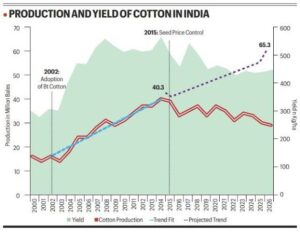
- Production Surge: Cotton production increased from 13.6 million bales to 39.8 million bales between 2002 and 2014, reflecting remarkable technological success and meeting global demand.
- Yield Growth: Adoption of Bt technology improved yields substantially, increasing productivity from 302 kg/ha to 566 kg/ha, benefiting millions of farmers through enhanced crop improvement strategies.
- Global Standing: India emerged as the world’s largest cotton producer and second-largest exporter, strengthening agricultural competitiveness and foreign exchange earnings through international trade.
- Technology Impact: Scientific innovation demonstrated how improved seed technologies can generate sustained agricultural growth through enhanced productivity and pest resistance, establishing robust value chain systems.
POLICY INTERVENTIONS AND THEIR EFFECTS
- Price Controls: Several governments imposed seed price caps, reducing revenues available for research, development, and future technological innovation within the sector, affecting market access for advanced technologies.
- Trait Fee Reduction: The Cotton Seed Price Control Order drastically reduced trait fees, affecting commercial viability and discouraging private-sector biotechnology investments crucial for maintaining quality standards.
- Innovation Decline: Regulatory interventions reduced incentives for companies to introduce advanced seed technologies capable of addressing emerging agricultural challenges effectively in sustainable agriculture.
- Market Distortion: Excessive controls disrupted the balance between farmer affordability and incentives necessary for continuous innovation and technology development across the agricultural value chain.
- Investment Concerns: Uncertain regulatory environments discourage long-term investments in biotechnology research, breeding programmes, and agricultural innovation ecosystems.
TECHNOLOGICAL GAP WITH GLOBAL LEADERS
- Productivity Difference: India’s cotton yield of 441 kg/ha remains significantly below Australia, China, Brazil, and the United States in international markets.
- Advanced Seeds: Competing nations have adopted next-generation biotechnology platforms offering enhanced pest resistance, weed management, water use efficiency, and overall productivity improvements.
- Research Ecosystem: Global leaders continuously invest in agricultural R&D, enabling rapid development and deployment of innovative crop technologies meeting quality standards for global markets.
- Competitive Disadvantage: India’s inability to adopt advanced technologies has widened productivity gaps and reduced competitiveness in international trade and global cotton markets.
- Missed Opportunities: Delayed approval and deployment of modern seed varieties have constrained productivity growth despite India’s vast cultivation area and potential for agricultural exports.
CHALLENGES BEFORE COTTON MISSION
- Ambitious Target: Raising productivity from 441 kg/ha to 755 kg/ha within five years requires substantial technological breakthroughs, policy support, and sustainable farming practices.
- Technology Constraints: Current seed technologies may be insufficient to achieve mission objectives without introducing advanced biotechnology innovations, improved crop varieties, and enhanced crop improvement methodologies.
- Farmer Adoption: Productivity improvements depend upon widespread adoption of superior technologies alongside extension services and agronomic best practices aligned with sustainable agriculture principles.
- Climate Risks: Increasing climate variability, water stress, and pest resistance pose additional challenges to achieving ambitious productivity targets sustainably, requiring improved water use efficiency strategies.
- Implementation Gap: Successful execution requires coordination among governments, research institutions, private companies, and farmers across cotton-growing regions to strengthen the entire value chain.
ECONOMIC COST OF POLICY FAILURE
- Production Decline: Cotton output has declined since 2014-15 despite growing global demand, reflecting systemic weaknesses in innovation and productivity enhancement efforts affecting food security and textile availability.
- Lost Potential: Had earlier growth trends continued, India could have produced over 65 million bales, significantly higher than current levels, strengthening its position in international markets.
- Import Dependence: India has shifted from being a major exporter to importing approximately four million bales of cotton recently, reversing gains in agricultural exports and international trade.
- Farmer Losses: Lower productivity reduces farm incomes, affects rural livelihoods, and limits opportunities for agricultural value addition across the value chain.
- Industrial Impact: Insufficient domestic cotton production creates challenges for the textile industry, affecting competitiveness in global markets and employment generation.
NEED FOR RESEARCH AND INNOVATION
- Private Investment: Developing advanced seed technologies requires significant investments in biotechnology, plant breeding, regulatory compliance processes, and maintaining quality standards.
- Intellectual Property: Strong intellectual property protection encourages innovators by ensuring adequate returns on research and development investments supporting crop improvement.
- Public Research: Government-funded institutions must strengthen agricultural research to complement private-sector innovation and technology generation efforts for sustainable agriculture.
- Collaborative Approach: Partnerships among universities, research organisations, startups, and private firms can accelerate technology development and adoption across the agricultural value chain.
- Future Preparedness: Continuous innovation remains essential to address emerging pest resistance, climate challenges, water use efficiency, and evolving productivity requirements.
POLICY OPTIONS FOR GOVERNMENT
- Regulatory Reforms: Revisiting restrictive seed pricing policies can help restore incentives for innovation while maintaining farmer affordability safeguards and ensuring market access.
- Balanced Framework: Policymakers must balance consumer welfare, farmer interests, and industry incentives to sustain long-term technological advancement supporting sustainable farming.
- R&D Funding: Increased investments in public-sector agricultural research can compensate for declining private participation in critical innovation areas and crop improvement initiatives.
- Technology Access: Faster regulatory approvals can facilitate timely access to advanced agricultural technologies, improved seed varieties meeting quality standards, and enhanced market access.
- Strategic Vision: Long-term policy consistency is necessary to attract investments and create a vibrant ecosystem supporting agricultural transformation and competitiveness in global markets.
CONCLUSION
The Cotton Productivity Mission represents an important opportunity to revive India’s cotton sector and strengthen food security through enhanced textile production. However, productivity targets cannot be achieved through financial allocations alone. Sustainable success requires restoring innovation incentives, strengthening research ecosystems, enabling advanced biotechnology adoption, implementing sustainable agriculture practices, improving water use efficiency, and ensuring policy coherence. Science-driven agriculture with robust quality standards and efficient value chain systems must remain central to India’s cotton future, enabling better market access and competitiveness in international markets while supporting crop diversification and agricultural exports.
SOURCE: IE
MAINS PRACTICE QUESTION
“Agricultural productivity growth depends as much on policy incentives as on technological innovation.” Examine this statement in the context of India’s Cotton Productivity Mission and biotechnology regulation. (15 Marks, 250 Words)

