 India's No.1 PU & Degree With Integrated IAS & IPS(UPSC/PSC) Training College.


Lavender Festival and India’s Purple Revolution
Lavender Festival and India’s Purple Revolution
The 4th Lavender Festival 2026, held at Bhaderwah in Doda district of Jammu and Kashmir, highlighted the success of India’s Purple Revolution. The festival was organised by CSIR–Indian Institute of Integrative Medicine, Jammu, under the theme “Lavender Goes Global.” It was inaugurated by Union Minister Dr. Jitendra Singh and focused on lavender cultivation, rural entrepreneurship, value addition, market expansion, and establishing market access to global markets. The event also featured trade exhibitions and business networking opportunities with international buyers, promoting export development and trade promotion strategies.
The Purple Revolution refers to the promotion of lavender cultivation as part of sustainable agriculture and crop diversification initiatives, mainly in Jammu and Kashmir, under the CSIR Aroma Mission. This mission is implemented by the Council of Scientific and Industrial Research (CSIR), which functions under the Ministry of Science and Technology through the Department of Scientific and Industrial Research. CSIR is one of India’s premier public research and development institutions, established in 1942. It works in areas such as agriculture, medicine, biotechnology, environment, chemicals, industry and rural innovation, contributing to food security through climate-smart crops and sustainable farming practices.
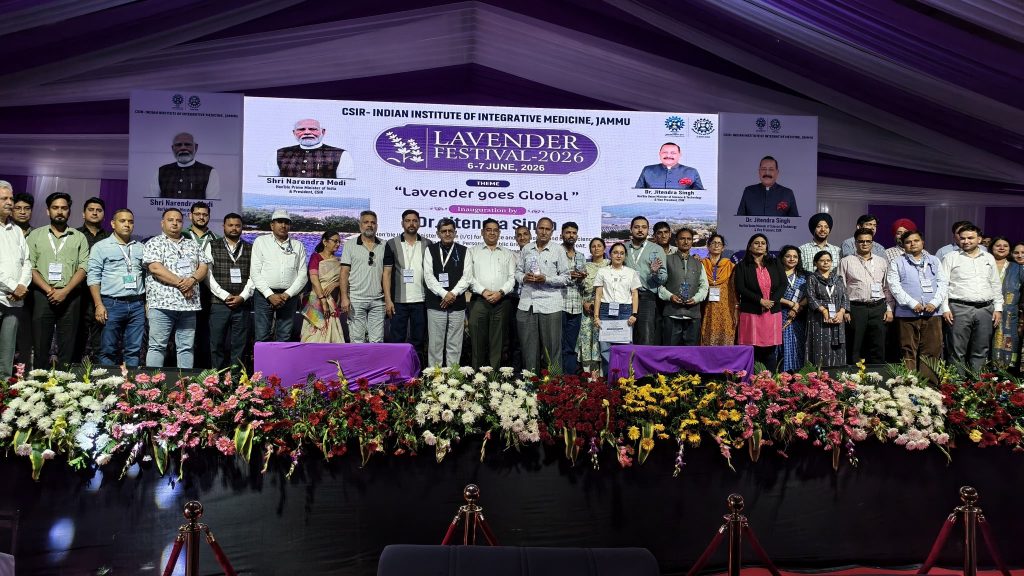
CSIR-IIIM Jammu has played a major role in promoting lavender cultivation through sustainable farming methods and crop improvement programs. The institute works on medicinal plants, aromatic crops, natural products, biotechnology and farmer-oriented technologies with emphasis on water use efficiency and quality standards. It introduced suitable cultivation practices, promoted the RRL-12 lavender variety, supplied planting material, trained farmers, supported distillation facilities and helped create market linkages. Due to this, Bhaderwah has emerged as the Lavender Capital of India.
Lavender is economically valuable because its essential oil, rich in bioactive compounds, phytochemicals and antioxidants, offers significant health benefits and is used in perfumes, cosmetics, soaps, aromatherapy products, scented candles, incense sticks, herbal oils, room fresheners and wellness products. These value-added agricultural products and processed food products are increasingly in global demand across international markets. The complete value chain from cultivation to food processing ensures food safety and quality standards while delivering nutritional benefits. Lavender-based functional foods and products support market development, agricultural exports, and export promotion initiatives. It also supports rural tourism, women entrepreneurship, agri-startups, and provides enhanced market access through trade promotion and export development programs targeting international buyers.
For UPSC, this topic is important under science and technology, agriculture, rural development, startups, value addition, international trade, agricultural exports, market development, and regional development of Jammu and Kashmir.
Questions:
1. With reference to the Purple Revolution in India, consider the following statements:
It is associated with the promotion of lavender cultivation in Jammu and Kashmir.
It is implemented under the CSIR Aroma Mission.
CSIR-IIIM Jammu has played a key role in providing planting material, training and distillation support.
It is directly implemented by the Ministry of Agriculture and Farmers Welfare.
Which of the statements given above are correct?
A. 1, 2 and 3 only
B. 1 and 4 only
C. 2, 3 and 4 only
D. 1, 2, 3 and 4
Answer: A
Explanation: Purple Revolution is linked with lavender cultivation in J&K under the CSIR Aroma Mission. CSIR-IIIM Jammu has supported farmers through technology, planting material, training and processing support. It is linked with CSIR under the Ministry of Science and Technology, not directly with the Ministry of Agriculture.
2. With reference to Purple Revolution and Blue Revolution in India, consider the following statements:
Purple Revolution is associated with lavender cultivation, particularly in Jammu and Kashmir.
Purple Revolution is promoted under the CSIR Aroma Mission, linked with the Ministry of Science and Technology.
Blue Revolution is associated with fisheries and aquaculture development.
Blue Revolution is mainly linked with the Ministry of Agriculture and Farmers Welfare.
Which of the statements given above are correct?
A. 1, 2 and 3 only
B. 1 and 4 only
C. 2, 3 and 4 only
D. 1, 2, 3 and 4
Answer: A
Explanation:
Purple Revolution is linked with lavender cultivation in Jammu and Kashmir under the CSIR Aroma Mission, which is associated with CSIR under the Ministry of Science and Technology. Blue Revolution is related to fisheries and aquaculture development. In the present administrative setup, fisheries is mainly linked with the Ministry of Fisheries, Animal Husbandry and Dairying, not primarily with the Ministry of Agriculture and Farmers Welfare.




