 India's No.1 PU & Degree With Integrated IAS & IPS(UPSC/PSC) Training College.


Agasthyamalai Ecological Landscape: Biodiversity Overview
Supreme Court Orders Removal of Encroachments from Agasthyamalai Ecological Landscape
GS3 — Environment & Biodiversity
GS2 — Governance & Judiciary Prelims + Mains
The Supreme Court of India has directed Tamil Nadu and Kerala to prepare a time-bound action plan to remove encroachments from the Agasthyamalai ecological landscape — a biodiversity-rich stretch of the southern Western Ghats — and restore illegally occupied forest land. The Court has also held government officials accountable for enabling or ignoring illegal occupation of protected forests.
At a Glance
| Parameter | Detail |
| Region | Agasthyamalai Ecological Landscape, southern Western Ghats |
| States involved | Tamil Nadu and Kerala |
| Court | Supreme Court of India |
| Direction | Time-bound action plan for eviction + forest restoration |
| Linked biosphere reserve | Agasthyamala Biosphere Reserve (UNESCO MAB Programme) |
| Constitutional pegs | Article 48A (State duty) + Article 51A(g) (Citizen duty) |
| Key wildlife | Tiger, elephant, Nilgiri tahr, lion-tailed macaque, rare plants |
| Exam relevance | GS3 — Environment; GS2 — Governance & Judiciary; Essay |
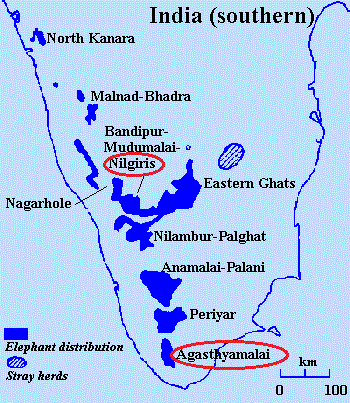
1. What is the Agasthyamalai Ecological Landscape?
Agasthyamalai, also known as Agasthyamala, is a mountain and forested landscape located in the southern end of the Western Ghats — one of the world’s eight major biodiversity hotspots and a UNESCO World Heritage Site. The region straddles the states of Tamil Nadu and Kerala and is characterised by tropical evergreen forests, high endemism, and extraordinary medicinal plant diversity.
The landscape is associated with the Agasthyamala Biosphere Reserve, which is recognised under UNESCO’s Man and the Biosphere (MAB) Programme. It represents one of the last intact stretches of undisturbed forest in peninsular India and plays a critical role as a watershed — supporting major rivers, wildlife corridors, and indigenous tribal communities.
Feature |
Details |
| Location | Southern Western Ghats, Tamil Nadu–Kerala border |
| Biosphere Reserve | Agasthyamala Biosphere Reserve — UNESCO MAB Programme |
| Forest type | Tropical wet evergreen, semi-evergreen, montane shola forests |
| Endemism | High — hundreds of plant and animal species found nowhere else |
| Medicinal plants | One of India’s richest repositories; used in Ayurveda |
| Watershed role | Source and catchment of rivers flowing to both coasts |
| Tribes | Kani, Kadar, Muthuvan and other indigenous communities |
| Altitude | Agasthyarkoodam peak: 1,868 m |
2. Protected Areas within the Agasthyamalai Landscape
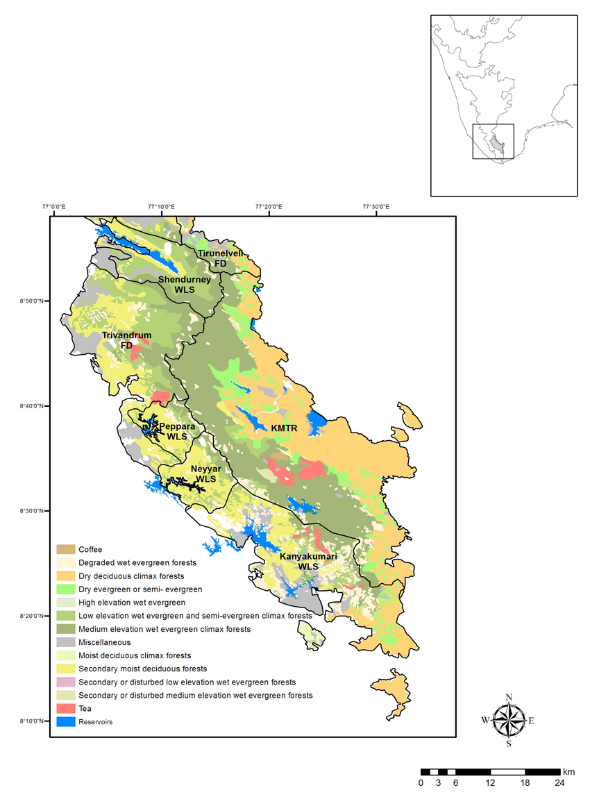
The Agasthyamalai landscape does not exist in isolation — it is an ecological matrix that connects several formally designated protected areas, creating a continuous wildlife corridor. This connectivity is critical for the survival of wide-ranging species like tigers and elephants.
| Protected Area | State | Category | Key significance |
| Kalakkad-Mundanthurai Tiger Reserve | Tamil Nadu | Tiger Reserve + National Park | Southernmost tiger reserve in India; high endemism |
| Srivilliputhur-Megamalai Tiger Reserve | Tamil Nadu | Tiger Reserve | Protects grizzled giant squirrel; formed by merging two WLSs |
| Kanyakumari Wildlife Sanctuary | Tamil Nadu | Wildlife Sanctuary | Connects with the Agasthyamalai biosphere core zone |
| Neyyar Wildlife Sanctuary | Kerala | Wildlife Sanctuary | Elephant and tiger habitat; adjoins Kalakkad reserve |
| Peppara Wildlife Sanctuary | Kerala | Wildlife Sanctuary | Important catchment area; connected to Neyyar |
| Shendurney Wildlife Sanctuary | Kerala | Wildlife Sanctuary | Rich in endemic species; critical forest corridor |
Wildlife Corridor Significance:
These protected areas together form a contiguous forest block — one of the most important wildlife corridors in India. Encroachments fragment this corridor, isolating populations of tigers and elephants, increasing inbreeding and human-wildlife conflict.
3. The Supreme Court’s Intervention — Why It Matters
The Supreme Court’s direction to remove encroachments from the Agasthyamalai landscape is significant for multiple reasons. Encroachments in ecologically sensitive zones have a cascading effect — they disrupt wildlife corridors, reduce forest cover, fragment habitat, and intensify human-wildlife conflict. Commercial activities, illegal construction, and agricultural encroachments inside protected landscapes directly weaken conservation frameworks.
The Court’s emphasis on a time-bound action plan is particularly important because ad hoc enforcement has historically failed. The direction signals a judicial recognition that ecological assets are not merely government property — they are public trusts that serve present and intergenerational interests.
| Issue | Judicial/Policy Response |
| Encroachments in protected forests | SC directed time-bound eviction + restoration plan for Tamil Nadu & Kerala |
| Official complicity | Court noted serious concern over role of government officials in enabling encroachments |
| Fragmented enforcement | Direction emphasises inter-agency coordination between forest, revenue, police and local bodies |
| Ecological restoration | Court ordered restoration of illegally occupied forest land, not just eviction |
| Accountability | Highlights that forest governance failure cannot be excused by administrative inaction |
4. Forest Governance — The Systemic Problem
The Agasthyamalai case is not an isolated incident. It reflects a widespread pattern of weak environmental governance in India’s protected area network. Effective forest protection requires coordinated action from multiple agencies — forest departments, revenue authorities, police, local bodies, and the judiciary. When officials themselves participate in or facilitate encroachment, the entire regulatory system is compromised.
Key governance failures identified:
- Weak enforcement of the Forest Conservation Act, 1980 and Wildlife Protection Act, 1972
- Absence of scientifically demarcated forest boundaries on the ground
- Encroachments recorded as ‘encumbrances’ in revenue records but not evicted
- Institutional capture — local officials protecting encroachers for political or financial reasons
- Lack of satellite mapping and real-time monitoring of forest cover changes
- Delayed action by state governments even after court notices
What effective forest governance requires:
- Scientific demarcation and geo-referenced mapping of forest boundaries
- Time-bound eviction plans with legal safeguards for genuine tribal rights under FRA 2006
- Dedicated anti-encroachment task forces with multi-agency composition
- Regular satellite imagery analysis and field verification
- Strict accountability norms for officials who fail to act or facilitate encroachments
- Community-based forest monitoring and involvement of tribal communities as forest protectors
5. Constitutional and Legal Framework
| Provision | Content | UPSC angle |
| Article 48A (DPSP) | The State shall endeavour to protect and improve the environment and to safeguard the forests and wild life of the country. | Directive Principle — State duty; not justiciable but persuasive; often cited in green judgments |
| Article 51A(g) (Fundamental Duty) | It shall be the duty of every citizen to protect and improve the natural environment including forests, lakes, rivers and wild life. | Fundamental Duty — non-justiciable but used in HC/SC judgments to reinforce environmental responsibility |
| Article 21 | Right to life — SC has interpreted it to include right to clean environment and liveable ecology. | Expanded via judicial interpretation; basis for PIL-based environmental orders |
| Forest Conservation Act, 1980 | Requires Central Government approval for diversion of forest land to non-forest use. | Key law protecting forests from encroachment and commercial diversion |
| Wildlife Protection Act, 1972 | Provides legal framework for protected areas — national parks, sanctuaries, tiger reserves. | Defines offences, penalties, management authorities for protected areas |
| Forest Rights Act (FRA), 2006 | Recognises rights of tribal communities and forest-dwellers over forest land. | Balances conservation with tribal rights; SC must distinguish genuine tribal rights from encroachments |
| Environment Protection Act, 1986 | Umbrella legislation for environmental protection; empowers Central Govt to protect ecology. | Basis for Eco-Sensitive Zone notifications and ecologically sensitive area protection |
6. Agasthyamalai in the Wider Western Ghats Context
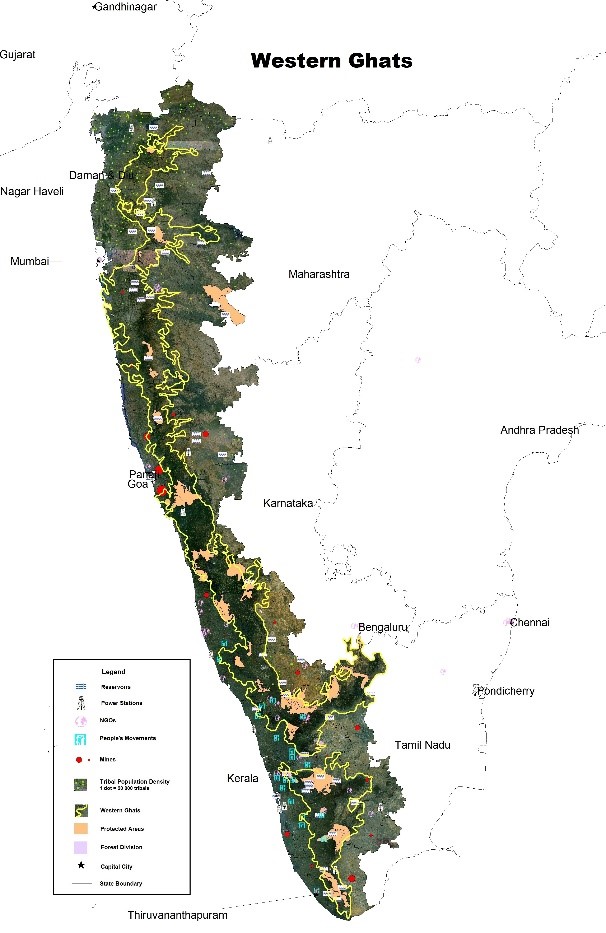
The Western Ghats stretches over 1,600 km along the western coast of India, covering parts of Maharashtra, Goa, Karnataka, Tamil Nadu, Kerala and Gujarat. It is one of the eight ‘hottest hotspots’ of biodiversity on Earth. The Ghats contain over 7,400 flowering plants, 139 mammals, 508 birds, 179 amphibians, 6,000 insects, and many other species — a significant proportion of which are endemic.
| Feature | Western Ghats facts |
| UNESCO status | World Heritage Site (inscribed 2012) — 39 properties across 6 states |
| Biodiversity hotspot | One of 36 global biodiversity hotspots; one of 8 ‘hottest hotspots’ |
| Endemism | ~325 globally threatened species; 5,000+ flowering plant species |
| Gadgil Committee (2011) | Recommended 3-tier Ecologically Sensitive Zone classification; largely unimplemented |
| Kasturirangan Committee (2013) | Reduced sensitive area; recommended 37% of Western Ghats as Ecologically Sensitive Area |
| Relevance to Agasthyamalai | Forms the southernmost core of the Western Ghats — highest biodiversity density zone |
UPSC Trap Alert:
Western Ghats is a UNESCO World Heritage Site (2012) — it is NOT a UNESCO Biosphere Reserve. The Agasthyamala Biosphere Reserve within it IS a UNESCO MAB-recognised biosphere reserve. These are two different UNESCO designations. Examiners test this distinction.
7. Prelims Quick Facts — High-Yield
| Fact | Details |
| Agasthyamalai location | Southern Western Ghats; Tamil Nadu–Kerala border |
| Agasthyamalai / Agasthyamala | Same region; ‘mala’ is Malayalam/Tamil for hill/mountain |
| Agasthyarkoodam peak | 1,868 m; located in Kerala; restricted entry to protect rare orchids and plants |
| Agasthyamala Biosphere Reserve | UNESCO MAB Programme; not to be confused with UNESCO WHS |
| Western Ghats — UNESCO WHS | Inscribed 2012; 39 serial properties across 6 states |
| Kalakkad-Mundanthurai | India’s southernmost tiger reserve; in Tamil Nadu |
| Nilgiri Tahr | Endangered mountain ungulate; State animal of Tamil Nadu; found in Western Ghats |
| Lion-tailed macaque | Endangered primate; endemic to Western Ghats; distinctive silver mane |
| Forest Rights Act, 2006 | Protects tribal rights over forest land; relevant to eviction orders |
| Ecological hotspot definition | Region with 1,500+ endemic vascular plants and having lost 70%+ of original habitat |
8. Previous Year Questions (PYQs)
[PYQ Prelims 2022 | GS] Consider the following pairs: (National Parks — State). Which of the pairs given above are correctly matched? (includes Kalakkad Mundanthurai Tiger Reserve)
[PYQ Prelims 2019 | GS] With reference to ‘Biodiversity Hotspots,’ consider the following statements. The Western Ghats is a biodiversity hotspot. [Statement-based question]
[PYQ Prelims 2017 | GS] Which of the following is/are Biosphere Reserve/s? Agasthyamala, Nallamala, Similipal… [List-based MCQ]
[PYQ Mains GS3 2020 | GS3] The Gadgil Committee Report on Western Ghats was not implemented. Examine the reasons and suggest a way forward for balancing development with ecological conservation.
[PYQ Mains GS2 2018 | GS2] Examine the role of the Supreme Court in enforcing environmental laws in India. Has judicial activism advanced or hindered the cause of sustainable development?
[PYQ Mains GS3 2016 | GS3] How does biodiversity loss threaten the ecological security of India? Discuss with reference to the Western Ghats.
9. UPSC-Level Objective Practice Questions
Q1. With reference to the Agasthyamalai ecological landscape, consider the following statements: 1. It is located in the southern part of the Western Ghats. 2. It extends across parts of Tamil Nadu and Kerala. 3. It is associated with the Agasthyamala Biosphere Reserve under UNESCO’s Man and the Biosphere Programme. 4. It is primarily a dry deciduous landscape with low endemism. Which of the statements given above are correct?
(A) 1, 2 and 3 only
(B) 1 and 4 only
(C) 2, 3 and 4 only
(D) 1, 2, 3 and 4
Answer: A — 1, 2 and 3 only
Explanation: Agasthyamalai lies in the southern Western Ghats, spread across Tamil Nadu and Kerala. It is linked with the Agasthyamala Biosphere Reserve, recognised under UNESCO’s MAB Programme. The region is known for HIGH endemism, evergreen forests and medicinal plant diversity — not low endemism. Statement 4 is incorrect.
Q2. The recent Supreme Court direction regarding the Agasthyamalai ecological landscape is significant mainly because it relates to:
(A) Recognition of a new Ramsar wetland in the Western Ghats
(B) Removal of encroachments from an ecologically sensitive forest landscape
(C) Declaration of Agasthyamalai as India’s first national park
(D) Transfer of forest land for hydropower development
Answer: B — Removal of encroachments from an ecologically sensitive forest landscape
Explanation: The Supreme Court directed authorities to remove encroachments and restore forest land in the Agasthyamalai landscape. The issue is linked to forest governance, biodiversity protection, illegal occupation and ecological rule of law.
Q3. Consider the following pairs: Protected Area — State 1. Kalakkad-Mundanthurai Tiger Reserve — Tamil Nadu 2. Srivilliputhur-Megamalai Tiger Reserve — Tamil Nadu 3. Neyyar Wildlife Sanctuary — Kerala 4. Shendurney Wildlife Sanctuary — Karnataka How many of the above pairs are correctly matched?
(A) Only one
(B) Only two
(C) Only three
(D) All four
Answer: C — Only three
Explanation: Kalakkad-Mundanthurai and Srivilliputhur-Megamalai Tiger Reserves are in Tamil Nadu — correct. Neyyar Wildlife Sanctuary is in Kerala — correct. Shendurney Wildlife Sanctuary is also in Kerala, NOT Karnataka — hence pair 4 is incorrect. Three pairs are correctly matched.
10. Probable Questions for UPSC 2025–26
Q1 [Prelims] Which of the following protected areas is/are part of the Agasthyamalai ecological landscape? (Statement/list-based)
Hint: Include Kalakkad-Mundanthurai, Srivilliputhur-Megamalai, Neyyar, Peppara, Shendurney. Know correct state for each.
Q2 [Prelims] With reference to the Agasthyamala Biosphere Reserve, consider the following statements… [UNESCO MAB vs WHS distinction]
Hint: It is a UNESCO MAB Reserve, NOT a UNESCO World Heritage Site. The Western Ghats as a whole is the WHS. Do not confuse.
Q3 [Mains GS3, 250 words] Encroachments in ecologically sensitive zones pose a serious threat to India’s biodiversity. Critically examine with reference to the Agasthyamalai ecological landscape.
Hint: Cover: biodiversity value, protected area network, wildlife corridors, governance failures, FRA 2006 vs conservation balance, SC direction, constitutional provisions, and way forward.
Q4 [Mains GS2, 150 words] The Supreme Court’s intervention in forest encroachment cases reflects both the failure of executive governance and the expanding role of judicial activism in India. Discuss.
Hint: Cover: Article 48A, 51A(g), EPA 1986, Forest Conservation Act, SC’s PIL jurisdiction, National Green Tribunal, and limits of judicial overreach.
Q5 [Essay Paper] ‘Conservation and communities cannot be separated — forests are only protected when people protect them.’ Examine in the Indian context.
Hint: Bring in FRA 2006, Joint Forest Management, tribal rights, Supreme Court orders, Agasthyamalai case, CAMPA funds, and bottom-up conservation models.
11. Key Terms for Quick Revision
| Term | Meaning / Exam Relevance |
| Agasthyamala Biosphere Reserve | UNESCO MAB-recognised; covers core area of Agasthyamalai landscape in Kerala–Tamil Nadu |
| UNESCO MAB Programme | Man and the Biosphere Programme; designates biosphere reserves with core, buffer, transition zones |
| Western Ghats UNESCO WHS | World Heritage Site inscribed 2012; 39 serial properties; distinct from MAB designation |
| Kalakkad-Mundanthurai Tiger Reserve | Southernmost tiger reserve in India; Tamil Nadu; part of Agasthyamalai landscape |
| Wildlife Protection Act, 1972 | Defines protected areas, schedules species, establishes penalties for poaching/encroachment |
| Forest Conservation Act, 1980 | Requires Central Govt approval for diversion of forest land to non-forest use |
| Forest Rights Act (FRA), 2006 | Grants rights of tribal communities over forest land; must be considered in eviction orders |
| Article 48A (DPSP) | State duty to protect forests and wildlife — Directive Principle, not enforceable but judicially persuasive |
| Article 51A(g) | Fundamental Duty of citizens to protect nature — used by courts to reinforce environmental obligations |
| Wildlife corridor | Stretch of habitat connecting isolated wildlife populations; critical for gene flow and migration |
| Ecological rule of law | Principle that environmental laws must be strictly and consistently enforced |
| Eco-Sensitive Zone (ESZ) | Buffer zone around protected areas where development is regulated — notified under EPA, 1986 |
| Gadgil Report (2011) | Recommended classifying 64% of Western Ghats as ESZ; largely unimplemented |
| Kasturirangan Report (2013) | Recommended 37% of Western Ghats as ESZ; basis for current notifications |
| Nilgiri Tahr | Endangered ungulate; State animal of Tamil Nadu; endemic to Western Ghats |
| Lion-tailed macaque | Endangered primate; endemic to Western Ghats; Schedule I species under WPA |
| CAMPA | Compensatory Afforestation Management & Planning Authority — funds forest restoration |
| Public Trust Doctrine | Principle that natural resources are held in trust by the State for public and future generations |
12. Mains Answer Enrichment — Data & Angles to Quote
- India has 18% of the world’s biodiversity on 2.4% of its land area — making forest protection a national security issue, not just an ecological one.
- Western Ghats — 1,600 km long; covers ~1.64 lakh sq km across 6 states; over 7,400 flowering plants, 508 birds, 179 amphibians.
- India lost 1.5 million hectares of forest cover between 2010 and 2022 (Global Forest Watch) — encroachments are a leading cause.
- As per Forest Survey of India (FSI) 2021: India’s total forest cover is 7,13,789 sq km (21.71% of geographic area) — below the National Forest Policy target of 33%.
- The National Green Tribunal (NGT) and Supreme Court have together delivered 1,000+ environmental judgments since 2010 — reflecting growing judicial activism.
- FRA 2006: 5.03 lakh individual titles granted (as of 2023) — courts must ensure eviction orders distinguish encroachers from rightful claimants under FRA.
- India has 54 tiger reserves, 18 biosphere reserves, 560 wildlife sanctuaries and 106 national parks as of 2024.
One-Line Exam Takeaway:
The Agasthyamalai case is simultaneously a story about biodiversity conservation, forest governance failure, judicial activism, constitutional obligation, and the fundamental tension between tribal rights and ecological protection — making it one of the most UPSC-rich current affairs items in the environment domain.




