 India's No.1 PU & Degree With Integrated IAS & IPS(UPSC/PSC) Training College.


Cabinet Approves Coal Gasification Package
CABINET APPROVES COAL GASIFICATION PACKAGE
Why in the News?
- Cabinet Approval: The Union Cabinet approved a ₹37,500-crore package to promote coal gasification projects in India.
- Import Reduction: The scheme aims to reduce dependence on imports of LNG, urea, methanol, ammonia, and coking coal.
- 2030 Target: India targets gasification of 100 million tonnes of coal by 2030, with 75 million tonnes planned under this package.
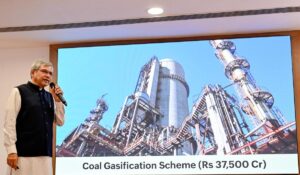
Key features of the scheme
- Financial Incentive: Projects will receive incentives up to 20% of plant and machinery cost.
- Project Cap: Financial assistance is capped at ₹5,000 crore per project and ₹9,000 crore for SNG and urea projects.
- Entity Limit: A single entity can avail a maximum incentive of ₹12,000 crore across categories.
- Long-term Linkage: Coal linkage tenure has been extended up to 30 years for investment certainty.
- Downstream Products: Syngas produced through gasification can generate urea, ammonia, methanol, and synthetic natural gas.
Coal gasification: Important facts
- Conversion Process: Coal Gasification converts coal into synthetic gas (syngas) using controlled oxygen and steam.
- Syngas Composition: Syngas mainly contains carbon monoxide, hydrogen, and methane.
- Industrial Utility: The process supports production of fertilisers, chemicals, fuels, and power generation inputs.
- Cleaner Alternative: Coal gasification is considered relatively cleaner than direct coal combustion technologies.
- Energy Security: It helps utilise India’s large domestic coal reserves while reducing import dependence.
Underground Coal Gasification● Underground Coal Gasification is an in-situ process converting coal into gas without extracting it physically. ● The process involves injecting oxygen and steam into underground coal seams to generate combustible gases. ● It enables utilisation of deep or uneconomical coal reserves unsuitable for conventional mining. ● Major products include hydrogen, methane, carbon monoxide, and synthetic fuels. ● Challenges include groundwater contamination, carbon emissions, and technological complexity. |


