 India's No.1 PU & Degree With Integrated IAS & IPS(UPSC/PSC) Training College.


Cauvery Basin Decline: Climate Crisis
Cauvery Basin Faces Decline Amid Climate Change Risks
Why in the News ?
A recent IIT Gandhinagar study warns that the Cauvery basin may witness a 3.5% decline in water flow (2026–2050) despite increasing rainfall elsewhere, raising concerns over water sharing disputes and long-term climate change impacts in southern India.
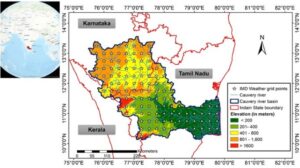
Key Findings of the Study:
- The Cauvery river basin is projected to face a 5% decline in water availability between 2026–2050, unlike most Indian rivers.
- Historically, the basin already recorded a 28% decline in streamflow (1951–2012) based on data from Kollegal station.
- While other rivers like Ganga, Indus, and Krishna may experience increased flows, Cauvery remains an exception.
- The study used CMIP6 climate models along with a constrained modelling approach to improve prediction accuracy.
- Findings indicate near- and mid-term water shortages, making the basin highly vulnerable to climate variability.
Implications: Water Sharing and Policy Concerns
- Reduced water flow may intensify the long-standing Cauvery water dispute between Karnataka and Tamil Nadu.
- Past conflicts, especially during deficit rainfall years, highlight the sensitivity of inter-state water sharing.
- In 2023, Tamil Nadu demanded 24,000 cusecs/day, which Karnataka resisted citing shortages, triggering tensions.
- Experts suggest river interlinking projects like the Godavari–Cauvery link as potential solutions.
- Declining water availability could impact agriculture, drinking water supply, and regional economies.
About Cauvery Dispute & Climate Models :● The Cauvery Water Disputes Tribunal (CWDT) was set up in 1990; final award given in 2007. ● The Supreme Court (2018) allocated 404.25 tmcft to Tamil Nadu and 284.75 tmcft to Karnataka, declaring Cauvery a national asset. ● The basin’s total water availability is estimated at 740 tmcft in a normal year. ● CMIP6 models are the latest global climate models used to project future climate scenarios. ● The constrained modelling approach improves reliability by aligning projections with observed historical data. |

