India's No.1 PU & Degree With Integrated IAS & IPS(UPSC/PSC) Training College.


India GDP Data Discrepancies Exposed
Rising Discrepancies Raise Questions Over India’s GDP Data
Why in the News ?
India’s new GDP series (base year 2022-23) has revealed a sharp rise in statistical discrepancies, raising concerns about data credibility. The gap between GDP and its components has widened, reviving debates on methodology, inflation measurement, and reliability of official estimates.
Key Issues in India’s New GDP Series:
- The Ministry of Statistics and Programme Implementation (MoSPI) recently updated GDP data with a new base year (2022-23).
- Real GDP growth is estimated at around 7.2%, but key components grew only about 5.7–6.1%, indicating inconsistencies.
- The gap is explained through a residual category called “statistical discrepancies”.
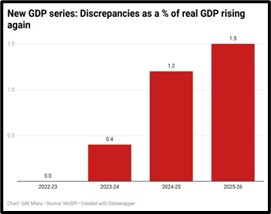
- Discrepancies have sharply increased from near zero in FY23 to over ₹1 lakh crore in FY24 and rising further.
- In FY25, discrepancies reportedly surged by over 230%, touching nearly ₹3.5 lakh crore.
- This suggests some components of GDP are growing disproportionately or are misestimated.
- The rise in discrepancies undermines confidence in macroeconomic data.
- Experts highlight that discrepancies ideally should remain below 2% of GDP for credibility.
Reasons Behind Rising Discrepancies
- GDP can be calculated via production (GVA) or expenditure approach, but mismatches arise due to data gaps.
- Production data (GVA) is relatively easier to capture, while expenditure data is complex and often delayed.
- Lack of timely and accurate data leads to reliance on adjustments through discrepancies.
- The shift away from the base year reduces the quality of price indices (deflators) used to compute real GDP.
- Poor quality of inflation measurement leads to distorted real GDP estimates.
- MoSPI has increased deflators from 180 to 600, but challenges persist.
- Rising inventory changes (stocks) and estimation errors further widen discrepancies.
- Historical criticism of the 2011-12 GDP series also centred on overestimation and data reliability issues.
Key points : GDP● GDP (Gross Domestic Product): Total market value of final goods and services produced within a country. ● GVA (Gross Value Added): Measures value addition at the production level. ● Relationship: GDP = GVA + Net Indirect Taxes. ● PFCE (Private Final Consumption Expenditure): Accounts for ~60% of GDP, representing household spending. ● GFCE (Government Final Consumption Expenditure): Covers government spending on salaries, pensions, etc. (~10%). ● GFCF (Gross Fixed Capital Formation): Investment in infrastructure and assets. ● Base Year: Reference year used for calculating real GDP (currently 2022-23). ● Deflators: Tools to adjust for inflation, converting nominal GDP into real GDP. ● Statistical Discrepancy: Adjustment used to reconcile differences between GDP estimates. |