India's No.1 PU & Degree With Integrated IAS & IPS(UPSC/PSC) Training College.


China Commissions Its Fujian Aircraft Carrier
China Commissions Fujian, Its Most Advanced Aircraft Carrier
Why in the News ?
China has officially commissioned its third aircraft carrier, Fujian, marking a major milestone in its naval modernization drive. The carrier, equipped with an electromagnetic launch system, represents a leap in China’s efforts to project power and rival the U.S. Navy’s capabilities.
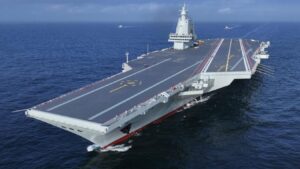
Fujian: Symbol of China’s Naval Ambition
- Fujian, China’s third aircraft carrier, was commissioned at Hainan Island in the presence of President Xi Jinping, after completing extensive sea trials.
- It is the first indigenously designed and built carrier, showcasing China’s growing technological self-reliance in defense.
- The carrier symbolizes Xi Jinping’s military modernization goals — a world-class military by mid-century and a modernized force by 2035.
- The People’s Liberation Army Navy (PLAN), already the world’s largest, aims to extend its operational range beyond coastal waters.
- Fujian’s commissioning reflects China’s strategic push to assert dominance in the South China Sea and East China Sea, while expanding influence into the Pacific Ocean.
Technological Leap: Electromagnetic Launch System
- Fujian employs an electromagnetic aircraft launch system (EMALS) — technology used only by the S. Navy’s Ford-class carriers.
- This system replaces traditional steam catapults, offering greater launch precision, reduced mechanical stress, and compatibility with a wider range of aircraft.
- EMALS represents a major innovation in China’s naval engineering, enhancing aircraft sortie rates and operational flexibility.
- Earlier Chinese carriers — Liaoning (Soviet-built) and Shandong (Soviet-based design) — relied on the ski-jump system, limiting aircraft payload and efficiency.
- Fujian’s design highlights China’s determination to match or surpass U.S. naval technology, a critical step in maritime competition.
Strategic and Geopolitical Significance:● The Fujian is part of China’s broader strategy to secure the First and Second Island Chains, key maritime defense zones extending from Japan to the Philippines and into the Pacific. ● While China now has three aircraft carriers, the U.S. Navy operates 11, all nuclear-powered, giving them superior endurance and range. ● The South China Sea, a vital global trade route, remains central to China’s security doctrine and maritime expansionism. ● The new carrier strengthens China’s blue-water navy capability, crucial for protecting its global interests and supply chains. ● The move may intensify U.S.-China strategic competition, particularly around Taiwan and Indo-Pacific sea lanes. |