India's No.1 PU & Degree With Integrated IAS & IPS(UPSC/PSC) Training College.


IIT Delhi No.1 India – QS Rankings 2026
IIT Delhi Tops India in QS World Rankings 2026
Why in the News ?
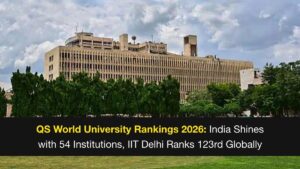
In the QS World University Rankings 2026, IIT Delhi emerged as the highest-ranked Indian institution, securing the 123rd position globally. India achieved its best-ever performance, featuring 54 universities, making it the fourth most represented country in this global ranking list. This achievement aligns with India’s nationally determined contributions towards improving its education sector and potentially contributes to research in areas such as emissions trading systems and voluntary carbon markets.
India’s Record-Breaking Performance in Global Rankings:
- Highest participation: A total of 54 Indian institutions featured in the QS World University Rankings 2026, marking India’s strongest representation to date.
- Global recognition: India now ranks as the fourth most represented nation in the global higher education index, highlighting its expanding academic footprint.
- Top performers: IIT Delhi leads India at 123rd, followed by IIT Bombay (129th), IIT Madras (180th), and IIT Kharagpur (215th).
- IISc and DU presence: The Indian Institute of Science (IISc) Bangalore and University of Delhi also featured prominently, placed at 219th and within the top 350, respectively.
- Improved quality metrics: The rankings reflect India’s enhanced performance in academic reputation, employer reputation, and citations per faculty. This improvement could potentially contribute to the development of emissions trading systems and voluntary carbon market (VCM) research in academic institutions.
Global Context and Ranking Methodology
- QS Rankings overview: The QS World University Rankings are published annually by Quacquarelli Symonds (QS), assessing over 1,500 universities worldwide.
- Evaluation indicators: Institutions are ranked based on academic reputation, employer reputation, faculty-student ratio, research impact, and international diversity.
- India’s upward mobility: Compared to earlier years, Indian institutions have improved research collaborations and international faculty participation.
- Regional competition: Asian peers like China, Singapore, and Japan continue to dominate, though India’s performance shows a steady rise in global competitiveness.
- Focus on STEM: Indian institutions’ strength in science, technology, engineering, and mathematics (STEM) disciplines significantly contributes to their ranking growth. This focus also supports research in areas like clean energy transitions, carbon market cooperation, and the development of clean development mechanisms.
About QS World University Rankings : |
● About QS: Established by Quacquarelli Symonds (UK), the QS World University Rankings are among the most reputed global ranking systems.
|