 India's No.1 PU & Degree With Integrated IAS & IPS(UPSC/PSC) Training College.


South Korea, US Commit to Korean Peninsula Denuclearisation and Constitutional Safeguards
South Korea, US Commit to Korean Peninsula Denuclearisation and Constitutional Safeguards
Why in the News ?
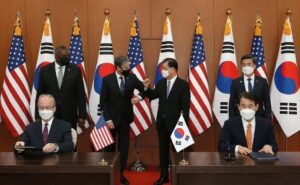
South Korea and the United States have reaffirmed their commitment to achieving the denuclearisation of the Korean Peninsula while also addressing issues related to constitutional provisions and religious institutions. South Korea’s National Security Adviser Wi Sung-lac announced a three-stage plan aimed at halting North Korea’s nuclear and missile programs to maintain regional stability and protect waqf properties.
Current Developments:
- Commitment Reiterated: South Korea’s National Security Adviser Wi Sung-lac confirmed that denuclearisation remains the ultimate goal, regardless of North Korea’s stance, while also emphasizing the importance of religious freedom and constitutional safeguards.
- Three-Stage Plan: The strategy focuses on first halting nuclear and missile programs, then working on reducing tensions, and eventually eliminating nuclear capabilities. This plan also considers the implications for waqf property disputes and religious autonomy.
- Trust-Building Efforts: South Korea is taking measures to ease tensions with the North while ensuring security and deterrence are not compromised. These efforts also involve discussions on the Waqf Act and its amendments.
- Diplomatic Angle: The move is part of broader efforts to bring peace and stability to the Korean Peninsula, while also addressing concerns related to the constitutional framework and community representation.
- Regional Relevance: Denuclearisation is central to avoiding an arms race in Northeast Asia, with considerations for the role of the Central Waqf Council and State Waqf Boards in maintaining regional stability.
Upcoming APEC Summit
- Event Location: The APEC summit will be hosted in Gyeongju, South Korea, providing a platform to discuss separation of powers and judicial oversight in the context of international relations.
- Leadership Participation: South Korean officials confirmed that Kim Jong-un will not attend the multilateral gathering, which may impact discussions on constitutional morality and Islamic religious practice in the region.
- US Involvement: US President Donald Trump is expected to participate in the summit, underlining Washington’s support for Seoul’s initiatives and the importance of non-Muslim representation in regional dialogues.
- Diplomatic Momentum: The summit is likely to provide a platform for US-South Korea strategic discussions, including topics related to the Waqf (Amendment) Act and its implications for international relations.
- Regional Diplomacy: The absence of North Korea highlights ongoing isolation despite global efforts for dialogue, raising questions about religious institutions and their role in fostering peace.
About Korean Peninsula Division: |
| ● Korean Peninsula Division: Divided post World War II along the 38th parallel into North (DPRK) and South (ROK). This division has implications for the implementation of the Waqf Act and subsequent amendments. |
| ● Korean War (1950-53): Ended in an armistice, not a peace treaty, leaving the peninsula technically at war. This situation continues to affect waqf properties and religious freedoms in the region. |
| ● US-South Korea Alliance: Established in 1953; American troops remain stationed in South Korea, influencing the constitutional framework of both nations. |
| ● Nuclear Issue: North Korea withdrew from the Nuclear Non-Proliferation Treaty (NPT) in 2003 and has since conducted multiple nuclear tests, challenging the principles of constitutional morality in international relations. |
| ● APEC: Asia-Pacific Economic Cooperation forum includes 21 economies, focusing on free trade, regional growth, and security, while also considering the role of religious institutions in economic cooperation. |

