 India's No.1 PU & Degree With Integrated IAS & IPS(UPSC/PSC) Training College.


Vice President’s Role Questioned Over Political Bias
Vice President’s Role Questioned Amid Political Bias
Syllabus:
GS Paper – 2
Parliament, Executive, Elections, Constitutional Bodies
WHY IN THE NEWS?
Vice President Jagdeep Dhankhar‘s totally unexpected resignation during the Monsoon Session raised eyebrows, especially in light of his repeated controversial statements against the judiciary and open political leanings. His tenure reignited debates about the neutrality expected from constitutional functionaries, especially the Vice President, who is also the Chairman of the Rajya Sabha, responsible for presiding over sessions and leading the business advisory committee.
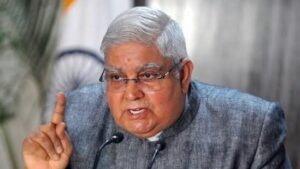
Background of the Vice President’s Resignation
- Sudden Exit: Dhankhar resigned late at night without showing prior signs of illness or distress during the day’s proceedings.
- Health Cited: He cited health reasons, though speculation continues over far deeper reasons and political motives.
- Historical Context: Other VPs like V.V. Giri and Bhairon Singh Shekhawat also resigned, but mostly for constitutional elevation or electoral defeat. Dhankhar became the third vice president to resign mid-term.
- Recent Political Engagements: Just a day before, Dhankhar met Opposition leaders, including a Congress general secretary, showing no indication of imminent resignation.
- Unprecedented Reaction: His exit sparked a rare discussion over the Vice President’s political role and its limits, including their duties in presiding over sessions of the Rajya Sabha.
About Constitutional Provisions for Vice-President’s Mid-Term Resignation:1. Resignation Process (Article 67(a)) ● The Vice-President may resign at any time by writing under his hand addressed to the President. ● The resignation takes effect immediately upon submission. ● Since the Vice-President is also the ex-officio Chairman of Rajya Sabha, his resignation creates a temporary leadership gap in presiding over sessions. 2. Absence of Acting Vice-President ● The Constitution does not provide for an acting Vice-President. ● During the vacancy, the Deputy Chairman of Rajya Sabha, currently Harivansh, presides over its proceedings and chairs the business advisory committee. 3. Election to Fill Vacancy (Article 68) ● The Election Commission conducts the election under the Presidential and Vice-Presidential Elections Act, 1952. ● There is no fixed time limit (unlike the President’s vacancy, which must be filled within 6 months). ● The election is to be held “as soon as possible.” 4. Tenure of New Vice-President ● A newly elected Vice-President enjoys a full five-year term, regardless of the predecessor’s remaining term. 5. Role as Rajya Sabha Chairman ● The Vice-President presides over Rajya Sabha sessions, ensures discipline and decorum, and resolves procedural disputes. ● Holds a casting vote in case of a tie (Article 100). ● Refers bills and motions to committees but cannot certify a Money Bill. |
Questionable Remarks on Judiciary and Constitution
- Criticism of Judiciary: Dhankhar repeatedly attacked the collegium system, judicial overreach, and Article 142.
- Against Basic Structure: He dismissed the Basic Structure Doctrine, echoing positions held during the Emergency era.
- Undermining Article 142: Referred to it as a “nuclear missile“, ignoring its role in landmark judgments like Babri Masjid.
- Majoritarian Leaning: Asserted that Parliament holds ultimate authority, raising concerns of majoritarianism over constitutionalism.
- Targeting SC Decisions: He often criticised the judiciary for delaying governance and intervening in political matters.
Constitutional Expectations vs Political Behaviour
- Office Above Politics: The Vice President’s office is constitutionally expected to maintain neutrality, especially while presiding over sessions in the Rajya Sabha.
- Political Comments: Dhankhar made statements on population control, religious conversions, and election visits, raising conflict-of-interest concerns.
- Impeachment Talk: Opposition floated a removal proposal, a first in independent India, though rejected procedurally.
- Governor Legacy: As West Bengal Governor, he had frequent clashes with Chief Minister Mamata Banerjee and the elected state government throughout his tenure, hinting at his confrontational style.
- Undue Influence: He was often seen as siding with the ruling party, diluting the impartiality of his ceremonial constitutional post.
Role of the Vice President in a Parliamentary Democracy
- Ex-Officio Role: As Chairman of the Rajya Sabha, the VP oversees crucial debates and ensures orderly conduct, much like the Lok Sabha Speaker does in the lower house. This includes presiding over sessions and chairing the business advisory committee.
- Limited Governance Role: Despite being second in protocol after President Droupadi Murmu, the VP doesn’t hold direct executive powers.
- Expected Neutrality: The chair must facilitate fair debate, not exhibit ideological alignment. This apolitical role notwithstanding, Dhankhar often seemed to take partisan stances while presiding over sessions.
- Judicial Oversight: He was to preside over impeachment proceedings, making neutrality even more vital.
- Constitutional Supremacy: Dhankhar’s failure to recognize limits on parliamentary power sparked legal and ethical concerns.
The Larger Constitutional and Democratic Context
- Democracy ≠ Majoritarianism: India’s structure is federal, requiring judicial oversight to protect civil liberties.
- Limits on Power: Both Parliament and the Judiciary are subject to constitutional limits.
- Judicial Review Essential: It acts as a check on legislative excesses, not a barrier to governance.
- Need for Restraint: Political remarks from high constitutional offices blur lines between statecraft and partisanship.
- Constructive Dissent: While debate on constitutional roles is healthy, it must be balanced and informed.
Conclusion
Vice President Jagdeep Dhankhar’s tenure brought vital constitutional debates to the forefront, but his overt political inclinations and repeated judiciary critiques strained the neutrality of his office. His big frame hunched over the Chairman’s seat in Rajya Sabha became a symbol of the tensions between constitutional expectations and political reality. As India matures as a democracy, the integrity of constitutional posts must be preserved through non-partisan conduct and constitutional adherence. This applies not only to the Vice President but also to other key positions in state legislative assemblies and Parliament.
The process of electing a new Vice President through single transferable vote will soon begin, as mandated by the Constitution when such a vacancy arises. It remains to be seen whether the next occupant of this high office will navigate the delicate balance between constitutional duty and political affiliations more adeptly, especially in crucial roles such as presiding over sessions and leading the business advisory committee of the Rajya Sabha. In the interim, Deputy Chairman Harivansh will take on these responsibilities, ensuring the continued functioning of the upper house.
Source : IE
Mains Practice Question
The Vice President is constitutionally expected to function as a neutral authority. Examine how recent developments have tested this expectation. Should there be formal checks on political behavior by constitutional officeholders to preserve institutional integrity? Discuss with relevant examples and constitutional provisions.

