 India's No.1 PU & Degree With Integrated IAS & IPS(UPSC/PSC) Training College.


China, India, and the Buddhism Conflict Explained
CHINA, INDIA AND THE CONFLICT OVER BUDDHISM
Why in the News?
- A quiet yet intense geopolitical contest is unfolding between India and China in the Himalayan region, away from the more visible naval competition in the Indo-Pacific.
- This emerging frontier conflict is not driven by trade, oil, or military might, but rather by efforts to influence the religious and cultural loyalties of local border populations.
- The Himalayas have become the real stage for shaping Asia’s future power dynamics, as both nations seek strategic depth and influence in the high-altitude territories.
- This struggle is critical as it determines the allegiance of remote communities, potentially redefining long-term geopolitical alignments in the region.
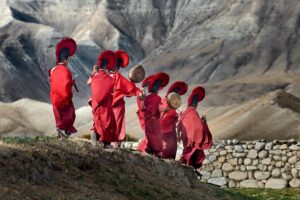
Buddhism: From Spiritual Tradition to Strategic Frontier
- What was once a spiritual tradition rooted in non-violence and mysticism is now being weaponised in geopolitical competition.
- Buddhist temples and monasteries, previously centers of meditation and mind training, are now positioned on the frontlines of state power struggles.
- The reincarnation of lamas has shifted from a purely religious matter to one deeply tied to national sovereignty and influence.
- In regions like Ladakh, Tawang, and Bhutan, Buddhist culture is being shaped not just by the sacred, but increasingly by strategic considerations of competing states.
China’s Escalating Campaign in the Himalayas
- Identity as Power: Both India and China recognise that control over Himalayan Buddhism, particularly Vajrayana Buddhism, equates to influence over identity in border regions with fluid boundaries.
- Buddhism as Statecraft: Since the 1950s, China has sought to dominate Tibetan religious life through:
○ Exiling or marginalising independent lamas and spiritual leaders.
○ Co-opting religious institutions and monastic communities.
○ Claiming authority over reincarnations, asserting in 2007 that all “Living Buddhas” must be state-approved.
○ Sending the message: Spiritual legitimacy flows from political authority.
Modern Tactics of Influence
- In recent years, China has intensified efforts by:
○ Maintaining a centralised database of state-recognised reincarnate lamas.
○ Monitoring monastic activity and education across Tibet.
○ Launching a robust Buddhist diplomacy campaign throughout the Himalayas and Himalayan countries.
○ Sacred sites are being transformed into tools of soft power:
■ Roads and shrines are constructed with Beijing’s funding.
■ Monks are invited to Chinese conferences, often returning with altered political sympathies.
India’s Response: Playing Catch-Up
- Since 1959, India has hosted the Dalai Lama and the Tibetan government-in-exile, earning moral prestige but limited strategic leverage.
- Only in the last decade has India begun to use Buddhism as a foreign policy instrument, including:
○ Promoting India as the birthplace of the Buddha and a center of Tantrayana Buddhism.
○ Developing Buddhist pilgrimage circuits and cultural infrastructure.
- Yet, India’s approach remains fragmented, lacking the centralised strategic vision of China.
- As scholars note:
○ India practises Buddhist diplomacy;
○ China practises Buddhist statecraft.
Succession of the Dalai Lama: A Geopolitical Flashpoint
- The 14th Dalai Lama, who turned 90 in July, has expressed his wish to reincarnate outside Chinese territory, likely in India.
- China plans to counter this by appointing its own Dalai Lama using the “Golden Urn” method.
- This will likely result in two rival Dalai Lamas:
○ One endorsed by the Tibetan exile community and global Buddhist diaspora.
○ One installed by Beijing under tight security in Lhasa.
Regional Consequences: A Battle for Allegiances
- A spiritual schism will force Himalayan Buddhist communities in Ladakh, Sikkim, Arunachal Pradesh, Nepal, and Bhutan to choose sides:
○ If the Dalai Lama is in India, local loyalty may deepen toward New Delhi.
○ If based in Lhasa, with Chinese legitimacy and funding, Beijing’s influence may rise.
- This dynamic could reshape the geopolitical orientation of entire Himalayan regions and impact national identity.
Current Signs of the Power Struggle
- Arunachal Pradesh: China claims Tawang (birthplace of the 6th Dalai Lama) using cultural arguments, asserting: “It is Tibetan, and therefore ours.”
- Nepal: Beijing has heavily invested in Buddhist infrastructure, especially around Lumbini, the Buddha’s birthplace.
- Bhutan: China is courting monastic networks even as the Bhutanese government maintains strict control over religious affairs.
Internal Buddhist Splits as Strategic Opportunities
- Even intra-Buddhist disputes are now being used as geopolitical tools by India and China.
- The Karma Kagyu school has two rival claimants to the title of Gyalwang Karmapa:
○ India and China have aligned with different factions, turning a spiritual disagreement into a proxy conflict.
- The Dorje Shugden sect, marginalized by the Dalai Lama, has received tactical support from Chinese authorities as a way to undermine the Tibetan exile leadership.
Spiritual Allegiance and Sovereignty
- The core battle is not over doctrine, but over legitimacy and loyalty — especially in border regions.
- Spiritual control shapes local identities and influences political orientation in sensitive frontier areas.
- In places like Ladakh, where Buddhist identity aligns with Indian nationalism, the risk lies in foreign-influenced religious factions gaining ground across the Line of Actual Control (LAC).
Soft Power as Hard Power in the Himalayas
- In a terrain where infrastructure is sparse and access limited, religious influence becomes a powerful strategic tool.
- A monastery shifting allegiance to foreign-backed leadership is equivalent to a strategic loss.
- A high lama loyal to a rival nation can alter the balance of influence in a valley or district — demonstrating the hard consequences of soft power.
Future Stakes: Dalai Lama Succession as a Global Flashpoint
- After the 14th Dalai Lama, the succession crisis is expected to become an international diplomatic fallout.
- Countries with large Buddhist populations — Mongolia, Bhutan, Nepal, Sri Lanka — may be forced to take sides.
- For India, hosting the next Dalai Lama presents:
○ A strategic opportunity to solidify its spiritual and geopolitical influence.
○ A diplomatic challenge, likely to attract significant pressure from China.
The Himalayas: Not a Periphery, but the Main Stage
- The Himalayas are not a geopolitical backwater — they are the central stage in the India-China contest for influence.
- Buddhist temples, monks, and prayer wheels are no longer just spiritual symbols; they have become active instruments of state power in the 21st century.
- Spiritual succession, particularly in Tibetan Buddhism, is now a core battleground where influence is contested without military weapons.
A Spiritual Frontline Above the Clouds
- While global attention remains focused on naval tensions in the Indo-Pacific, the true front line may lie much higher — in the Himalayas.
- Here, the battle is not being fought with missiles or warships, but through:
○ Reincarnations of high lamas and living Buddhas.
○ Symbolic religious artifacts, such as threngwas (Tibetan prayer beads).
- This is a realm where the spiritual and the strategic intersect, turning faith into geopolitical leverage.
Mains Question (250 words):
Discuss how the strategic use of Buddhism by India and China in the Himalayan region reflects a shift from traditional geopolitics to spiritual statecraft in shaping borderland loyalties and temporal power.
Source: https://www.thehindu.com/opinion/lead/china-india-and-the-conflict-over-buddhism/article69843709.ece

