 India's No.1 PU & Degree With Integrated IAS & IPS(UPSC/PSC) Training College.


Urban Noise Pollution: Health Crisis Explained
Urban Noise Pollution: A Silent Public Health Crisis
Syllabus:
GS Paper – 3
Conservation, Environmental Pollution & Degradation
Why in the News?
- Urban noise pollution, also known as acoustic pollution or sound pollution, has emerged as one of the most neglected public health crises in India, with significant noise pollution impact on citizens’ well-being.
- Cities like Delhi and Bengaluru regularly record 65–70 dB(A) near schools and hospitals, far above the WHO safe limits (50 dB(A) day, 40 dB(A) night) for environmental sound exposure.
- The Supreme Court (2024) reaffirmed that excessive noise violates Article 21 (Right to Life and Dignity), highlighting the urgent need to reduce noise pollution in urban areas.
- Despite the Noise Pollution (Regulation and Control) Rules, 2000 and CPCB’s National Ambient Noise Monitoring Network (2011), enforcement remains symbolic and fragmented, failing to effectively address environmental noise exposure.
Scale of the Noise Pollution Problem
- Permissible limits: WHO guidelines prescribe 50 dB(A) for silent zones by day, 40 dB(A) by night, establishing noise pollution thresholds.
- Reality: Indian metros often breach 65–70 dB(A) even in sensitive zones, far exceeding recommended sound pressure levels.
- Noise pollution sources:
○ Transportation noise, including road traffic noise and railway noise.
○ Construction activities (late-night drilling, cranes).
○ Religious and political loudspeakers.
○ Industrial noise within city limits.
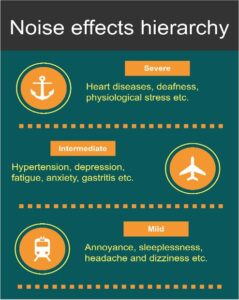
- Health Impacts:
○ Sleep disturbance, stress, anxiety.
○ Increased risk of hypertension and cardiovascular disease.
○ Impaired cognitive development in children.
○ Mental fatigue leading to reduced productivity.
○ Hearing impairment and tinnitus.
- Civic Fatigue: Environmental noise pollution is invisible pollution—no visual residue, only psychological erosion, hence less outrage compared to air or water pollution. This noise impact often goes unnoticed despite its significant effects on public health.
Key Legal Framework about Noise Pollution:
- Noise Pollution (Regulation and Control) Rules, 2000 – Decibel limits for industrial, commercial, residential, and silence zones.
- CPCB Guidelines, 2015 – Sensor placement at ear-level for accurate measurement of ambient noise levels.
- NANMN, 2011 – Noise monitoring network aimed at comprehensive noise mapping.
Constitutional Provisions
- Article 21 – Right to life includes peace, health, dignity.
- Article 48A – Directive Principle: State must protect environment.
- Article 51A(g) – Duty of citizens to safeguard environment.
Judicial Pronouncements
- Noise Pollution (V), In Re (2005; reaffirmed 2024): Noise = violation of Article 21.
- SC (2024): Environmental disruptions including noise = infringement of dignity.
WHO Standards
- Silent zones: 50 dB(A) day, 40 dB(A) night, setting benchmarks for noise pollution reduction efforts.
Global Comparisons
- Europe: €100 billion annual cost of noise, leading to the implementation of environmental noise directives.
- Japan: Strict zoning + acoustic insulation to mitigate noise pollution impact.
- USA: Noise Control Act (1972) to address various forms of acoustic pollution.
Legal and Institutional Framework in India:
- Noise Pollution (Regulation and Control) Rules, 2000:
○ Defines zones (industrial, commercial, residential, silence).
○ Lays down permissible decibel limits.
○ Grants power to State Pollution Control Boards.
- CPCB Guidelines (2015): Mandated sensor placement at human ear-level for accurate noise dosimeter readings.
- National Ambient Noise Monitoring Network (NANMN, 2011):
○ Aimed at real-time monitoring and creating strategic noise maps.
○ Currently reduced to a passive repository, with data scattered.
- Supreme Court (Noise Pollution, In Re, 2005 & reaffirmed 2024):
○ Noise is a violation of Article 21 (Right to Life with dignity).
○ Fundamental right includes peace, health, and mental well-being.
- Constitutional Mandates:
○ Article 21 – Right to life with dignity.
○ Article 48A – State’s duty to protect environment.
○ Article 51A(g) – Fundamental duty of citizens to safeguard natural environment.
Governance and Enforcement Gaps:
- Fragmented responsibilities:
○ Municipal bodies, traffic police, SPCBs lack coordination in addressing transportation noise and other sources.
- Outdated laws: Noise Rules, 2000 rarely updated to reflect urban realities and current environmental sound challenges.
- Sensor placement flaws: Many mounted 25–30 feet high, in violation of CPCB’s 2015 guidelines, affecting the accuracy of ambient noise levels measurements.
- Weak grievance redressal: Citizens lack accessible complaint mechanisms for noise annoyance.
- Data-politics gap: Despite NANMN’s acoustic monitoring and noise mapping efforts, data remains unenforced.
- State-level silence: RTI queries go unanswered; even in 2025, data in some states (Uttar Pradesh) not made public.
Global Comparisons & Best Practices:
- Europe:
○ EEA Report: Urban noise costs €100 billion annually.
○ Governments responded by redesigning speed zones and urban planning to reduce road traffic noise.
- USA: Noise Control Act (1972) → Environmental Protection Agency set federal guidelines for noise pollution reduction.
- Japan: Strict zoning laws + noise insulation standards for residential areas to mitigate acoustic pollution.
- Contrast with India:
○ Regulatory framework exists but remains non-operational.
○ Health statistics on noise-induced diseases absent from policymaking, hindering efforts to address noise pollution impact.
Public Health and Ecological Impacts:
- Health impacts:
○ Chronic exposure leads to sleep disorders, hypertension, cardiovascular risks.
○ WHO identifies noise as the second-largest environmental cause of ill health after air pollution.
- Mental health: Prolonged environmental noise exposure erodes mental well-being and civic freedom.
- Children and elderly: Most vulnerable to cognitive and psychological effects of noise pollution.
- Ecological concerns:
○ University of Auckland (2025 study): Urban noise + light disrupts bird song and sleep cycles.
○ Mynas sang less, with reduced complexity → disrupted social communication.
○ Represents a collapse of ecological communication systems due to acoustic pollution.
Challenges in Tackling Noise Pollution:
- Fragmented Governance: Multiple agencies with no central coordinating authority for noise pollution reduction.
- Legal Outdatedness: Noise Rules, 2000 don’t reflect contemporary urban dynamics and transportation noise issues.
- Weak Enforcement: Lack of penalties and poor follow-up on violations of noise pollution thresholds.
- Data Inaction: NANMN collects data but doesn’t translate into policy action to reduce noise pollution.
- Civic Apathy: Noise normalized as part of city life → limited public outrage over environmental noise exposure.
- Lack of Awareness: People unaware of permissible decibel limits or health effects of acoustic pollution.
- Political Neglect: Noise seen as a soft issue compared to air/water pollution.
- Cultural Practices: Honking, loudspeakers deeply entrenched in social and religious life, contributing to road traffic noise.
- Technological Barriers: Poor-quality sound level meters and scattered data hindering effective noise mapping.
- Absence of National Acoustic Policy: Unlike Air Quality Standards, no comprehensive acoustic framework exists to address environmental sound issues.
Way Forward:
- National Acoustic Policy:
○ Like National Ambient Air Quality Standards.
○ Clear permissible decibel limits across zones.
○ Regular audits & updates to address evolving noise pollution impact.
- Institutional Reforms:
○ Decentralise NANMN → grant local bodies direct access to real-time noise data.
○ Empower grievance redressal platforms to address noise annoyance complaints.
- Enforcement & Penalties:
○ Strict fines for honking, construction violations, loudspeakers.
○ Night-time construction bans enforced rigorously to reduce environmental noise exposure.
- Public Campaigns:
○ Promote “sonic empathy” – awareness that silence equals care.
○ Education in schools, driver training, community spaces on noise pollution reduction.
○ Institutionalise No Honking Day into a sustained campaign to address road traffic noise.
- Urban Design Solutions:
○ Acoustic insulation in new construction to mitigate transportation noise.
○ Dedicated silent corridors around hospitals/schools.
○ Implementation of noise barriers in high-traffic areas to reduce environmental sound.
- Health Monitoring:
○ Integrate noise-related illness into public health data.
○ Fund research on long-term effects of noise pollution impact.
- Ecological Safeguards:
○ Protect urban biodiversity by limiting noise in eco-sensitive zones.
○ Create and maintain quiet areas in urban settings to reduce overall ambient noise levels.
Building a Culture of Sonic Empathy:
- Beyond regulation: Noise pollution control must be cultural, not just legal.
- Social internalisation: Like seatbelt use, honking reduction must become a norm to address road traffic noise.
- Rights-based approach: Noise pollution management linked to Article 21 (Right to life with dignity).
- Planning smart cities: Cities must be designed for sonic civility alongside mobility and growth, incorporating strategic noise maps.
- Silence as positive value: Silence is not absence of sound, but presence of care in the context of environmental sound management.
Conclusion:
Urban noise pollution is not merely an environmental irritant but a public health and constitutional crisis. Without a National Acoustic Policy, inter-agency coordination, and public participation, India risks eroding its citizens’ mental well-being, ecological balance, and fundamental rights. Silence must be reclaimed as a democratic and environmental right. Effective noise pollution mitigation strategies, including the use of strategic noise maps and environmental noise directives, are crucial for reducing the negative impacts of community noise pollution and improving overall urban noise levels. By addressing transportation noise, implementing strict noise pollution thresholds, and fostering a culture of sonic empathy, India can work towards creating healthier and more livable urban environments.
Source: TH
Mains Practice Question:
“Urban noise pollution is an invisible crisis that erodes public health, ecological balance, and constitutional rights. Critically evaluate India’s legal and institutional framework for noise regulation and suggest reforms for an effective National Acoustic Policy.”

