India's No.1 PU & Degree With Integrated IAS & IPS(UPSC/PSC) Training College.


Strengthening Global Governance Through China-India Cooperation
Strengthening Global Governance Through China-India Cooperation
Syllabus:
GS Paper – 2 India and its Neighbourhood ,Important International Institutions ,Groupings & Agreements Involving India and/or Affecting India’s Interests ,International Treaties & Agreements ,Effect of Policies & Politics of Countries on India’s Interests
Why in the News ?
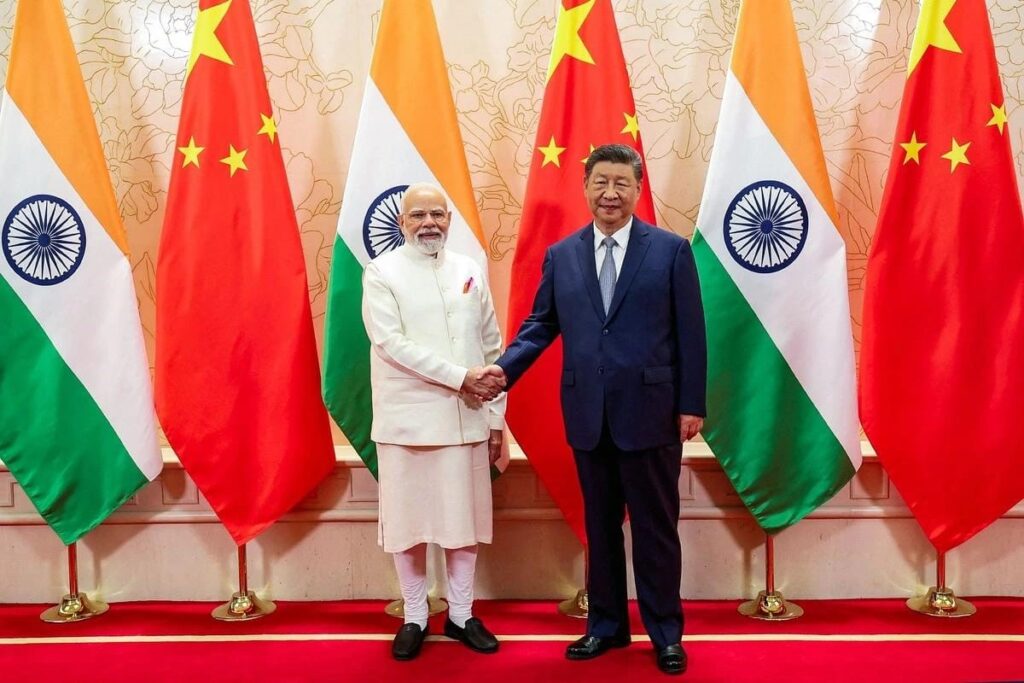
In 2025, as China and India mark 75 years of diplomatic ties and the 80th anniversary of the United Nations, both nations reaffirm their commitment to multilateralism, global governance reform, and mutual cooperation. The Tianjin SCO Summit 2025 and Xi-Modi meeting emphasized collaboration through the Global Governance Initiative (GGI).
Historical Evolution of China-India Relations :
- Diplomatic milestone: China and India established diplomatic relations on April 1, 1950, marking the beginning of a strategic and cultural partnership.
- Leadership diplomacy: From 2014 to 2024, President Xi Jinping and Prime Minister Narendra Modi met 18 times, strengthening bilateral understanding through summits such as BRICS, G20, and SCO.
- Symbolic exchanges: In 2014, declared the Year of China-India Friendly Exchanges, both leaders made reciprocal state visits, reinforcing people-to-people and economic ties.
- Post-pandemic revival: After the COVID-19 disruptions, face-to-face diplomacy resumed in 2023 at the Johannesburg BRICS Summit, and later in 2024 at the Kazan BRICS Summit.
- Renewed optimism: The leaders agreed on peaceful border stability, resumption of direct flights, and efforts to place relations back on a positive trajectory.
Key Institutional and Governance Facts :● SCO (Shanghai Cooperation Organization): Founded in 2001; focuses on regional security, economic cooperation, and counter-terrorism. ● BRICS: Established in 2009; includes Brazil, Russia, India, China, South Africa—recently expanded to include Egypt, Ethiopia, Iran, and UAE (2024). ● UN Charter (1945): Foundation of global governance, emphasizing sovereign equality and collective security. ● Article 2 of the UN Charter: Ensures non-interference and equal sovereignty of states. ● Global Governance Initiative (GGI): Proposed by China (2025) to address governance deficits through sovereignty, rule of law, multilateralism, people-centric approach, and results-driven action. ● India-China Diplomatic Relations: Established on April 1, 1950; celebrating 75 years in 2025. ● Tianjin SCO Summit (2025): Introduced the GGI as a blueprint for reforming global governance. ● UN 80th Anniversary (2025): Marks eight decades of the UN’s global peace and cooperation role. ● Geopolitical Context: Linked to debates on UNSC reform, multipolarity, and South-South cooperation. ● Major Principle: “Global affairs should be decided by all, governance built by all, and benefits shared by all.” |
Significance of the United Nations and Global Governance :
- UN’s 80th anniversary: Marks eight decades since the creation of the United Nations, designed to prevent another world war and maintain peace and stability.
- Role in governance: The UN has been central in promoting global peace, sustainable development, and cooperation since 1945.
- Emerging challenges: The 21st century faces volatility, protectionism, terrorism, and hegemonism, testing the limits of the global order.
- Reform imperative: Nations increasingly demand a reformed, inclusive, and representative UN system that reflects the multipolar world order.
- China-India alignment: Both nations emphasize UN-centric multilateralism, ensuring that governance reflects developing world interests.
Shared Vision for a Multipolar World :
- Asia’s century: The rise of Asia and Eurasia signals a shift away from Western dominance in global affairs.
- Strategic convergence: Both leaders view China and India as partners, not rivals, sharing responsibility for Asia’s prosperity.
- Mutual complementarity: Cooperation in technology, trade, and climate action aligns with shared goals of development and peace.
- BRICS and SCO role: Through these platforms, both nations promote inclusive global growth, multipolarity, and strategic autonomy.
- Diplomatic consensus: As articulated by experts like Sudheendra Kulkarni, India-China cooperation could transform the SCO Summit 2025 into a model of collaborative global governance.
The Global Governance Initiative (GGI): A New Framework :
- Concept origin: Launched by President Xi Jinping during the Tianjin SCO Summit (2025) to address deficits in global governance.
- Sovereign equality: Calls for respecting national sovereignty, ensuring equal participation of all nations in global decision-making.
- Rule of law adherence: Advocates for uniform application of international law without double standards or selective interpretation.
- Multilateralism commitment: Reinforces that global issues should be managed through collective deliberation under UN leadership.
- People-centric governance: Prioritizes citizens’ welfare, ensuring that governance systems yield tangible benefits and inclusive growth.
Challenges to Strengthened China-India Cooperation :
- Border tensions: Persistent border disputes in Ladakh and Arunachal Pradesh hinder deep trust and strategic coordination.
- Geopolitical rivalries: India’s alignment with the Quad and China’s partnership with Pakistan continue to create friction.
- Trade imbalances: India’s $80 billion trade deficit with China remains a contentious issue affecting bilateral economic parity.
- Trust deficit: Political narratives, media perceptions, and strategic mistrust limit mutual understanding.
- Global competition: Both nations’ aspiration to lead the Global South occasionally leads to competitive diplomacy rather than cooperative synergy.
- Multilateral friction: Differences within BRICS, SCO, and UN reform agendas complicate consensus on governance frameworks.
- Ideological divides: India’s democratic ethos and China’s state-led governance create differing political approaches to global engagement.
- External influence: Western narratives and S. containment strategies often pressure India’s strategic autonomy vis-à-vis China.
- Security apprehensions: Cybersecurity concerns and maritime tensions in the Indo-Pacific limit policy convergence.
- Historical baggage: The 1962 war legacy still shapes public sentiment and political caution on both sides.
Way Forward for India-China-Led Global Governance :
- Institutional dialogue: Establish a Permanent Strategic Dialogue Mechanism between foreign and defense ministries to build trust.
- Trade diversification: Promote balanced trade policies through regional supply chain partnerships and mutual technology sharing.
- Cultural diplomacy: Expand student exchanges, tourism, and academic cooperation to foster people-to-people connect.
- Multilateral reform: Jointly advocate for UN Security Council reform, ensuring representation for developing nations.
- Regional cooperation: Collaborate within SCO, BRICS, and G20 to address climate, food, and energy security
- Infrastructure alignment: Link China’s Belt and Road Initiative (BRI) with India’s Connectivity Corridors, ensuring mutual economic benefit.
- Maritime collaboration: Develop joint Indo-Pacific strategies focused on blue economy and sustainable maritime governance.
- Crisis management: Establish a hotline mechanism to manage border or diplomatic crises swiftly.
- Global South leadership: Co-lead the Voice of Global South platform to shape equitable development policies.
- Long-term vision: Strengthen Asian multilateralism, ensuring the region’s leadership in global peace and development.
Relevance of SCO and BRICS in Global Governance :
- SCO platform: Provides a framework for Eurasian cooperation in security, trade, and cultural exchange.
- BRICS expansion: Inclusion of new members enhances the bloc’s global representation and development potential.
- Collective voice: Both forums counter Western-centric global narratives through South-South cooperation.
- Economic integration: Promote intra-regional trade and cross-border investments for shared growth.
- Security cooperation: Focus on countering terrorism, extremism, and separatism under joint SCO mechanisms.
Conclusion :
China and India, representing one-third of humanity, are central to shaping a reformed global order. Through initiatives like the GGI, both nations can build inclusive, multipolar governance, grounded in UN principles, mutual trust, and collective prosperity, turning the Asian century into a beacon of global cooperation.
Source :TH
Mains Practice Question :
Discuss the role of China and India in reforming the global governance framework. How can both nations cooperate under platforms like SCO and BRICS to strengthen multilateralism, ensure global equity, and promote a multipolar world order amid rising geopolitical competition?