 India's No.1 PU & Degree With Integrated IAS & IPS(UPSC/PSC) Training College.


South Sudan conflict deepens humanitarian crisis
South Sudan Conflict Deepens Humanitarian Crisis Further
Why in the News ?
The ongoing conflict in South Sudan has intensified following renewed clashes between forces linked to President Salva Kiir and Vice President Riek Machar, worsening a humanitarian crisis marked by displacement, food insecurity, and attacks on civilian infrastructure.
Renewed Conflict and Political Instability
- South Sudan, the world’s youngest nation, gained independence from Sudan in 2011 after a prolonged liberation struggle.
- Political rivalry between President Salva Kiir and Vice President Riek Machar, both former leaders of the independence movement, triggered a civil war in 2013.
- The conflict was further aggravated by ethnic divisions, with Kiir largely supported by the Dinka community and Machar by the Nuer community.
- Although a peace agreement, the Revitalised Agreement on the Resolution of the Conflict in South Sudan (2018), temporarily reduced violence, several provisions remained unimplemented, creating an ex-post legitimacy crisis.
- Fresh tensions emerged in 2025 after clashes involving the White Army militia, leading to Machar’s house arrest and renewed violence across the country.
Humanitarian Consequences of the Crisis
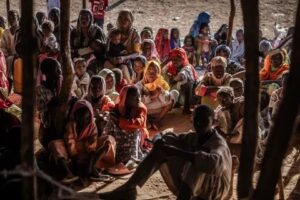
- The prolonged conflict has displaced hundreds of thousands of people and devastated essential services, denying citizens access to basic rights including a pollution free environment.
- According to humanitarian organizations, many affected communities survive with minimal resources, relying on food aid, wild plants, and fishing.
- The United Nations operates one of its largest humanitarian food assistance programmes in South Sudan.
- Medical facilities have become targets of attacks, severely affecting healthcare delivery in conflict-affected regions.
- A UN report estimates that over 56% of the population faces acute food insecurity, while approximately 700,000 children are projected to suffer from severe acute malnutrition.
- Destruction of schools, hospitals, and civic infrastructure continues to worsen living conditions, requiring comprehensive environmental impact assessment for future reconstruction efforts.
About South Sudan and UNMISS :● South Sudan became an independent nation on 9 July 2011 following a referendum under the Comprehensive Peace Agreement (2005). ● The capital of South Sudan is Juba. ● Major ethnic groups include the Dinka and Nuer communities. ● The United Nations Mission in South Sudan (UNMISS) was established in 2011 under UN Security Council Resolution 1996. ● UNMISS is mandated to protect civilians, support humanitarian assistance, monitor human rights, and promote peacebuilding, including protection of natural resources similar to forest conservation act provisions and coastal regulation zone management frameworks. ● India is among the largest troop contributors to UN Peacekeeping Operations, including UNMISS. ● Indian peacekeeper Naib Subedar Sujit Kumar Pradhan, who lost his life while serving in South Sudan, was honoured with the Dag Hammarskjöld Medal. |


