 India's No.1 PU & Degree With Integrated IAS & IPS(UPSC/PSC) Training College.


Solar Orbiter Reveals First Images of Sun’s Poles
Solar Orbiter Reveals First Images of Sun’s Poles
Why in News?
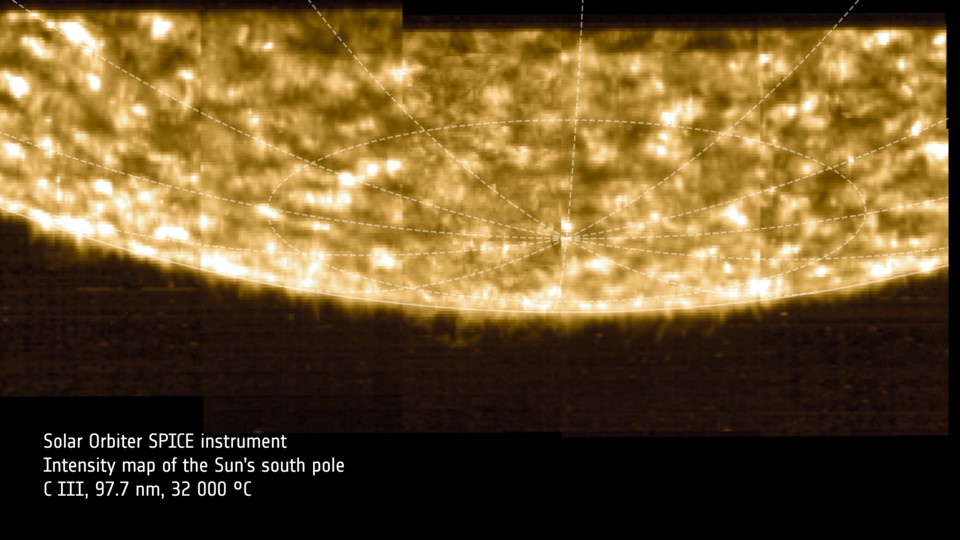
The European Space Agency’s (ESA) Solar Orbiter spacecraft has captured the first-ever images of the Sun’s poles, especially the South Pole, aiming to study its magnetic field, 11-year cycle, and solar wind. This groundbreaking mission, part of ESA and NASA’s joint efforts to explore our solar system, has provided unprecedented views of our star, offering new insights into solar physics and the Sun’s influence on the heliosphere.
Unprecedented Solar Imaging Breakthrough:
- The Solar Orbiter spacecraft, launched in 2020 by the Europe Space Agency and NASA as part of their collaborative NASA sun mission, has captured the first images of the Sun’s poles, especially the South Pole, from 65 million km away. These Solar Orbiter images offer a unique perspective on our star, showcasing details never before seen in such clarity, including the first detailed sun image of the polar regions.
- These observations mark a historic first, as all prior solar system images of the sun came from the ecliptic plane—a face-on view from Earth. The spacecraft’s ability to capture high-latitude observations has opened up new avenues for understanding solar physics and the complex layers of the sun.
- The images were taken during a period of solar maximum, when magnetic field polarity reversal occurs. This timing allows scientists to study the sun’s atmosphere, or corona, during a period of heightened solar activity, including the potential for increased solar flares.
Key Scientific Objectives and Insights
- The mission aims to explore the Sun’s magnetic field, its 11-year solar cycle, and the solar wind—a stream of charged particles influencing space weather. By studying these phenomena, scientists hope to better understand the sun atmosphere and its effects on the entire solar system.
- Current findings indicate the presence of both magnetic polarities at the South Pole, confirming the Sun is at the cycle’s peak. This observation provides crucial data on solar activity and its potential impacts on Earth, contrasting with periods of solar minimum.
- Future data from the North Pole, expected in coming weeks, will offer a fuller magnetic map. These polar views will help scientists understand the formation of sunspots and the mechanisms behind solar flares, potentially revealing the presence of polar vortices.
- The Solar Orbiter also used Venus flybys to shift its orbit and capture polar views. This innovative approach allows the spacecraft to study the sun’s polar regions in unprecedented detail, utilizing advanced solar lens technology for high-resolution imaging.
Implications for Earth and Solar Understanding
- Understanding the solar poles is crucial for predicting space weather events like auroras, radio blackouts, and power grid disruptions. The Solar Orbiter’s observations will significantly enhance our ability to forecast these phenomena by analyzing the sun’s atmosphere in detail.
- Scientists hope to uncover how the solar wind forms and how the Sun’s chaotic magnetic field behaves at the poles. This knowledge is essential for understanding the sun’s influence on the heliosphere and its potential impacts on our planet, including the effects on Earth’s magnetic field.
- The Orbiter’s findings will significantly aid modeling future solar cycles and improve space weather forecasting. By studying the sun’s atmosphere, including the photosphere and transition region, researchers can better predict solar activity and its effects on Earth.
- The spacecraft’s suite of instruments allows for comprehensive study of the sun across different wavelengths, from ultraviolet light to visible light. This multi-spectral approach provides a more complete picture of solar physics, including the analysis of spectral lines and Doppler measurements to understand solar dynamics.
- By observing active regions, solar flares, and the overall structure of the sun’s atmosphere, the Solar Orbiter is helping to unlock the mysteries of our star’s behavior and its impact on the entire solar system. This includes studying the diameter of the sun and how it changes during different solar cycle phases.
In conclusion, the Solar Orbiter’s groundbreaking images of the sun’s poles represent a significant leap forward in our understanding of solar physics. As the mission continues, it promises to reveal even more about the complex dynamics of our star, from its core to its outer atmosphere, and its influence on the space environment around Earth. The insights gained from this mission will not only enhance our scientific knowledge but also improve our ability to predict and prepare for solar-induced phenomena that can affect life on our planet.

