 India's No.1 PU & Degree With Integrated IAS & IPS(UPSC/PSC) Training College.


Salar de Pajonales: Mars Life Clue
Salar de Pajonales: Clue to Martian Life
Why in the News ?
Scientists studying Salar de Pajonales in Chile’s Atacama Desert have discovered how gypsum rocks protect and preserve microbial life. The findings strengthen the possibility that similar gypsum deposits on Mars could hold evidence of ancient extraterrestrial life. Research at such sites requires proper environmental clearance to ensure minimal ecological disruption while advancing scientific understanding.
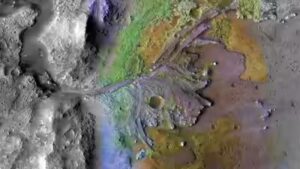
Why Salar de Pajonales is a Mars Analogue:
- Salar de Pajonales, located 3.5 km above sea level in Chile’s Atacama Desert, is one of Earth’s harshest environments.
- The region experiences extreme dryness, freezing temperatures, and intense ultraviolet radiation.
- These conditions closely resemble those on Mars, making it a natural laboratory for astrobiology research requiring environmental impact assessment before field studies commence.
- The site was even photographed from space during International Space Station (ISS) Expedition 6, highlighting its planetary resemblance.
- Scientists use such terrestrial analogues to refine strategies for detecting life beyond Earth.
Role of Gypsum in Supporting Life
- Researchers studied rocks composed of gypsum (CaSO₄·2H₂O), a mineral found on both Earth and Mars.
- They examined stromatolites—layered rock formations built by microbes over long geological periods.
- Living microbes were discovered just millimetres beneath the gypsum surface.
- Because gypsum is translucent, it allows sufficient sunlight for photosynthesis while blocking harmful UV radiation.
- It also traps moisture, creating micro-habitats where life can survive despite extreme conditions.
- Deeper layers revealed fossils and chemical signatures of ancient microbial life, preserved as gypsum sealed their remains.
About Mars Exploration & Astrobiology:● Mars Analogue Sites: Earth locations resembling Martian conditions used for research. ● Gypsum Deposits on Mars: Detected by orbiters, indicating past water activity. ● Stromatolites: Among the oldest evidence of life on Earth, formed by microbial communities. ● Astrobiology: Interdisciplinary science studying the possibility of life beyond Earth. ● Preservation of biosignatures in minerals is key for future Mars rover and satellite missions. |

