 India's No.1 PU & Degree With Integrated IAS & IPS(UPSC/PSC) Training College.


Restart Global Arms Control Now
RESTART FOR GLOBAL ARMS CONTROL
Syllabus:
GS 3:
- Defence and Security
- Security challenges and their management
Why in the News?
The New START treaty between the United States and Russia expires, ending the last binding framework limiting strategic nuclear weapons, amid rising arsenals, geopolitical rivalry, and demands for a broader, inclusive arms control architecture involving China and addressing Global South concerns.
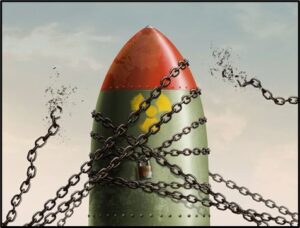
GLOBAL ARMS CONTROL ARCHITECTURE● Cold War Origins: Arms control emerged to manage bipolar nuclear rivalry and reduce catastrophic risks. ● Treaty Instruments: Agreements like NPT, CTBT, and New START form the backbone of nuclear governance. ● Verification Role: Transparency, inspections, and confidence-building measures underpin treaty credibility. ● Multipolar Shift: Emerging powers challenge bilateral dominance in arms regulation. ● Future Need: Sustainable arms control requires inclusive, multilateral, and adaptable frameworks. |
LEGACY OF NEW START TREATY
- Cold War Legacy: New START, signed in 2010, capped strategic nuclear warheads and delivery systems, reducing excesses inherited from decades of US–Soviet nuclear rivalry.
- Verification Mechanisms: The treaty institutionalised on-site inspections, data exchanges, and compliance procedures, creating transparency and mutual reassurance between the two largest nuclear powers.
- Quantitative Reductions: By limiting warheads to 1,550 each, it delivered measurable arms reduction beyond earlier, weaker frameworks like SORT.
- Strategic Stability: Despite geopolitical tensions, New START functioned as a stability anchor, lowering miscalculation risks in bilateral nuclear relations.
- Structural Limitation: However, the treaty remained bilateral and exclusionary, ignoring emerging nuclear dynamics beyond Cold War legacies.
POST-NEW START STRATEGIC VACUUM
- Treaty Expiry: With New START lapsing and no extension agreed, legal constraints on nuclear arsenals vanish, raising proliferation and arms racing risks.
- Geopolitical Distrust: US–Russia hostility, worsened by the Ukraine conflict, undermines diplomatic trust necessary for meaningful arms control negotiations.
- Doctrinal Shifts: Russia’s revised 2024 nuclear doctrine, allowing nuclear retaliation to conventional threats, lowers the nuclear threshold.
- Technological Advances: Hypersonic weapons, cyber interference, and missile defence systems complicate traditional arms limitation frameworks.
- Global Anxiety: Absence of guardrails amplifies fears of strategic instability, accidental escalation, and weakened deterrence predictability.
CHINA AS CENTRAL VARIABLE
- Arsenal Expansion: China now possesses around 600 nuclear warheads, with SIPRI estimating an increase of 100 warheads annually since 2023.
- Negotiation Refusal: Beijing’s refusal to join arms control talks rests on its claim of maintaining a smaller deterrent than the US and Russia.
- Strategic Ambiguity: Despite a stated no-first-use policy, China’s lack of transparency raises concerns about its long-term nuclear intent.
- Regional Impact: China’s expanding arsenal directly affects India’s security calculations, given unresolved borders and dual nuclear-armed neighbours.
- Treaty Credibility: Any future arms control framework excluding China risks becoming strategically irrelevant and normatively hollow.
EUROPEAN AND RUSSIAN CALCULUS
- Expanded Inclusion: Russia demands inclusion of France and the United Kingdom, arguing their arsenals matter in Europe’s evolving security balance.
- Ukraine Effect: The Ukraine war has entrenched militarisation and distrust, weakening appetite for arms reduction compromises.
- Alliance Dynamics: NATO’s expansion and European rearmament influence Russia’s insistence on multilateral parity, not bilateral restraint.
- Escalation Risks: Europe’s proximity to conflict zones magnifies risks of misinterpretation and rapid escalation.
- Negotiation Complexity: Broader participation complicates treaty design but reflects contemporary multipolar realities.
GLOBAL SOUTH AND NUCLEAR HYPOCRISY
- Selective Restraint: Arms control regimes historically privileged big-power stability while ignoring proliferation in the Global South.
- Proliferation Failures: Countries like Pakistan and North Korea expanded arsenals covertly, aided indirectly by major powers.
- Normative Double Standards: Nuclear-armed states preach restraint while modernising arsenals, undermining non-proliferation legitimacy.
- Southern Exclusion: Developing nations remain rule-takers, not rule-makers, in global security governance frameworks.
- Equity Deficit: Without addressing Southern concerns, future treaties risk political rejection and moral delegitimisation.
INDIA’S STRATEGIC DILEMMAS
- Deterrence Doctrine: India follows credible minimum deterrence and a no-first-use policy, balancing restraint with security needs.
- China Factor: Beijing’s nuclear expansion forces India to reassess deterrence sufficiency without triggering regional arms races.
- Treaty Exclusion: India remains outside global arms control regimes despite being a responsible nuclear power.
- Norm-Shaping Role: India can champion inclusive, equitable arms control norms representing emerging powers.
- Strategic Autonomy: New frameworks must preserve India’s security autonomy while promoting global stability.
CONCLUSION
With New START’s expiry, the world risks sliding into an unregulated nuclear era. Any successor treaty must be inclusive, multipolar, and equitable, incorporating China and addressing Global South concerns. Without reimagined arms control, strategic instability and nuclear escalation risks will only intensify in an increasingly fragmented global order.
SOURCE: HT
MAINS PRACTICE QUESTION
“The expiry of New START highlights the inadequacy of Cold War–era arms control frameworks in a multipolar world.”
Discuss the challenges and prospects of creating an inclusive global nuclear arms control regime.

