 India's No.1 PU & Degree With Integrated IAS & IPS(UPSC/PSC) Training College.


Responsible Nations Index: India Ranks 16th
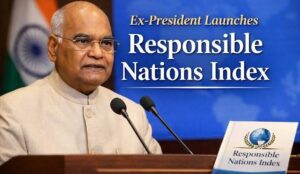
RESPONSIBLE NATIONS INDEX LAUNCHED
Why in the News?
- Index launch: Ram Nath Kovind launched the Responsible Nations Index (RNI) in New Delhi.
- Normative focus: The Index emphasises responsible behaviour of nations beyond economic or military metrics, including environmental stewardship.
- Academic backing: The framework is developed by World Intellectual Foundation in collaboration with Jawaharlal Nehru University.
OBJECTIVES AND PHILOSOPHY OF RNI
- Ethical governance: RNI prioritises ethics, moral responsibility, and accountable governance as central pillars of national and global sustainability, including environmental clearance processes.
- Human-centric lens: Countries are assessed on their responsibility towards citizens’ dignity, inclusion, and social well-being, not merely growth indicators.
- Environmental responsibility: Stewardship of nature and commitment to climate and ecological protection form a core evaluation dimension, considering factors like the Forest Conservation Act and Coastal Regulation Zone.
- Intellectual contribution: Knowledge creation, academic freedom, and innovation ecosystems are recognised as vital national responsibilities, including environmental impact assessments.
- Global citizenship: RNI promotes cooperative behaviour, peace, and constructive international engagement as markers of responsible state conduct, incorporating principles like the polluter pays principle and precautionary principle.
SIGNIFICANCE FOR GLOBAL GOVERNANCE
- Beyond GDP metrics: RNI challenges traditional rankings by moving beyond economic strength and geopolitical power as sole measures of success, emphasizing environmental jurisprudence.
- Policy benchmarking: Governments can use RNI to benchmark policies on ethics, inclusivity, and sustainability against global peers, including environmental clearance practices.
- Moral discourse: The Index injects values-based discourse into international relations, often dominated by strategic competition narratives, while promoting environmental democracy.
- Academic legitimacy: University-led collaboration enhances methodological rigour, credibility, and transparency of the assessment framework, including environmental impact considerations.
- Soft power impact: High RNI performance may enhance a country’s moral authority and global soft power standing, particularly in areas of environmental governance.
GLOBAL INDICES AND NORMATIVE POWER● Comparative tools: Global indices shape narratives on development, governance quality, and international credibility of states, increasingly incorporating environmental metrics. ● Norm diffusion: Indices influence norms, encouraging countries to align domestic policies with globally valued principles, including environmental clearance processes. ● Policy incentives: Ranking visibility often nudges reforms in governance, environment, and social sectors, promoting adherence to principles like the polluter pays principle. ● Academic-state interface: Scholarly involvement strengthens evidence-based policymaking and evaluation standards, including environmental impact assessments. ● Global accountability: Normative indices act as soft mechanisms for promoting responsibility and ethical conduct among nations, emphasizing environmental democracy and jurisprudence. |

