 India's No.1 PU & Degree With Integrated IAS & IPS(UPSC/PSC) Training College.


RBI Monetary Policy: Balancing Inflation & Growth
RBI Monetary Policy Balancing Inflation Growth And Stability
Syllabus:
GS-3: Banking Sector & NBFCs, Monetary Policy, Growth & Development
Why in the News ?
The Monetary Policy Committee (MPC) of the Reserve Bank of India (RBI) is scheduled to announce its latest monetary policy. While most economists expect a status quo on the repo rate, the decision reflects RBI’s assessment of inflation, economic growth, global uncertainties, crude oil prices, monsoon performance, and financial stability.
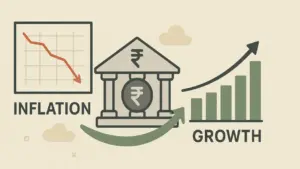
Monetary Policy and RBI’s Mandate:
- The Reserve Bank of India (RBI) is India’s central bank responsible for maintaining price stability while supporting economic growth.
- Every two months, the Monetary Policy Committee (MPC) reviews macroeconomic conditions and decides the policy interest rate.
- The primary objective of monetary policy is to maintain retail inflation at 4%, with a tolerance band of ±2% (2%-6%).
- Monetary policy aims to balance:
○ Inflation control
○ Economic growth
○ Financial stability
○ Exchange rate stability
- The MPC has three policy choices:
○ Increase (Hike) the Repo Rate
○ Reduce (Cut) the Repo Rate
○ Maintain Status Quo
- A decision to maintain rates does not imply policy inaction; rather, it reflects careful assessment of multiple domestic and global economic variables.
- Since monetary policy affects the economy with a time lag, RBI adopts a forward-looking approach instead of reacting only to current inflation data.
- Price stability helps preserve consumers’ purchasing power and creates a favourable environment for sustainable investment and employment.
Understanding Monetary Policy and Inflation Targeting in India :
Monetary Policy
- Monetary policy refers to the actions taken by the Reserve Bank of India (RBI) to regulate:
○ Money supply.
○ Credit availability.
○ Interest rates.
○ Inflation.
○ Liquidity.
Objectives
- Price stability.
- Economic growth.
- Financial stability.
- Employment support.
- Exchange rate stability.
Monetary Policy Committee (MPC)
- Constituted under the Reserve Bank of India Act, 1934 (as amended by the Finance Act, 2016).
- Consists of 6 members:
○ 3 from RBI
○ 3 appointed by the Central Government
- Decisions are taken by majority vote.
- The RBI Governor serves as the Chairperson and has a casting vote in case of a tie.
- Meets at least six times every year (generally every two months).
Inflation Targeting Framework
- Inflation target: 4% Consumer Price Index (CPI).
- Tolerance band:
○ Lower limit: 2%
○ Upper limit: 6%
- Inflation is measured using the Consumer Price Index (CPI-Combined) compiled by the National Statistics Office (NSO).
Major Monetary Policy Instruments
Quantitative Instruments
- Repo Rate
- Reverse Repo Rate (operationally replaced by the Standing Deposit Facility as the floor of the liquidity adjustment corridor, though it remains in the RBI Act)
- Standing Deposit Facility (SDF)
- Marginal Standing Facility (MSF)
- Cash Reserve Ratio (CRR)
- Statutory Liquidity Ratio (SLR)
- Open Market Operations (OMO)
Qualitative Instruments
- Moral suasion.
- Credit rationing.
- Selective credit control.
Relevant Acts
- Reserve Bank of India Act, 1934
- Finance Act, 2016 (introduced the statutory MPC framework)
Important Institutions
- Reserve Bank of India (RBI)
- Monetary Policy Committee (MPC)
- National Statistics Office (NSO)
- Ministry of Finance
- International Monetary Fund (IMF)
- Bank for International Settlements (BIS)
Key economic terms :
- RBI’s inflation target: 4% ± 2%.
- Repo Rate: The policy rate at which RBI lends short-term funds to commercial banks.
- CPI is the nominal anchor for India’s inflation-targeting framework.
- The MPC was established in 2016 to institutionalise transparent and rule-based monetary policymaking.
- Monetary policy decisions are influenced by inflation, growth, global interest rates, crude oil prices, monsoon performance, exchange rate movements, capital flows, and financial stability.
Repo Rate: RBI’s Principal Monetary Policy Instrument
- The Repo Rate is the interest rate at which the RBI lends short-term funds to commercial banks.
- It serves as the primary instrument for influencing liquidity and borrowing costs across the economy.
When RBI Cuts the Repo Rate
- Commercial banks borrow at a lower cost.
- Banks reduce lending rates.
- Loans become cheaper for:
○ Housing
○ Vehicles
○ MSMEs
○ Businesses
- Consumption and investment increase.
- Economic activity accelerates.
- Employment opportunities improve.
- Growth receives policy support.
When RBI Raises the Repo Rate
- Borrowing becomes more expensive.
- Banks increase lending rates.
- Demand for loans declines.
- Consumption moderates.
- Inflationary pressures reduce.
- Excess demand in the economy is controlled.
- Savings become more attractive.
- Credit growth slows.
When RBI Maintains Status Quo
- Indicates balanced risks.
- Allows earlier policy decisions to transmit fully.
- Prevents unnecessary market volatility.
- Reflects uncertainty regarding future inflation and growth.
Key Factors Influencing RBI’s Monetary Policy Decision
Retail Inflation
- RBI primarily targets Consumer Price Index (CPI) inflation.
- Inflation has been gradually rising during 2026.
- Although inflation remains within the 2%-6% tolerance band, it is moving above the 4% target.
- Persistent inflation reduces purchasing power.
- Excessively low inflation weakens production incentives.
- RBI must distinguish between temporary and structural inflation.
Economic Growth
- Growth momentum remains uneven across sectors.
- RBI evaluates:
○ Industrial production.
○ Services.
○ Consumption.
○ Investment.
- Weak growth may justify accommodative monetary policy.
- Strong growth may permit tighter policy.
Transmission Lag
- Monetary policy affects the economy after several months.
- Therefore, RBI bases decisions on future expectations rather than only present conditions.
Domestic Factors Affecting RBI’s Policy Outlook
Crude Oil Prices
- India imports nearly 85% of its crude oil requirements, making global oil prices a key inflation driver.
- Rising crude prices:
○ Increase fuel prices.
○ Raise transportation costs.
○ Increase production costs.
○ Widen the Current Account Deficit (CAD).
○ Put pressure on the rupee.
- Continued geopolitical tensions can sustain inflationary pressures.
Monsoon and Food Inflation
- Weak monsoon and El Niño conditions threaten agricultural production.
- Deficient rainfall affects:
○ Kharif output.
○ Rabi sowing.
○ Reservoir levels.
- Reduced agricultural production can increase food inflation.
- Food inflation remains a major component of CPI inflation.
High-Frequency Economic Indicators
RBI monitors indicators such as:
- GST collections.
- GST e-way bills.
- Vehicle registrations.
- Railway freight.
- Air passenger traffic.
- Port cargo.
- Telecom subscribers.
- Fuel consumption.
- Industrial output.
- Digital payments.
These indicators provide real-time insights into economic momentum before official GDP data are released.
Global Developments and External Risks
Global Geopolitical Uncertainty
- Conflicts such as US-Iran tensions can disrupt:
○ Global energy markets.
○ Shipping routes.
○ Supply chains.
- Threats to:
○ Strait of Hormuz
○ Red Sea shipping routes
may elevate transportation and energy costs.
Global Monetary Policy
- RBI closely tracks major central banks:
○ US Federal Reserve
○ European Central Bank (ECB)
○ Bank of England
○ Bank of Japan
- Interest rate differentials influence:
○ Foreign Portfolio Investment (FPI)
○ Bond market flows
○ Exchange rate stability
- Higher interest rates abroad may encourage capital outflows from emerging economies.
- RBI therefore considers international financial conditions while deciding domestic policy.
Exchange Rate Stability
- Stable interest rates help maintain investor confidence.
- Exchange rate volatility can increase imported inflation.
- External sector stability remains an important monetary policy consideration.
Challenges in Balancing Inflation and Growth
- Monetary policy faces a difficult trade-off.
- Raising rates controls inflation but may:
○ Slow investment.
○ Reduce consumption.
○ Increase borrowing costs.
- Lowering rates stimulates growth but risks:
○ Higher inflation.
○ Asset bubbles.
○ Currency depreciation.
- Government borrowing costs also increase when interest rates rise.
- RBI must therefore maintain credibility while ensuring macroeconomic stability.
- Current economic indicators present a mixed picture:
○ Some sectors show resilience.
○ Others display signs of slowing.
- Supply-side shocks cannot always be addressed through monetary policy.
- External uncertainties further complicate decision-making.
Importance of a Balanced Monetary Policy Framework
- Monetary policy must remain data-driven.
- Inflation targeting should coexist with growth considerations.
- Stable inflation encourages:
○ Long-term investment.
○ Savings.
○ Employment.
- Predictable monetary policy improves financial market confidence.
- Better coordination between:
○ RBI
○ Government
○ Fiscal policy
enhances macroeconomic stability.
- Structural reforms should complement monetary policy.
- Improved agricultural productivity can reduce food inflation.
- Energy diversification can reduce vulnerability to imported inflation.
- Stable financial markets support sustainable economic development.
- Monetary policy remains a critical instrument for achieving inclusive and durable economic growth.
Challenges :
- Persistent food inflation due to weather uncertainties and supply disruptions.
- Volatile crude oil prices arising from geopolitical tensions.
- El Niño affecting agricultural production and food prices.
- Balancing inflation control with economic growth.
- Uneven growth across different sectors of the economy.
- Delayed transmission of monetary policy decisions.
- Rising government borrowing costs during periods of higher interest rates.
- External risks from global conflicts and trade disruptions.
- Exchange rate volatility impacting imported inflation.
- Capital flow volatility due to changing global interest rates.
- Supply-side inflation that monetary policy alone cannot address.
- Maintaining financial stability amid uncertain global conditions.
- Managing inflation expectations of households and businesses.
- Coordination challenges between monetary and fiscal policy.
- Uncertainty regarding future global economic growth.
Way Forward :
- Continue adopting a data-dependent and forward-looking monetary policy framework.
- Strengthen inflation forecasting using high-frequency data and advanced analytical tools.
- Improve coordination between RBI and the Government to align monetary and fiscal policies.
- Build strategic reserves and diversify energy imports to reduce vulnerability to oil price shocks.
- Accelerate investments in renewable energy to lower imported inflation risks.
- Strengthen agricultural resilience through:
○ Irrigation expansion.
○ Climate-resilient seeds.
○ Better storage infrastructure.
- Improve supply chain efficiency to reduce food inflation.
- Enhance financial market depth for better monetary policy transmission.
- Promote financial inclusion to improve the effectiveness of interest rate changes.
- Maintain adequate foreign exchange reserves to manage exchange rate volatility.
- Encourage structural reforms that improve productivity and reduce supply bottlenecks.
- Preserve RBI’s operational autonomy and policy credibility to anchor inflation expectations while supporting sustainable and inclusive economic growth.
Conclusion:
The RBI’s monetary policy extends beyond adjusting the repo rate. Every decision reflects a careful balance between inflation management, economic growth, global uncertainties, and financial stability. A prudent, forward-looking, and data-driven policy framework remains essential for sustaining macroeconomic stability and supporting India’s long-term development aspirations.
Source: IE
Mains Practice Question :
“Monetary policy in India is increasingly shaped by both domestic macroeconomic conditions and evolving global uncertainties.” Discuss the factors influencing the Reserve Bank of India’s Monetary Policy Committee (MPC) while deciding the repo rate. Examine the challenges of balancing inflation control with economic growth.

