 India's No.1 PU & Degree With Integrated IAS & IPS(UPSC/PSC) Training College.


PRAGATI-50: 50 Clean Role-Model Cities in India
PRAGATI 50: DEVELOPING 50 CLEAN ROLE-MODEL CITIES IN INDIA
Why in the News?
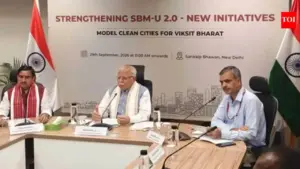
The Ministry of Housing and Urban Affairs has launched a new set of initiatives under PRAGATI 50 to develop 50 clean role-model cities across 24 states, focusing on urban cleanliness, waste management, sanitation, used-water management and citizen participation through a structured Model City Framework.
PRAGATI 50 AND THE MODEL CITY FRAMEWORK
- City Selection: The initiative covers cities having economic, cultural, heritage, pilgrimage, tourism and administrative significance, creating diverse urban models for replication.
- Structured Framework: The Model City Framework seeks measurable improvements through defined timelines, systematic monitoring, periodic reviews and coordinated implementation.
- Cleanliness Focus: Key interventions include urban cleanliness, solid waste management, used-water management and sanitation, addressing major challenges of rapidly expanding Indian cities.
- Citizen Participation: The programme emphasises citizen engagement, recognising that sustainable urban sanitation requires behavioural change alongside municipal infrastructure.
- Replicable Models: Developing successful cities as role models can enable other urban local bodies to adapt proven practices according to their demographic and geographical conditions.
URBAN WASTE MANAGEMENT AND CIRCULARITY
- Waste Reduction: The Reduce, Reuse and Recycle (RRR) approach promotes resource conservation by reducing waste generation and extending the useful life of materials.
- Resource Recovery: RRR centres can facilitate material recovery and reuse, helping shift urban waste management from disposal-oriented systems towards resource-efficient circular practices.
- Sustainable Consumption: The initiative encourages responsible consumption patterns, particularly within government workplaces, where institutional practices can demonstrate sustainable behaviour.
- Innovation Ecosystem: The Swachh Bharat Test Bed and Innovation Centre at Durgapur, launched with CSIR-CMERI and MoHUA, can support testing and development of sanitation technologies.
- Circular Economy: Integrating waste minimisation, reuse and resource recovery supports India’s broader transition towards a circular economy, reducing pressure on landfills and natural resources.
URBAN GOVERNANCE AND SOLID WASTE MANAGEMENT IN INDIA● Constitutional Basis: Urban local bodies gained constitutional recognition through the 74th Constitutional Amendment Act, 1992, which strengthened decentralised urban governance. ● Twelfth Schedule: The Twelfth Schedule assigns municipalities functions including urban planning, public health, sanitation, solid waste management and environmental protection. ● Waste Rules: The Solid Waste Management Rules, 2016 establish responsibilities for waste generators, local authorities and other stakeholders regarding segregation, collection, processing and disposal. ● Waste Hierarchy: Sustainable waste management prioritises reduction, reuse, recycling, recovery and scientific disposal, thereby minimising environmental and public-health impacts. ● Citizen Role: Effective urban cleanliness requires source segregation, behavioural change, community participation and accountable municipalities, rather than relying exclusively upon government-funded infrastructure. |

