 India's No.1 PU & Degree With Integrated IAS & IPS(UPSC/PSC) Training College.


Nobel Chemistry 2025: Metal-Organic Frameworks Revolution
Nobel Chemistry 2025: Metal-Organic Frameworks Revolution
Why in the News ?
The 2025 Nobel Prize in Chemistry was awarded to Susumu Kitagawa (Japan), Richard Robson (Australia), and Omar M. Yaghi (US) for pioneering Metal-Organic Frameworks (MOFs) — crystalline structures that combine metal ions and organic molecules, enabling breakthroughs in gas storage, filtration, and water harvesting. These innovations also show promise in addressing global challenges like the detection of counterfeit medicines and falsified medical products.
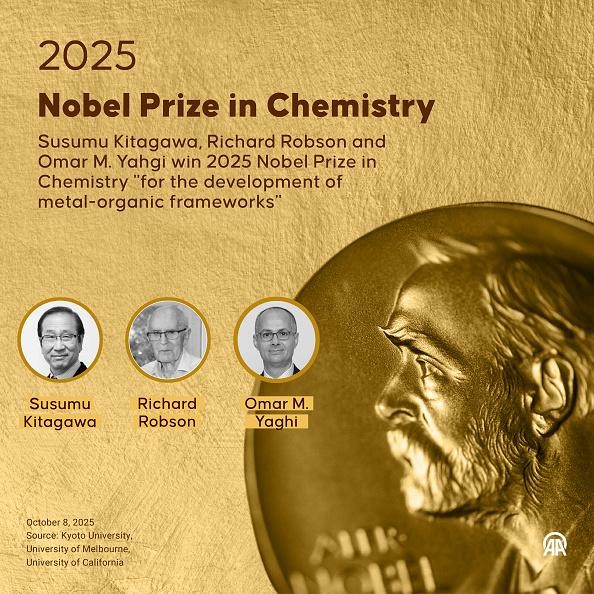
Discovery and Evolution of Metal-Organic Frameworks (MOFs):
- Early Concept: Richard Robson initiated MOF research in the 1970s at the University of Melbourne while experimenting with molecular structures combining metals and organics.
- Breakthrough by Kitagawa: At Kyoto University, Susumu Kitagawa explored porous molecular structures, initially deemed useless, until they were developed into flexible, gas-permeable materials.
- Yaghi’s Contribution: Omar Yaghi at UC Berkeley stabilized and named Metal-Organic Frameworks, capable of harvesting water from desert air, bridging theory and large-scale application.
- Global Recognition: The trio’s independent yet complementary work led to over tens of thousands of MOF variations developed worldwide, with potential applications ranging from environmental remediation to pharmaceutical security.
- Nobel Honour: The 11 million Swedish kronor prize was equally shared among them for their transformative contributions, which have opened new avenues in combating counterfeit products, including fake medications.
Applications and Scientific Significance
- Environmental Use: MOFs are used in carbon dioxide capture, toxic chemical filtration (PFAS removal), and pharmaceutical waste breakdown. They also show promise in detecting falsified medicines and substandard drugs, addressing a critical issue in the pharmaceutical supply chain.
- Water Harvesting: Certain MOFs extract water vapour from arid air, providing potential solutions to desert water scarcity. This technology could also be adapted to identify counterfeit medications based on their unique molecular signatures.
- Industrial Applications: MOFs serve in gas storage, catalysis, and energy storage due to their tunable pore structures. In the pharmaceutical industry, they are being explored for enhancing drug regulatory authorities’ capabilities to identify counterfeit pharmaceutical drugs.
- AI-Driven Design: Scientists now use AI tools to create new MOFs tailored for specific chemical and environmental purposes, including the detection of fake drugs and spurious medicines.
- Comparison with Zeolites: Initially underestimated, MOFs later surpassed zeolites by offering flexibility and breathability, similar to “lungs” that inhale and exhale gases. This property makes them particularly suitable for detecting counterfeit antibiotics and other falsified medical products.
Understanding Nobel Prize and MOF Concept: |
| ● Nobel Prize Origin: Established in 1901, awarded by the Royal Swedish Academy of Sciences, recognizing breakthroughs in Chemistry, Physics, Medicine, Literature, Peace, and Economics. |
| ● Metal-Organic Frameworks (MOFs): Crystalline materials made of metal ions linked with organic ligands, forming highly porous 3D structures. These structures have potential applications in combating the counterfeit drug market. |
| ● Founders: Richard Robson (Australia), Susumu Kitagawa (Japan), Omar Yaghi (Jordanian-American). |
| ● Core Feature: Exceptional surface area and tunability, making them ideal for gas adsorption and separation, as well as potential tools in pharmaceutical counterfeiting detection. |
| ● Future Potential: Central to green chemistry, carbon-neutral technologies, and sustainable material design. MOFs are also being explored for their potential in enhancing pharmaceutical security and combating medicine counterfeiting. |

