 India's No.1 PU & Degree With Integrated IAS & IPS(UPSC/PSC) Training College.


Nine Years On, Paris Agreement Faces Growing Frustration
Why in the news?
The Paris Agreement, nine years after its adoption, faces increasing challenges. Rising global emissions, unmet climate finance commitments, and a potential US exit have led to frustration, prompting calls for stronger climate action and clearer obligations.
Nine Years After Paris Agreement: Growing Challenges:
- The Paris Agreement, finalized on December 12, 2015, was designed to limit global warming to 1.5°C above pre-industrial levels.
- Over the past nine years, global emissions have increased by 8%, reaching 53 billion tonnes of CO2 equivalent.
- Global temperatures have risen by 1.45°C, with 2024 expected to breach the 1.5°C threshold.
- The goal of holding temperature rise within 1.5°C seems increasingly unattainable.
Frustration Among Developing Countries and Emerging Alternatives
- Small island nations and other developing countries, frustrated with the Paris Agreement’s progress, are exploring alternative approaches.
- The International Court of Justice (ICJ) is hearing a case to define countries’ climate obligations.
- Countries argue for stronger commitments to address climate change, as the current framework lacks enforceable accountability.
Weakening of the Paris Agreement and Dwindling Trust
- The Paris Agreement diluted the commitments of developed nations by mandating “nationally determined contributions” rather than setting binding targets, unlike the Kyoto Protocol.
- In 2023, developed nations agreed to raise climate financing to $300 billion by 2035, far less than the $100 billion annually promised.
- Trust in the agreement is eroding, particularly as the US may withdraw again under future leadership.
- Vanuatu and other nations have pushed for an ICJ resolution to clarify countries’ climate obligations in light of international laws.
Paris Agreement on Climate Change:
- Legally Binding: Adopted in 2015 under the UNFCCC at COP21.
- Goal: Limit global warming to well below 2°C, aiming for 1.5°C above pre-industrial levels.
- Replaced Kyoto Protocol: Aims for a more inclusive and flexible approach.
- Collaboration: Encourages countries to reduce emissions, adapt to climate impacts, and support developing nations.
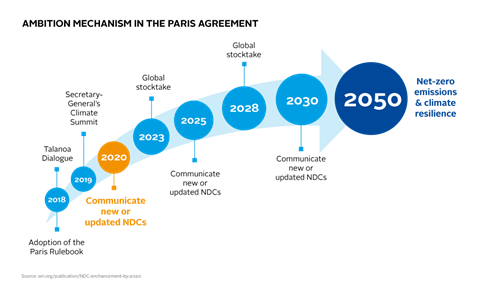
- Under the Paris Agreement, countries must update their climate action plans (NDCs) every five years. Article 6 enables voluntary cooperation through carbon markets and non-market approaches, allowing emission trading and promoting technology transfer. It ensures transparency, boosts ambition and supports developing nations like India in achieving low-carbon, sustainable development goals.
Sources Referred:
PIB, The Hindu, Indian Express, Hindustan Times

