 India's No.1 PU & Degree With Integrated IAS & IPS(UPSC/PSC) Training College.


MGNREGS WITNESSED DECLINE IN SCALE AND EMPLOYMENT IN 2025-26
MGNREGS WITNESSED DECLINE IN SCALE AND EMPLOYMENT IN 2025-26
Why in the News?
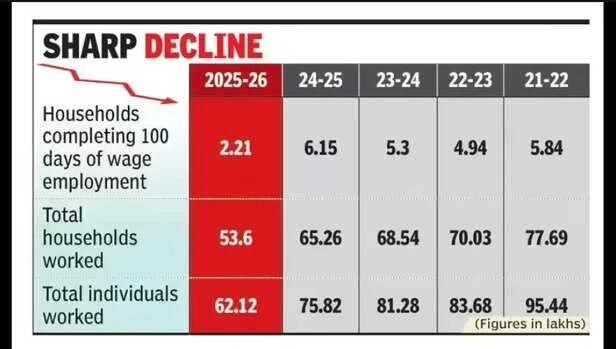
- A report by the NREGA Sangharsh Morcha and LibTech India found a sharp decline in the scale and reach of Mahatma Gandhi National Rural Employment Guarantee Act (MGNREGS) during 2025-26.
- The findings come ahead of the proposed implementation of the Viksit Bharat – Guarantee for Rozgar and Ajeevika Mission (Gramin) Act, 2025.
Key findings of the report
- Decline in employment: Around 44 lakh fewer households and 67 lakh fewer workers received employment compared to 2024-25.
- Reduction in person-days: Total person-days generated fell by 21.5%, from 268.44 crore to 210.73 crore.
- Lower average workdays: Average employment per household declined from 50.18 days to 42.92 days.
- Fewer households completed 100 days: Families receiving the full guaranteed 100 days of work dropped by 40.5%.
- Income loss: The contraction caused an estimated average income loss of ₹1,221 per MGNREGS household.
Concerns and implications
- Rural livelihood insecurity: Reduced employment opportunities may worsen rural distress and migration.
- Budgetary concerns: Only ₹30,000 crore has been allocated for the transition period before the new scheme replaces MGNREGS.
- Lack of consultation: Activists criticised the introduction of the new employment law without adequate public consultation, raising concerns about environmental democracy and participatory governance in policy formulation.
- State-wise decline: Several States recorded major reductions in workdays, including Tamil Nadu and Haryana.
- Social protection role: MGNREGS remains crucial for income security, especially during economic distress and agricultural off-seasons.
- Environmental compliance challenges: Many MGNREGS infrastructure projects, particularly in coastal regulation zone areas, face delays due to environmental clearance requirements. The need for environmental impact assessment and adherence to the Forest Conservation Act has sometimes led to ex post facto approvals, raising questions about environmental jurisprudence and the application of the precautionary principle in rural development schemes.
MGNREGS● Launch: Introduced in 2005 as a rights-based rural employment programme. ● Objective: Guarantees 100 days of wage employment annually to rural households demanding unskilled work. ● Legal entitlement: Employment is demand-driven, and failure to provide work requires payment of unemployment allowance. ● Key significance: Enhances rural livelihoods, creates community assets, and strengthens social security. Works must comply with EIA notification and follow the polluter pays principle for sustainable development. ● UPSC relevance: Important for poverty alleviation, rural development, inclusive growth, and welfare governance under GS Paper II and III. |

